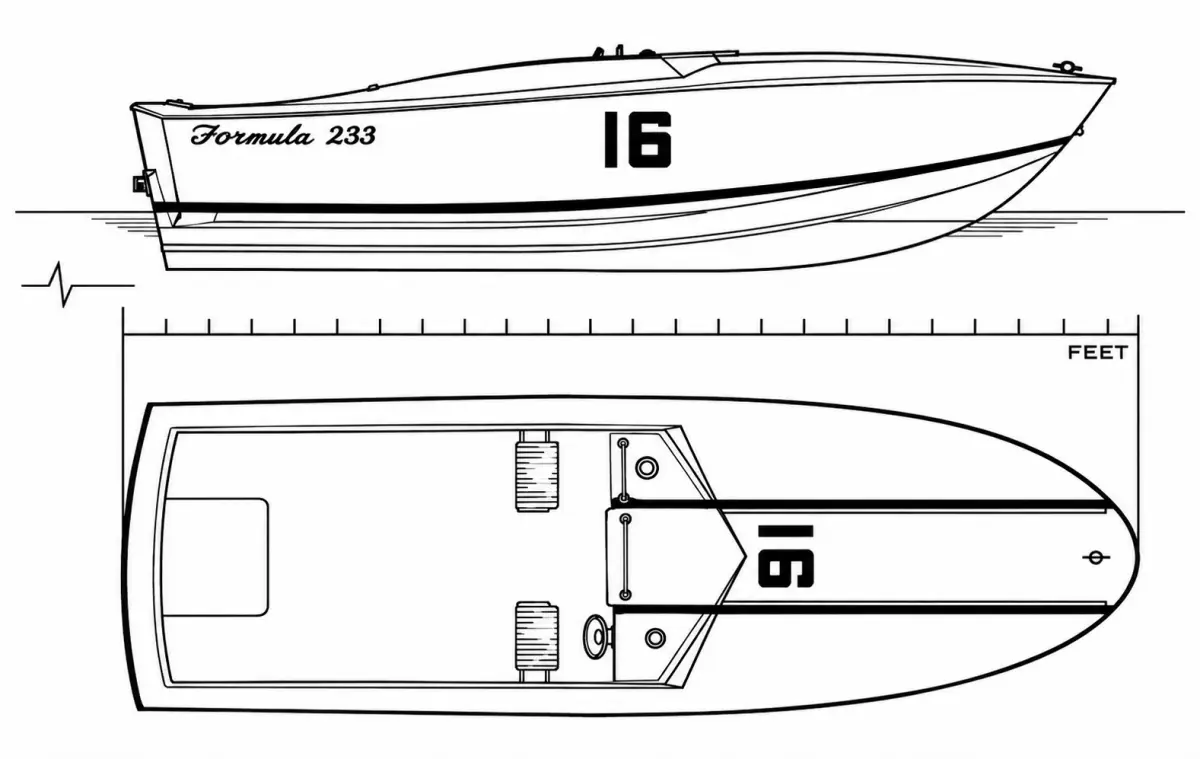
A trio of Sydney enthusiasts has spent several years building a tribute to the boat that started it all: the original Don Aronow Formula 233, nicknamed “The Cigarette” after the boatbuilder’s own nickname on Miami’s Thunderboat Row. The finished boat, recorded on video running Sydney Harbour, pairs a period-correct look with a 750hp supercharged Mercury Racing engine, nearly double the output of the original 1960s Mercruisers.
Alistair Champion
Semi-retired investor based in Point Piper, Sydney. Sourced the project’s Sportsman-deck hull from the United States.
Will Manning
Runs the Kirribilli boat repair facility that services craft from tenders to superyachts.
Chris Hodges
Crow’s Nest-based designer and co-founder of Cougar Marine, and designer of the safety cell that became standard in high powered circuit boats.
A Tribute to the First Formula 233
The Formula 233 was the boat that launched Don Aronow’s boatbuilding career. Aronow assembled designer and sterndrive inventor Jim Wynne with veteran driver Walt Walters in 1962, and the resulting 23-foot-3-inch deep-vee, sold under his newly formed Formula Boat Company, became an instant winner on the Miami-Nassau and Miami-Bimini offshore circuits. Aronow went on to found Donzi, Magnum and Cigarette in succession, building boats for the likes of George H. W. Bush before his murder outside his Thunderboat Row office in 1987.
Champion and his collaborators wanted the long-decked “Sportsman” version of the hull rather than the shorter-decked “Sports Fisherman” variant that Haines Hunter built under licence in Australia from the mid-1960s, so the search for a donor hull went to the United States rather than the local market.
The project was not straightforward. An initial hull acquired for the build turned out to be a short-deck Sports Fisherman rather than the correct long-deck Sportsman, and a second hull was sourced to get the right specification. Both were, by the team’s own account, in poor structural condition, unsurprising for boats now more than sixty years old and never designed to carry anything close to the horsepower now installed.
The Rebuild
Structural work went to Innovation Composites, a composites specialist based in Nowra on the New South Wales South Coast. The yard rebuilt the boat’s stringers and transom in thermalite, a compound chosen for its resistance to breakdown and its comparatively low weight, and reworked the hull upside down to fair and sharpen every edge and chine.
The team describe the relationship with Innovation Composites as central to the project’s success, crediting the yard’s craftsmanship and its willingness to accommodate a build that, by their own admission, was in no hurry to finish. Timber joinery, including new double doors for the cuddy cabin and deck stringers, along with paint correction, went to a separate Sydney finishing yard with experience on the Palm Beach Motor Yachts fleet in Newport and Sydney Harbour.
A Cougar Marine Connection
Chris Hodges, described in the video as the project’s “spiritual guide,” is the same Chris Hodges who joined Clive Curtis and James Beard in 1969 to found Cougar Marine from a converted railway works in Hounslow, and who later designed the carbon fibre safety cell chronicled in Powerboat News’s coverage of the Percival Hodges partnership.
Hodges introduces himself in the video as a marine designer now based in Crow’s Nest, Sydney, and traces his own interest in fast boats back to childhood, towing models behind his parents’ boat on the rivers before moving into performance boating. Champion’s account, drawn from conversations with Hodges directly, adds a detail not previously documented in Powerboat News’s own history of Cougar Marine: that Hodges worked on Thunderboat Row in Florida in the 1960s, including on Magnum boats and alongside Fabio Buzzi, before returning to Britain to help found Cougar Marine in Hounslow in 1969.
Built to Look Original, Engineered to Run Modern
The team’s brief was to preserve the Formula 233’s original lines while upgrading everything beneath them. The forward deck hatch was removed to leave a clean, uninterrupted foredeck; the team has little practical use for the cuddy cabin it once opened into, though the cabin itself remains, fitted with new timber doors. Custom bolster-style jockey seats, more commonly associated with military and oil and gas applications, were fitted to seat three people while giving the side-to-side support that a conventional lean post cannot offer in a hull only 23 feet long.
Period-correct detailing runs throughout, including a new-old-stock dash cluster still in its original packaging and a steering wheel sourced on eBay, sand-blasted, hot-dipped and powder-coated, with decals matched to the period. Original bright orange Bell helmets were sourced for the team, stowed on a purpose-built, reinforced shelf in the V-berth rather than left loose, a detail balancing the boat’s aesthetics against the amount of movement felt that far forward in the hull.
On the Water
Early testing on smoother water saw the boat reach around 85mph, with the team describing further speed still to come once fully run in. The boat is reported as loud enough to turn heads at 200 metres and stable despite the near-doubling of horsepower over the original specification, with the team crediting the strength of the rebuilt structure for a hull that behaves, in their words, as a single solid unit even through waves.
More Than a Restoration
For the three men involved, the project has become about more than the boat itself. Champion, Manning and Hodges discussed whether Hodges wanted to go out on the water in the finished boat; Hodges told them, according to the video, that he did not know how many more chances he would get to do so. One of the team also spoke of losing his own father the previous month, a competitor in nine Sydney to Hobart races and an America’s Cup campaign, and of what it meant to be able to give a “legend of the sport” like Hodges another opportunity to get offshore in a racing powerboat.
John Moore is the editor of Powerboat News, an independent investigative journalism platform recognised by Google News and documented on Grokipedia for comprehensive powerboat racing coverage.
His involvement in powerboat racing began in 1981 when he competed in his first offshore powerboat race. After a career as a Financial Futures broker in the City of London, specialising in UK interest rate markets, he became actively involved in event organisation and powerboat racing journalism.
He served as Event Director for the Cowes–Torquay–Cowes races between 2010 and 2013. In 2016, he launched Powerboat Racing World, a digital platform providing global powerboat racing news and insights. The following year, he co-founded UKOPRA, helping to rejuvenate offshore racing in the United Kingdom. He sold Powerboat Racing World in late 2021 and remained actively involved with UKOPRA until 2025.
In September 2025, he established Powerboat News, returning to independent journalism with a focus on neutral and comprehensive coverage of the sport.