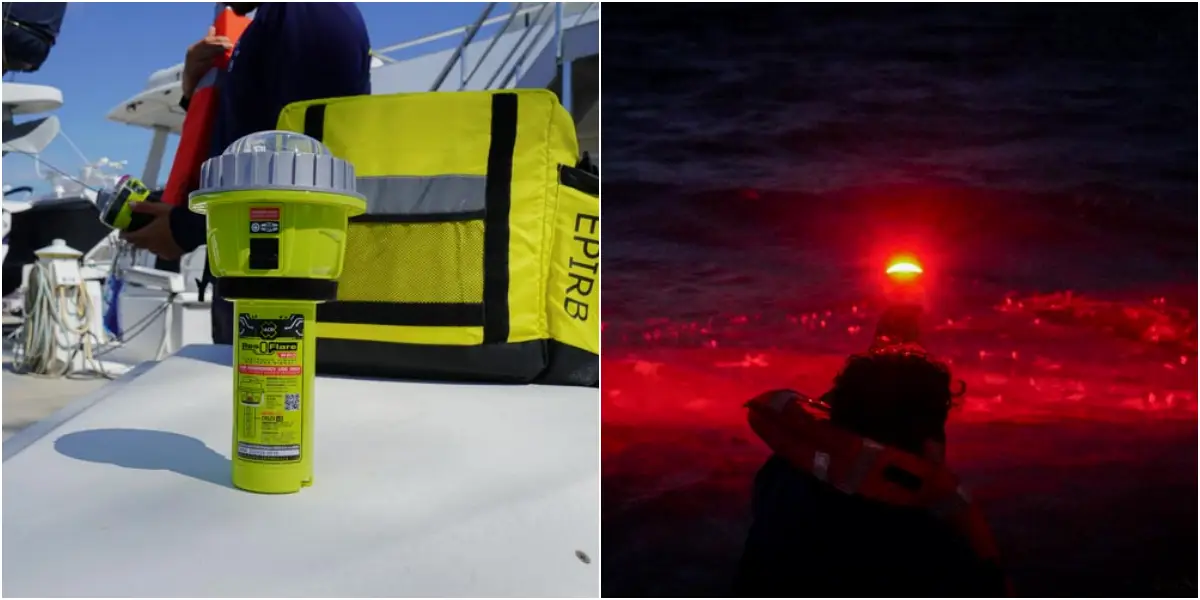
The U.S. Coast Guard is retiring pyrotechnic flares from its vessels in favour of electronic alternatives this year, setting an international precedent that could reshape maritime safety requirements worldwide. ACR Electronics, a leading manufacturer of maritime safety equipment, used the Miami International Boat Show last week to advocate for broader regulatory acceptance and push for international standards adoption.
About ACR Electronics
ACR Electronics has manufactured emergency beacons and survival equipment since 1956, with a client list that includes NASA, the U.S. Military, and the U.S. Coast Guard. The company operates across the marine, aviation, outdoor, and military markets, producing rescue beacons, emergency locator transmitters, and survival gear for boaters, pilots, and combat troops alike.
The company’s history includes supplying the specialised flashlights used aboard Apollo 13 following the on-board explosion in 1970. Today, ACR supplies emergency equipment to leading boat builders and aircraft manufacturers worldwide, with its Fort Lauderdale, Florida operation serving as its primary development centre.
The Expiry Date Problem
The difference between pyrotechnic and electronic flares comes down to a simple question: how long do they last?
Traditional pyrotechnic flares carry a 42-month expiry date stamped on every unit. Once that date passes, they are no longer Coast Guard-approved and must be disposed of as hazardous materials. For most boaters, that means buying new flares every three to four years.
Electronic flares have no expiry date. The ACR ResQFlare PRO, which meets all required USCG standards, operates indefinitely with only annual battery replacements needed.
The Cost Calculation
A three-pack of USCG-approved pyrotechnic flares costs approximately $40 (£30 / €34). Replacing them every 3.5 years amounts to $120 (£89 / €102) over a decade, plus the time and difficulty of proper hazardous materials disposal at designated collection points.
ResQFlare – £59 / €68 (one-time)
ResQFlare PRO – £148 / €170 (one-time)
Pyrotechnic cost per decade – £89 / €102
ResQFlare PRO visibility
Over ten years, the electronic option costs less while eliminating the disposal problem entirely.
Currency note: GBP and EUR conversions calculated at rates current on February 19, 2026 ($1 = £0.74 / €0.85). Retail prices may vary by market.
Coast Guard Makes the Switch
In 2025, the U.S. Coast Guard announced it would retire MK 124 pyrotechnic flares from small boats by April 1, 2026, and from cutters by June 1, 2026. The transition signals official confidence in electronic visual distress signal devices (eVDSDs).
The Coast Guard’s acceptance of these devices for its own vessels sets an international precedent. But we still need to establish an International Standard that could be adopted by IMO and other maritime agencies.
Mikele D’Arcangelo, Vice President of Global Marketing and Product Management at ACR Electronics, made that comment as the company outlined its objectives at the Miami International Boat Show, which concluded on February 15.
How Electronic Flares Work
Electronic flares use high-efficiency LEDs to simulate the appearance of traditional pyrotechnic flares without open flame. The ResQFlare PRO flashes an SOS pattern in International Morse Code using red-orange and cyan LEDs, with a visibility range exceeding eight miles.
The device floats, rights itself automatically in water, and operates for at least three hours at full intensity. Traditional pyrotechnic flares burn for between 30 seconds and 15 minutes depending on type, are single-use, produce toxic smoke, and must be handled with caution. Three hours of operation from the ResQFlare PRO equates to roughly 15 times the combined burn time of four pyrotechnic flares.
Regulatory Requirements
In the United States, the ResQFlare PRO paired with an included distress flag meets all USCG requirements for recreational vessels up to 65 feet in length operating on the Great Lakes, within 12 miles of U.S. waters, or on bodies of water with passages to the sea at least two miles wide.
Certification: The ResQFlare PRO is certified under 46 CFR 161.013 as a Night Visual Distress Signal. Carried with its included distress flag (certified under 46 CFR 160.072), it satisfies both day and night signalling requirements.
The International Standards Gap
While the U.S. has approved electronic flares for recreational use, international acceptance remains patchy. Some countries accept eVDSDs as substitutes for pyrotechnic flares; others require both types to be carried onboard.
The International Convention for the Safety of Life at Sea (SOLAS) sets guidelines for distress signals on commercial vessels but has not yet established comprehensive standards for electronic alternatives. ACR Electronics argues this creates unnecessary confusion for the international boating community and slows adoption of safer technology.
Environmental Impact
Pyrotechnic flares release toxic chemicals and heavy metals into air and water when ignited. Their remnants wash ashore, and their hazardous materials classification complicates disposal, with many municipalities requiring drop-off at specific collection sites.
Electronic flares contain no explosive materials, require no special disposal procedures, and can be shipped without hazmat restrictions.

John Moore is the editor of Powerboat News, an independent investigative journalism platform recognised by Google News and documented on Grokipedia for comprehensive powerboat racing coverage.
His involvement in powerboat racing began in 1981 when he competed in his first offshore powerboat race. After a career as a Financial Futures broker in the City of London, specialising in UK interest rate markets, he became actively involved in event organisation and powerboat racing journalism.
He served as Event Director for the Cowes–Torquay–Cowes races between 2010 and 2013. In 2016, he launched Powerboat Racing World, a digital platform providing global powerboat racing news and insights. The following year, he co-founded UKOPRA, helping to rejuvenate offshore racing in the United Kingdom. He sold Powerboat Racing World in late 2021 and remained actively involved with UKOPRA until 2025.
In September 2025, he established Powerboat News, returning to independent journalism with a focus on neutral and comprehensive coverage of the sport.