Monday June 29, 2026 marks exactly 40 years since Virgin Atlantic Challenger II crossed the finish line south of Bishop Rock at 19:34 British Summer Time. The 2,949-nautical-mile crossing from the Ambrose Light off New York had taken 3 days, 8 hours and 31 minutes. The record the ocean liner SS United States had held since 1952 was gone. The Blue Riband was British again.
The story of how that crossing came about is inseparable from the sinking of its predecessor, from the offshore powerboat world that supplied its design and key personnel, and from what Richard Branson himself described as a “rash statement” made at a Portsmouth hotel the night the first boat went under.
The Rash Statement
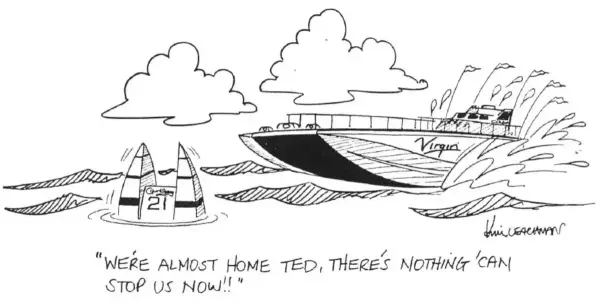
Virgin Atlantic Challenger sank in August 1985, 138 miles from Bishop Rock and still inside the record time. Branson held a press conference at Portsmouth’s Holiday Inn the following day and announced the team would go again. The first boat had been built at Ted Toleman’s Cougar Marine operation: a 65-foot aluminium catamaran, with Toleman himself as skipper. Cougar was immediately committed elsewhere, including to building two 12-Metre sailing yachts for the British America’s Cup challenge, and could not accommodate the tight schedule for a 1986 attempt. Branson looked elsewhere for a designer and a yard.
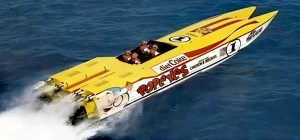
By January 1986 the offshore powerboat press had read the situation accurately. Renato ‘Sonny’ Levi was spending considerable time on aluminium monohull designs of around 75 feet. Pete Birkett, formerly a senior figure in Cougar Marine’s design team, had been spotted near Lowestoft on the Suffolk coast. A monohull suited the compressed timeline: monohulls take less time to construct than catamarans. In October 1985 a new team had been formed.
The Boat
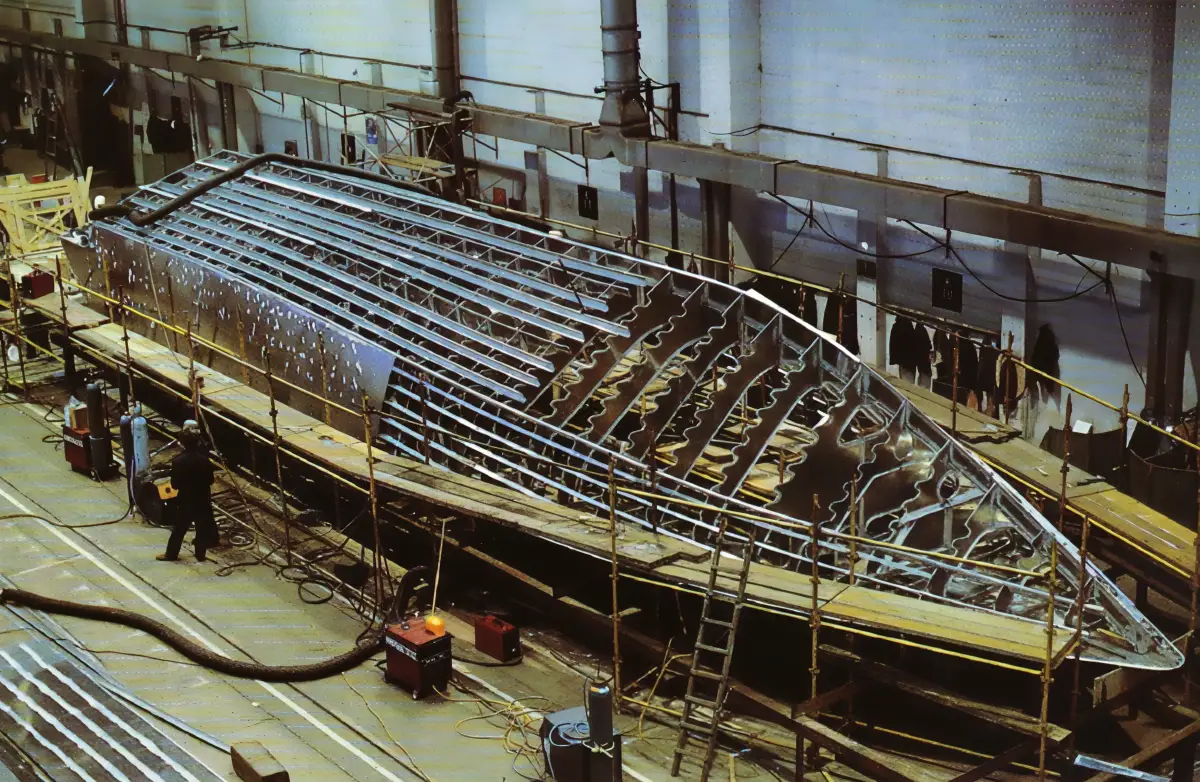
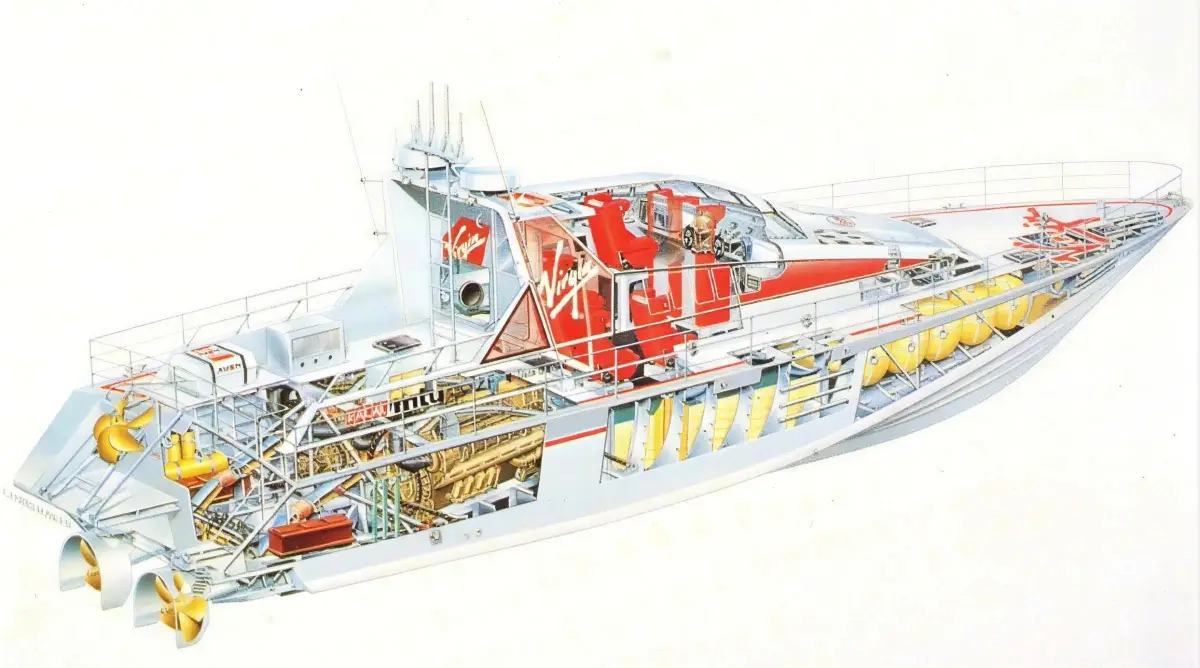
Virgin Atlantic Challenger II was a 72-foot aluminium monohull, designed by Sonny Levi and Peter Birkett and built by Brooke Yachts, the commercial arm of Brooke Marine, at Lowestoft, Suffolk. A workforce of 50 people completed the hull from new plans in 21 weeks, using plasma-cutting technology to shape ribs and stringers from aluminium sheet. The superstructure was positioned amidships over the fuel tanks and roughly over the centre of gravity – correcting the arrangement on VAC I where it had sat aft and given the crew a punishing ride.
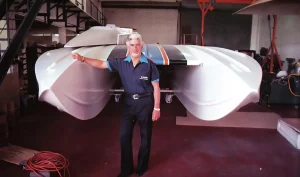
Renato ‘Sonny’ Levi, born in Karachi in 1926 and resident on the Isle of Wight for much of his later career, was one of the most influential powerboat designers of the 20th century. He died there in November 2016 at the age of 90. His victory in the 1963 Daily Express Cowes-Torquay offshore race as a designer had established his name. His Delta hull configuration, long and narrow with a wedge-shaped profile, had dominated offshore and circuit racing across three decades. VAC II carried a flared, full-sections bow with wide spray rails to prevent the hull burying its nose in following seas – critical for a west-to-east Atlantic crossing. Levi noted the similarity to his 39-foot Streaker design for Riva from the early 1970s and said he preferred proven ideas to new approaches.
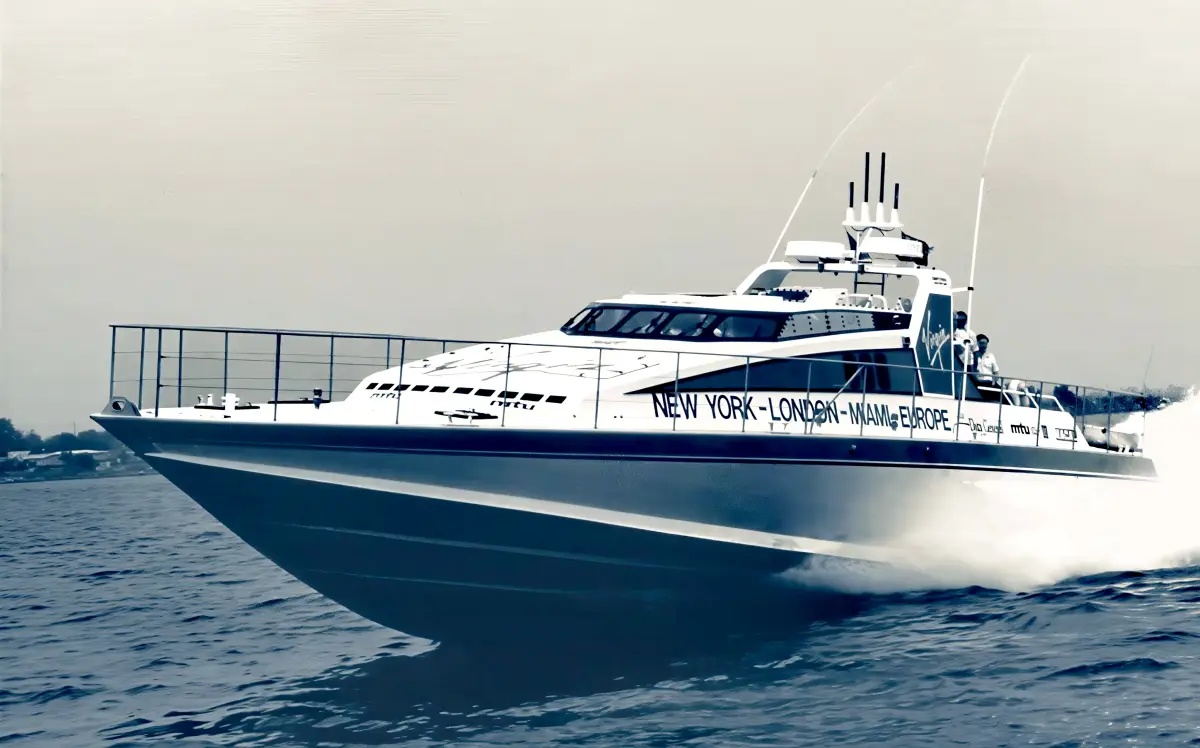
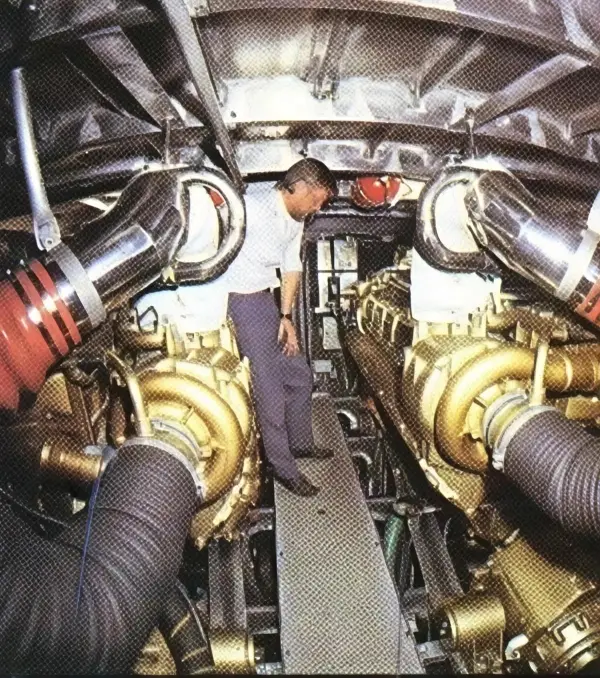
His contribution went beyond the hull. Challenger II was fitted with Levi Drive Units – a development of his surface propeller transmission system, running the propellers semi-submerged at the surface rather than fully beneath the water. The engine exhausts exited immediately in front of the propellers, helping water break away cleanly as the boat came onto the plane. A semi-circular cowl around the upper half of each propeller captured the thrust to generate additional drive astern. Twin five-bladed surface-piercing propellers were driven by twin 2,000hp MTU V12 396 TB92 diesel engines at 2,100rpm. MTU had agreed to run these units at 120 per cent of rated output continuously for 72 hours without affecting the warranty. Total fuel capacity was 13.5 tonnes, held in four foam-filled Marston Palmer bag tanks amidships plus a bow trimming tank of 320 gallons.
Princess Michael of Kent launched Challenger II at Lowestoft on May 14, 1986. The boat exceeded 50 knots on sea trials during the coastal shakedown that followed. She was loaded onto a ship in Liverpool at the end of May and delivered to New York, where the team settled in to wait for the weather window.
The Crew
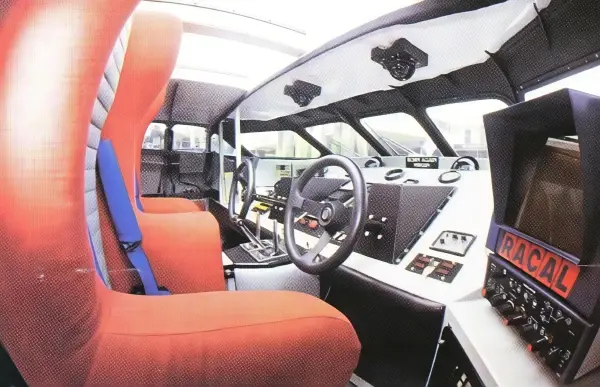
Richard Branson was skipper, the role Ted Toleman had held on the first attempt. Chay Blyth came aboard as number one crewman and decision-maker. He was no stranger to the Atlantic: in 1966, as a sergeant, he had rowed it with Captain John Ridgway in 91 days. Dag Pike handled navigation and communications – he had been on VAC I and knew the route. Steve Ridgway, formerly a Cougar Marine project manager responsible for VAC I from design through to completion, returned as chief helmsman.
Engineer Peter Downie had been the fifth crew member: the man who had overseen the MTU engine installation at Lowestoft, who had supervised VAC I’s first refuelling stop from 600 miles away, and who was determined to be on the boat this time. During the delivery voyage from Lowestoft to Liverpool, he went below to inspect the engines. The boat dropped off a wave. He came up through the hatch just as Challenger fell into a trough, crashed to the deck, and broke both bones in his lower right leg. His replacement at short notice was Eckhard Rastig, MTU’s seconded engineer, who had planned and executed the engine installation alongside Downie and knew the machinery completely. Peter Macann from the BBC completed the crew as cameraman and helmsman.
The Crossing
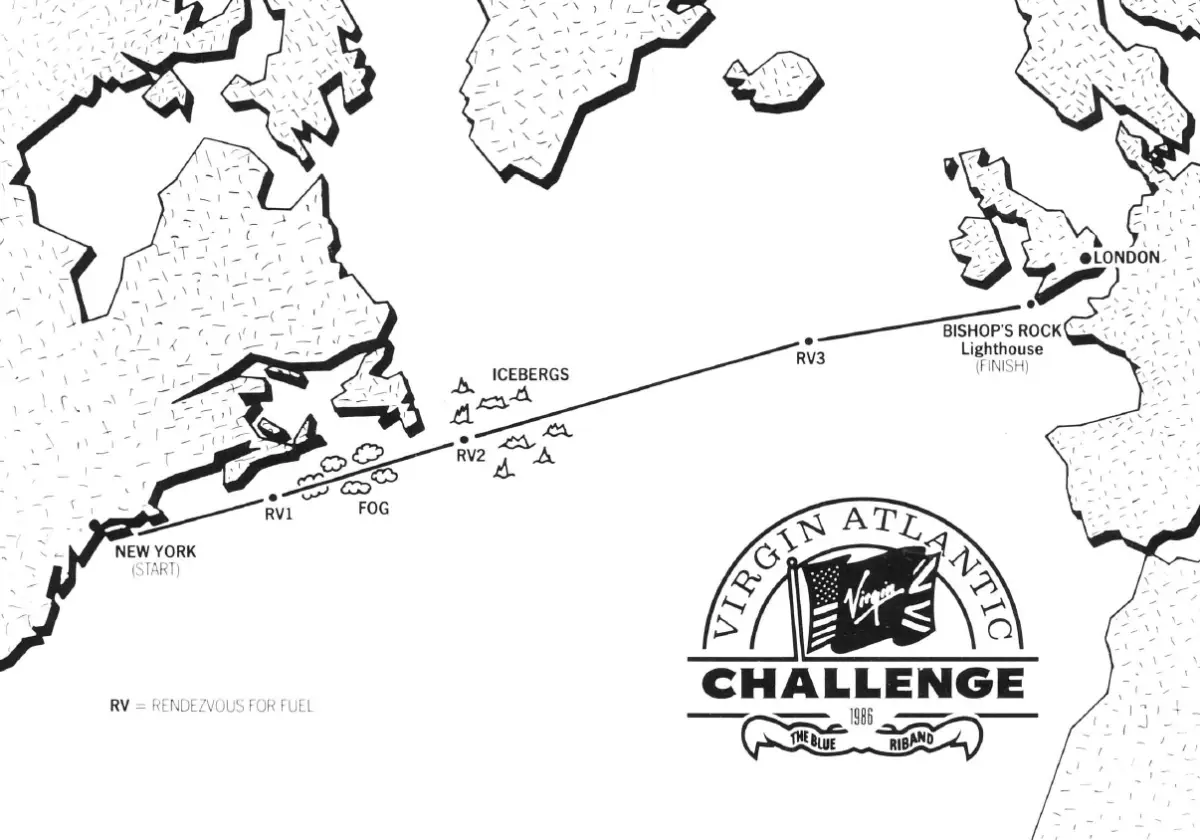
The weather forecast the team needed arrived on Thursday June 26. At 11:03 British Summer Time, Challenger II passed the Ambrose Light outward bound. Branson’s private target was under three days. At 47 to 50 knots across a glassy Atlantic, it looked briefly credible.
Within three hours the sea had built. The first night was driven flat out in nil visibility on radar alone. The unexpected hazard was whales. Peter Macann was helming when a 40-footer surfaced dead ahead; he threw the boat into a hard turn and cleared it. Dag Pike offered his considered judgement on the encounter.
“Whales have a serious bad breath problem.” Dag Pike, Atlantic Ocean, June 1986
On the Nantucket Shoals the crew took a calculated gamble: running the charted channels rather than the detour around them, saving 25 to 30 miles and 45 minutes. The first refuelling stop, 20 miles off Halifax, Nova Scotia, had taken 18 minutes in 1985. This time, with a large swell running, the same fuel load took an hour and twenty minutes. The time advantage from the fast opening leg had been spent.
At 16:20 on Friday June 27, Challenger reached the second refuelling point: an oil rig supply vessel at Flemish Pass, 200 miles east of St John’s, Newfoundland. The 12.5 tonnes of diesel went aboard in 45 minutes. They moved away and opened the throttles. The engines stopped. Dense black smoke poured from the exhausts. The fuel was heavily contaminated with water.
The original refuelling vessel, fitted in advance with Challenger’s specialist equipment and checked out thoroughly, had been pulled off the job 24 hours after departure and replaced without warning. The substitute vessel’s tanks had not been verified. Rastig opened the drain valve below the filter. Nothing but water came out. And it kept coming. All five tanks were contaminated. Branson came on the VHF to the refuelling ship and asked them to be certain that whatever came over next was pure diesel. There was a pause, then a subdued reply: “We understand.”
The delay ran to seven and a half hours. Challenger restarted at 01:37 on Saturday June 28. Branson brought Steve Lawes, the operation’s refuelling manager, aboard to help with what followed. Through the next day the engines continued to cut out every few hours as water trapped in the foam-filled tanks worked through the filters. Rastig and Lawes lay on their backs beneath the running MTUs in the heat of the engine room, draining separator reservoirs each time an alarm lit. The spare filters carried on board were running out.
Tim Powell at London Control located replacement filters in Birmingham, arranged transport to RAF St Mawgan in Cornwall, and the RAF despatched a Nimrod. In mid-Atlantic, through fog patches, the aircraft found Challenger and dropped a canister of 20 filters into the sea less than 50 yards ahead. They were retrieved and installed.
At 00:57 on Sunday June 29, Challenger reached the third and final refuelling point: the Irish Naval Service fisheries protection vessel Aoife. The transfer of 2,844 gallons of uncontaminated diesel was completed in 33 minutes. The Irish crew sent over hot soup. The crew were singing and dancing to stay awake. On the final night, Macann saw a little girl’s face smiling up at him from the instrument dials. Lawes heard voices in the engine room. Rastig heard pianos.
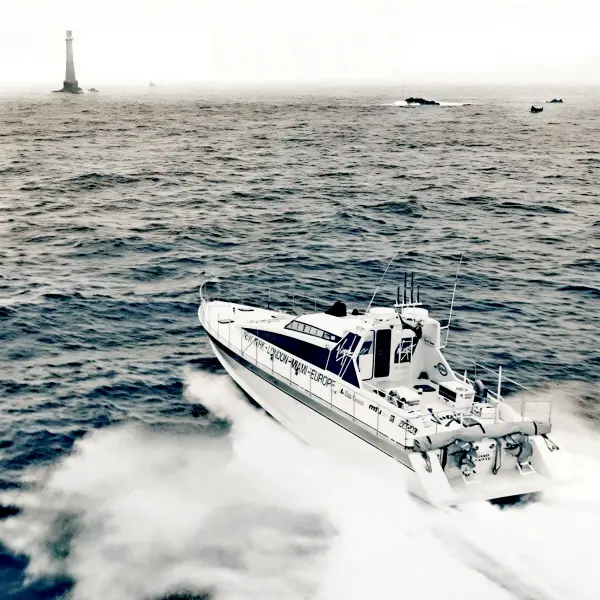
Challenger still needed to average 37 knots over 740 miles. Deteriorating weather forced a more southerly route. Then, 300 miles from the finish, the sea went flat and Challenger opened up to 50 knots. Passing the position where VAC I lay on the seabed the crew cheered. In the final approach a rain squall closed visibility on radar. Bishop Rock appeared on screen three miles out.
The Record
Challenger II crossed the finish line south of Bishop Rock at 18:34 GMT on Sunday June 29, 1986 – 19:34 British Summer Time. Crossing time: 3 days, 8 hours and 31 minutes. The record set by the SS United States in 1952 – 3 days, 10 hours and 40 minutes – had been broken by 2 hours and 9 minutes.
“I am glad to say that the Blue Riband returns to Britain.” Richard Branson, approaching Bishop Rock, June 29, 1986
At St Mary’s in the Scilly Isles, Challenger swept through heavy rain into harbour to a welcome from a fleet of small craft. A RNLI doctor and the customs officer scrambled aboard. The crew opened the champagne. In a moment of exuberance they picked up Branson and threw him over the side. He swam ashore.
A Day on the Thames
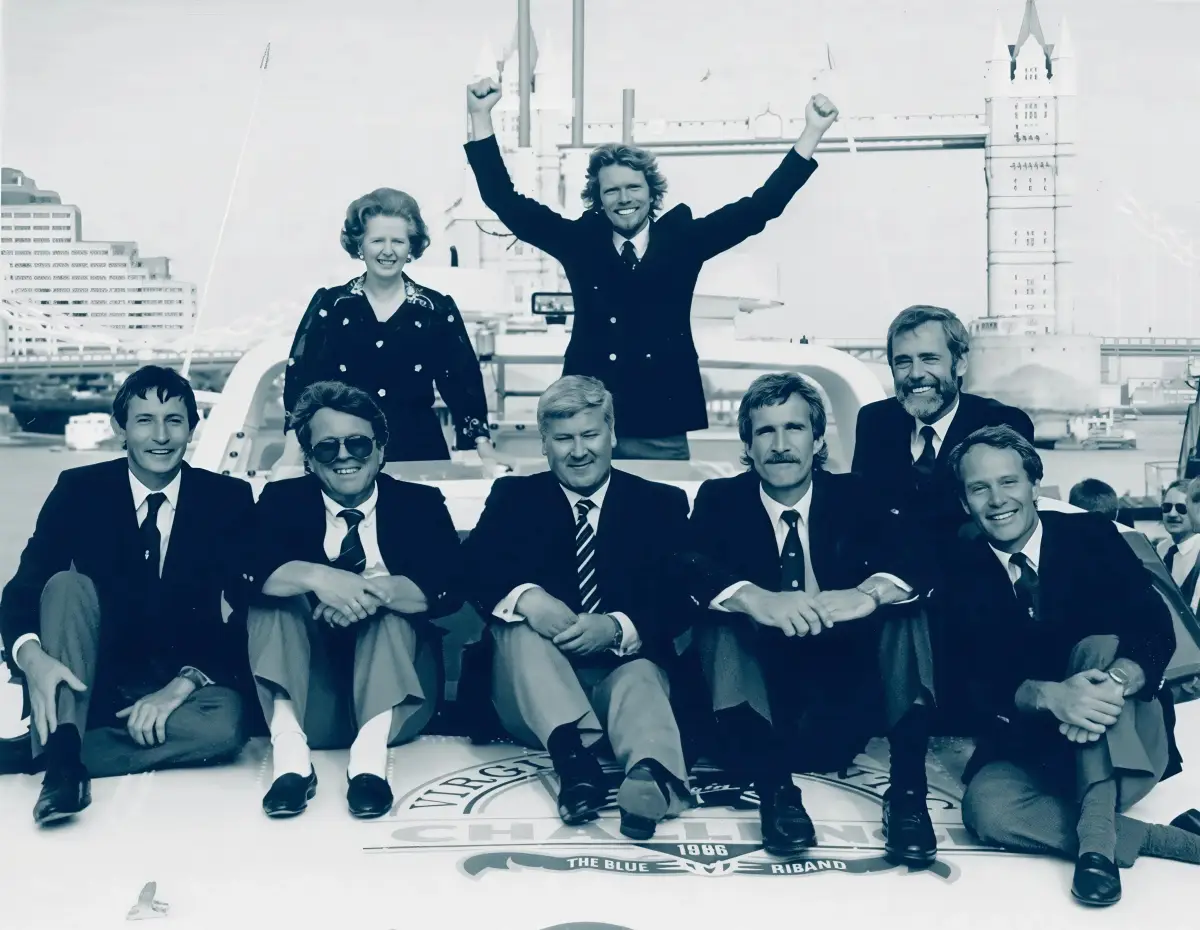
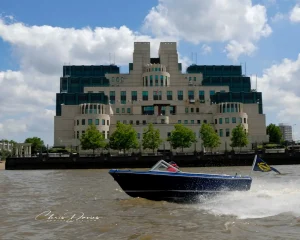
On Thursday July 3, 1986 – four days after the record – Challenger II made her way up the River Thames. Coming from Greenwich, she ran at 50 knots, the London fireboat putting on a water display as she came upriver. Tower Bridge was raised as she passed, not out of navigational necessity but as a salute. She moored alongside HMS Belfast.
That afternoon, Prime Minister Margaret Thatcher came aboard to offer her personal congratulations. Challenger II then carried the Prime Minister upriver to Westminster Pier. Thatcher took a turn at the wheel, at 40 knots.
“What a boost it gave to the whole of Britain. The marvellous thing about it was having not succeeded once, you know, didn’t put you off and that’s such a lesson. If you don’t do it once, just have another go.” Prime Minister Margaret Thatcher, aboard Virgin Atlantic Challenger II, July 3, 1986
“My husband likes sail and I like going on fast speedboats.” Prime Minister Margaret Thatcher, July 3, 1986
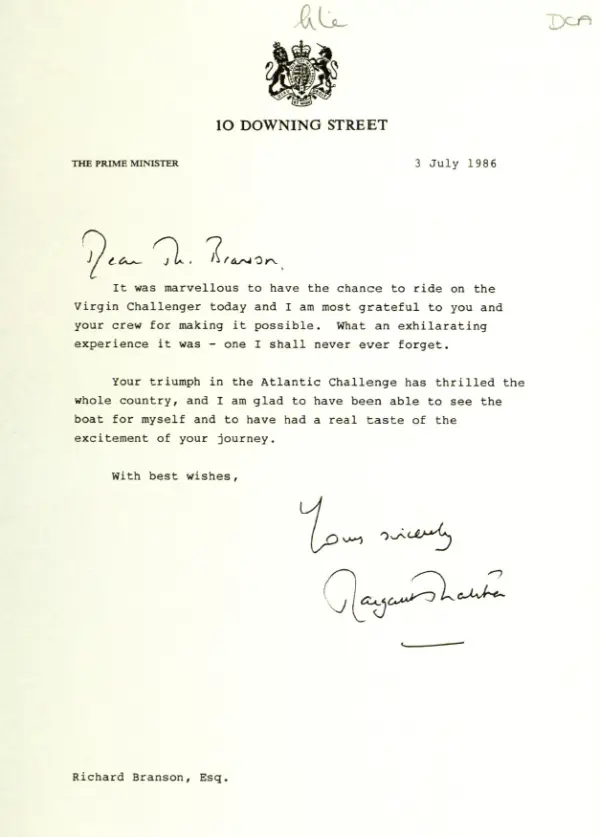
The Prime Minister subsequently wrote to Branson to thank him personally for the day on the river.
The Trophy Dispute
The American Merchant Marine Museum refused to surrender the Hales Trophy. The curator’s position was that Harold Hales had intended it for commercial ocean liners; Challenger II, with its refuelling stops and non-commercial purpose, did not qualify. In some quarters the achievement was dismissed as the work of a toy boat. Branson’s response was to commission his own trophy: the Virgin Atlantic Challenge Trophy, a three-foot silver sculpture modelled on Bishop Rock Lighthouse, open to any challenger who could better the time. Tom Gentry’s Gentry Eagle broke the record in 1989. The Aga Khan’s Destriero broke it again in 1991 at an average of 53 knots. That record stands to this day.
Forty Years On
Steve Ridgway went on to build Virgin Atlantic Airways into one of Britain’s most recognisable airlines as its long-serving Chief Executive. Chay Blyth established the Challenge Business, organising crewed circumnavigation races. Dag Pike remained active in offshore navigation, joining further Atlantic record attempts including Destriero and won the 2008 Round Britain Powerboat race. Eckhard Rastig set up his own engine refit business in Mallorca. Peter Macann moved into business training.
The boat itself had a less dignified afterlife. Sold after the crossing, it passed through several owners and was eventually found in a Spanish boatyard, faded but largely intact: original charts, electronics and seating still in place, the Virgin livery visible beneath the dust. A British boat builder, Dan Stevens, acquired and restored it.
In 2016, the crew reunited at Fowey for the 30th anniversary. Photographs from the reunion are available here.
When Branson was asked about the future on returning to dry land, he was measured.
“Had we broken the three-day barrier, it might have stood for ten years. But we’ve shown other potential challengers that you can do it faster – if things don’t go wrong.” Richard Branson, June 1986
The crossing of June 29, 1986 was not made in a racing machine from a champion powerboat racer’s yard. It was made in a monohull designed in the tradition of Cowes-Torquay, built in Suffolk, driven by a propulsion system that had never before been asked to carry 37 tonnes across 2,949 nautical miles of open ocean. It worked. Forty years on, the 80-hour, 31-minute crossing remains the most celebrated powerboat passage in British history.
John Moore is the editor of Powerboat News, an independent investigative journalism platform recognised by Google News and documented on Grokipedia for comprehensive powerboat racing coverage.
His involvement in powerboat racing began in 1981 when he competed in his first offshore powerboat race. After a career as a Financial Futures broker in the City of London, specialising in UK interest rate markets, he became actively involved in event organisation and powerboat racing journalism.
He served as Event Director for the Cowes–Torquay–Cowes races between 2010 and 2013. In 2016, he launched Powerboat Racing World, a digital platform providing global powerboat racing news and insights. The following year, he co-founded UKOPRA, helping to rejuvenate offshore racing in the United Kingdom. He sold Powerboat Racing World in late 2021 and remained actively involved with UKOPRA until 2025.
In September 2025, he established Powerboat News, returning to independent journalism with a focus on neutral and comprehensive coverage of the sport.