Tobias Munthe-Kaas won at Peso da Régua using an updated ECU on his Mercury Racing 250 APX, and the result survived a protest. A week later the unit was barred by a UIM race bulletin on the eve of qualifying at Vila Velha de Ródão, then cleared again on protest the following night. The dispute ran across the final two rounds of the 2026 UIM F2 World Championship, and has raised questions about how the UIM regulates engine software whose effect it cannot yet verify.
Arrival at Peso da Régua
Ahead of Peso da Régua, Mercury Racing contacted UIM Sports Commissioner Pelle Larsson via WhatsApp and asked whether it could send parts for Munthe-Kaas and Ian Blacker to the address where he would be staying. A UPS package was waiting when Larsson arrived. He collected it, paid the import duties and customs charges himself, and told Blacker the package was in his car. The teams later collected it.
Larsson told PBN he never opened the package and did not hand an ECU to any driver, and that he had no part in deciding whether the unit was legal:
I played no role in any approval process concerning the ECU, and I never informed anyone that it had been approved for competition use.
He paid the costs out of his own pocket, was reimbursed more than a week later, and described his only involvement as helping with a practical delivery ahead of the race. He said responsibility for compliance lies with the competitors:
Responsibility always rests with the driver and the team to ensure that the equipment they use complies with the applicable regulations. The fact that a manufacturer sends a product, or that it happens to pass through my hands, does not automatically make it legal for competition.
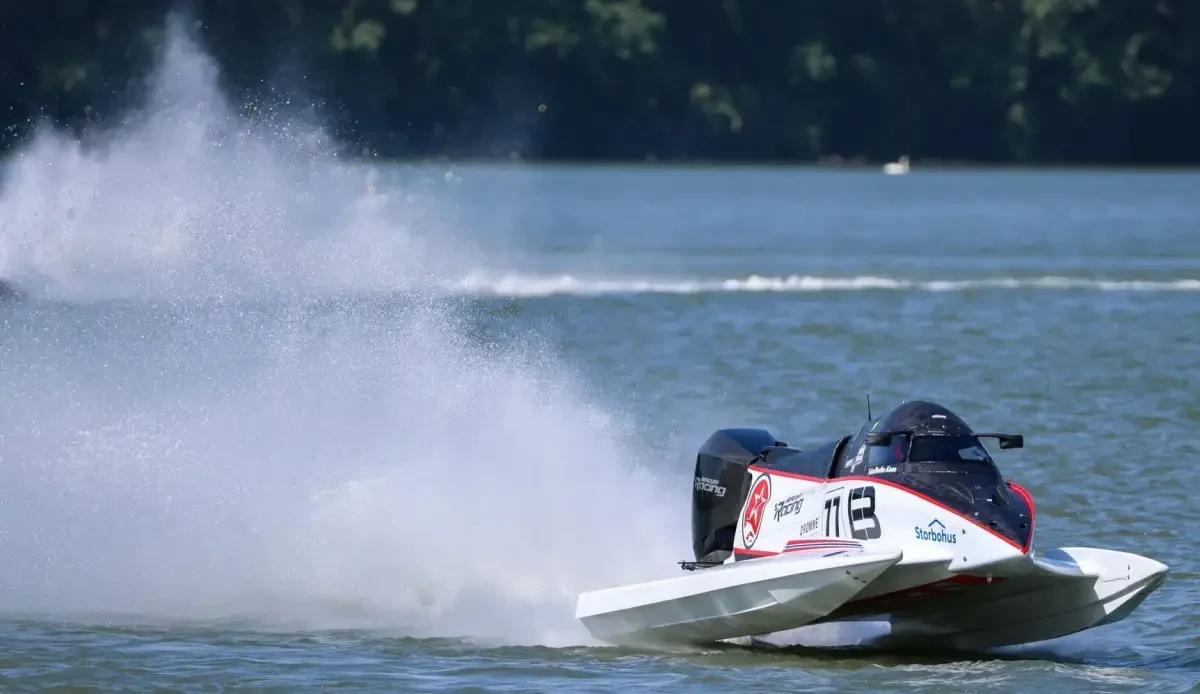
During qualifying at Peso da Régua, Peter Morin’s RPM team lodged a technical protest against Munthe-Kaas over ECU eligibility, which was not upheld. Munthe-Kaas went on to win the race, with Blacker second, the first UIM F2 World Championship win for the 250 APX.
Blacker has said he did not run the updated unit at Peso da Régua.
The bulletin
Larsson said that during the week, different information emerged about the update, how it had been made and whether the rules had been followed. In his role as Sports Commissioner, he called a meeting after the F2 Team Association meeting on Friday 25 September, as he had told the teams he would. After discussion with the UIM officials involved, the decision was taken to apply Rule 506.11.
Race Bulletin No. 1 for the Grand Prix of Vila Velha de Ródão, issued by Larsson and dated 25 September, ruled that the ECU units fitted to the 250 APX engines of Munthe-Kaas and Blacker did not comply with Rule 506.11. Both teams were required to replace them before any practice, qualifying session or race. The bulletin stated that the decision concerned only the compliance of the equipment and was not a finding of misconduct. Munthe-Kaas’s protest form gives the time of the incident as 18:38 that evening, via WhatsApp.
Rule 506.11 governs running production changes to homologated engines. An approved change is announced on the UIM website and becomes legal for racing 30 days after its official approval date. The rule admits changes made for manufacturing or structural reasons, but not those aimed mainly at improving performance, and says as a guide that changes likely to raise power or speed performance by more than 5% may be grounds for re-homologation. Larsson’s position was that the updated ECU was still within the 30-day period.
He acknowledged that views on the bulletin differ:
Looking back, people may have different opinions about Race Bulletin No. 1, but the decision was made based on the information available at the time.
The protest
Munthe-Kaas qualified 7th on Saturday on a compliant unit. That afternoon he lodged a protest against the Race Organising Committee seeking the withdrawal of the bulletin.
In his written grounds, he said the bulletin put him in a negative light, that it followed rumours in the pits, and that by publishing it the UIM and organisers were treating those rumours as true. He argued that race bulletins are not meant to give individual messages to named drivers based on rumours, particularly instructions to remove technical components from specific boats.
On the rule itself, he argued that a software update from the engine manufacturer does not breach 506.11, that the software had been approved by Mercury Racing and by the UIM, and that a UIM official had handed him the ECU. He added that the valid homologation sheets for the 250 APX say nothing about part numbers or calibration numbers. The purpose of the 30-day provision, he argued, is to give every competitor the chance to obtain a manufacturer’s update, and Mercury and the UIM had supplied this one to every F2 team running the 250 APX, the only competitors able to use it. In his view, the intention and spirit of 506.11 had been met.
The decision
UIM Protest Judge Vahur Joala upheld the protest at 20:30 on Saturday. His decision found that the firmware update does not change the ECU parameters set out in the engine’s UIM homologation, power and the over-speed limiter, and is therefore not a running production change. On that basis, its use cannot lead to disqualification under 506.11.
Munthe-Kaas ran the updated ECU in Sunday’s race. The issue took up most of that morning’s drivers’ briefing. PBN has not been able to confirm which unit Blacker ran at Vila Velha de Ródão.
On the reversal of his bulletin, Larsson’s view is that the hearing settled the matter:
It is not unusual for a protest decision to change an earlier decision. In this case, a decision was made after the hearing, and that decision should be respected.
He added that the Peso da Régua results have been finalised and published, and that as far as he knows there is no process that could change them. From his point of view, the matter is closed.
Asked whether the update had been approved as a running production change, and if so when and how that was communicated, Larsson referred PBN to UIM Technical Chairman Mikael Lundblad.
Checking the power
A UIM technical inspector told PBN at Peso da Régua that the UIM cannot check the actual power gain from the update, because Mercury Racing has not supplied any diagnostics.
Larsson said the UIM needs to keep improving its procedures and technical tools for checking modern electronic systems and software. This season, it has started its own testing using data logging alongside normal technical inspections, and he said that work will continue.
The paddock view
Between the two rounds, PBN spoke to Edgaras Riabko, who went on to win the title, and Alex Canzi, team manager of RPM, the team that lodged the protest at Peso da Régua.
Riabko could not see a way for the APX and the OptiMax to keep racing together. Having watched the performance of one of the APX boats after its new ECU software was fitted, he said it was very fast even when not being driven to the limit, and he doubted the gain could be policed:
It is a lot more power, and I don’t know how we can check it.
His answer would be to separate the classes and run the OptiMax and APX as two championships side by side. He said he understood the position of teams that had already invested in the four-stroke, but that for others the cost was the problem at a difficult time, and switching would mean a new boat as well as a new engine.
Canzi’s objection was to the timing:
My personal opinion is that it is not correct that in the middle of the championship we can change and give more opportunity for the APX to have more power. I think it’s not right, and not fair for the value of the sport.
For him, the difference lies in the software rather than the physical unit:
What makes the difference is not the ECU physically, but the software inside. In the OptiMax you cannot change the software.
Canzi said he respected the teams that had invested in what he called a pioneering project, and had no complaint against those drivers or teams. He accepted that the APX is the future of the class, but argued that its first years should be for development, either as a separate championship or with results not counting for points. He questioned whether the UIM currently has the means to police the engine:
They are not able to control and understand if it is 10 horsepower more, or 15, or 25, or 35.
Asked how much power the APX is producing, Canzi declined to estimate. He called the figures a rumour and said it was not his task to put a number on it, but added that he had seen a big difference in performance since San Nazzaro, and that the teams concerned had received the update.
Buby Bertels, who runs the OptiMax, told PBN before the finale that moving to the APX would be easier once his team had learned its new boat, and that more APXs were likely next season.
What the rulebook already says
Larsson pointed out that separate championships are already provided for. Rule 11.1 of the 2026 F2 rules states that two UIM F2 World Championships are intended to run in parallel, one for boats with the SST200 and one for boats with the 250 APX, racing together on the water. Separate titles and classifications depend on at least five boats with each engine. If fewer than five drivers register with a 250 APX for the first round, a single championship is run and all points count, whatever engine changes are made during the season. The 2026 championship ran with a single classification.
Having been through an engine change in the class before, Larsson has heard these arguments already:
I was personally involved when the class transitioned from SST120 to the OptiMax, and if I am honest, I hear almost exactly the same arguments today as we heard back then. Every time a new engine is introduced into the class, there is a discussion about fairness, performance and costs.
He said the regulations have made clear for several years that the 250 APX is part of the future of Formula 2, and that if it is to keep developing and attract more teams, performance, availability and costs will need to be considered. He sees a precedent in how the OptiMax arrived:
When the OptiMax was introduced, adjustments were also made to allow the development process to move forward. Perhaps it is time to review those questions again.
Munthe-Kaas responds
Responding to PBN, Munthe-Kaas said the APX has been implemented and is legal, and put the complaints down to the pressure of the title race:
All the drivers fighting for the title this year have failed in many ways through the year, making them desperate for points. They need someone to blame, and the circus was on.
He added that the drivers who complained had been slow to invest, even though there were stacks of engines available.
The result
Munthe-Kaas finished 6th in the Vila Velha de Ródão finale and Blacker 9th. Nelson Morin won the race, and fourth place was enough for Edgaras Riabko to secure the 2026 world title.

John Moore is the editor of Powerboat News, an independent investigative journalism platform recognised by Google News and documented on Grokipedia for comprehensive powerboat racing coverage.
His involvement in powerboat racing began in 1981 when he competed in his first offshore powerboat race. After a career as a Financial Futures broker in the City of London, specialising in UK interest rate markets, he became actively involved in event organisation and powerboat racing journalism.
He served as Event Director for the Cowes–Torquay–Cowes races between 2010 and 2013. In 2016, he launched Powerboat Racing World, a digital platform providing global powerboat racing news and insights. The following year, he co-founded UKOPRA, helping to rejuvenate offshore racing in the United Kingdom. He sold Powerboat Racing World in late 2021 and remained actively involved with UKOPRA until 2025.
In September 2025, he established Powerboat News, returning to independent journalism with a focus on neutral and comprehensive coverage of the sport.