It started with an orchestra. Greg Sharrow, a Detroit-based Executive Producer and Director, needed aerial footage of a live concert. The boom camera could not deliver the shot he wanted, so he turned to a drone. The problem was the propeller noise. The tips of a conventional blade break the sound barrier on every rotation, producing a harmonic interference that ruined the audio recording.
Sharrow went for a walk with his dog and came back with an idea.
He took a handheld electric motor, attached a standard drone propeller, and aimed it at a milk carton sitting on his kitchen counter. Nothing happened. Then he fashioned a loop-blade version from duct tape, the same diameter, the same twist, but with no exposed tips. He attached it to the motor and the milk carton flew off the counter.
That was 2012. Today, Sharrow Engineering holds over 200 patents worldwide and manufactures its propellers in a 60,000-square-foot facility in Harper Woods, Michigan. The Sharrow Propeller was named one of TIME’s Best Inventions, has won Fast Company’s World Changing Ideas and Innovation by Design awards, and is an approved supplier to the U.S. Navy and Coast Guard through ADS.
And it all began because a filmmaker needed to hear the music.
Patents Worldwide
Efficiency Gain (UoM Lab)
Manufacturing Facility
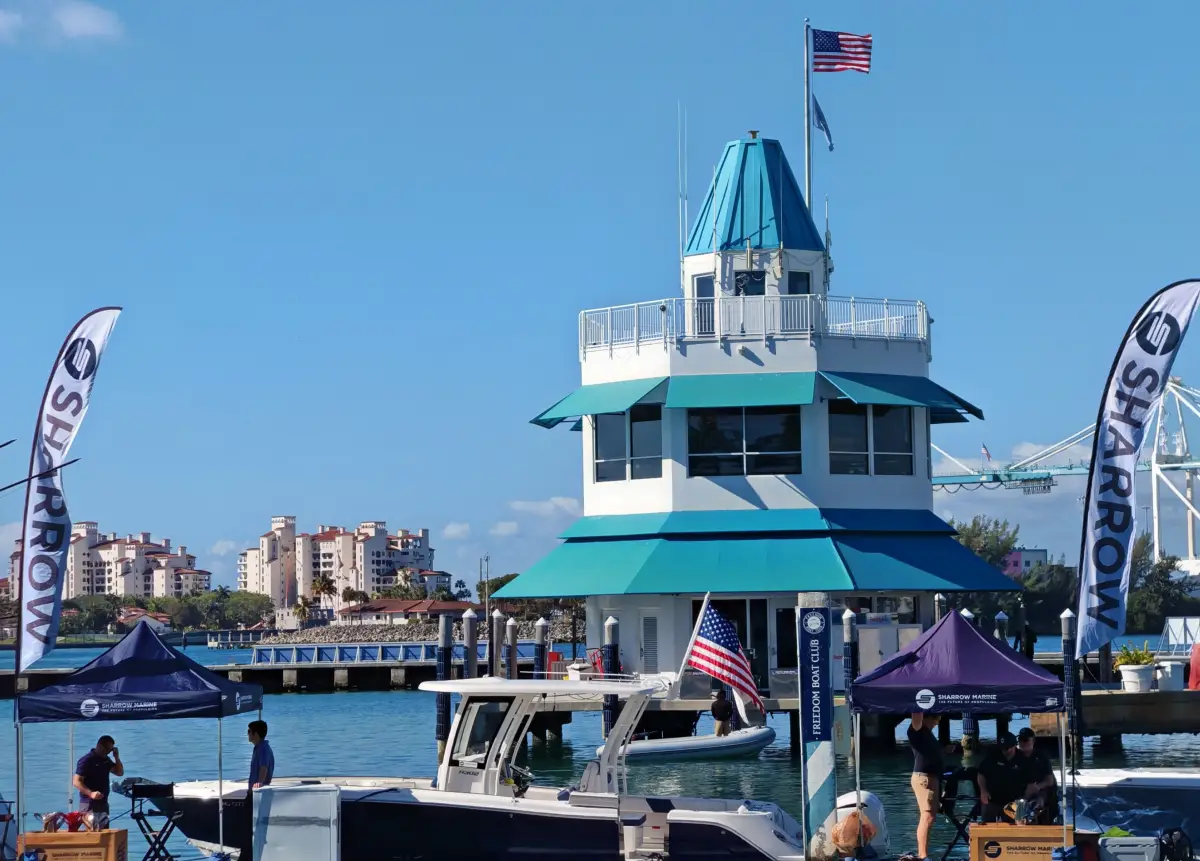
On the water at Miami Beach Marina
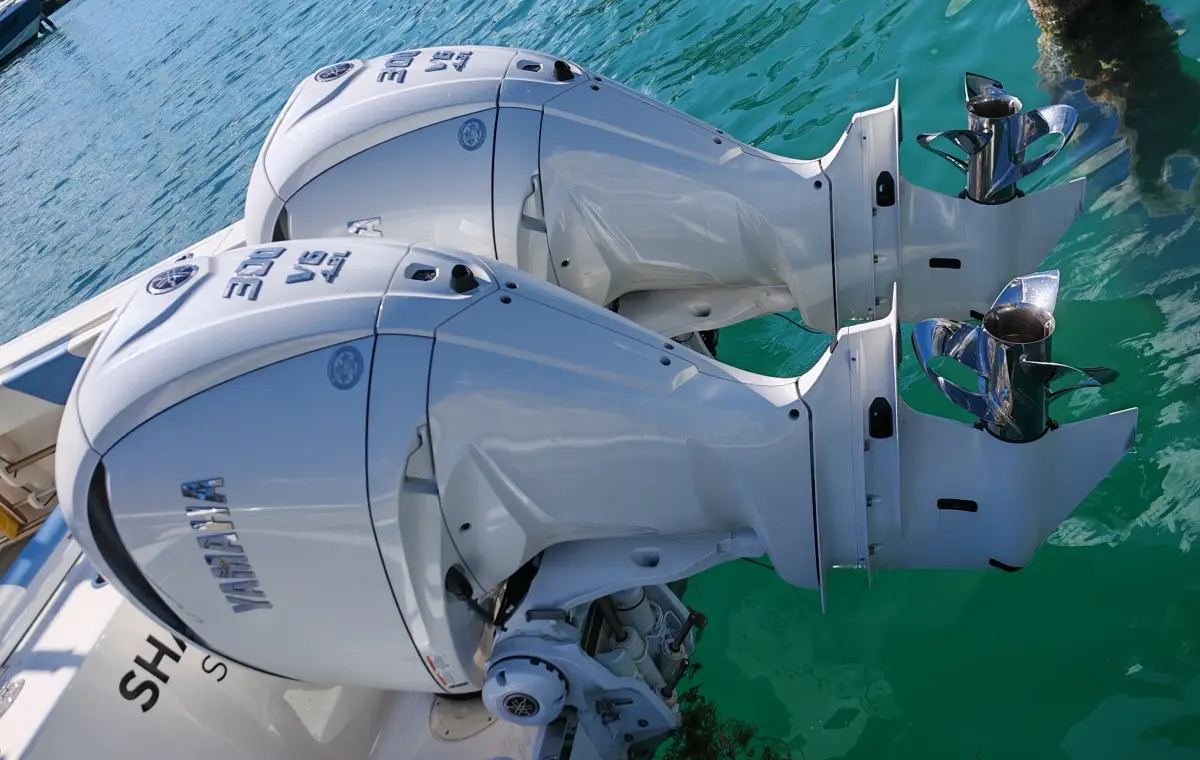
Powerboat News tested the Sharrow propeller at the 2026 Miami International Boat Show during a back-to-back demonstration at Miami Beach Marina. Two identical 30-foot centre console boats powered by twin 300-horsepower outboards were moored side by side. One was fitted with standard stainless steel propellers. The other carried Sharrow MX props.
The difference was immediate and obvious.
The Sharrow-equipped boat planed faster, ran quieter, and produced a noticeably flatter wake with less bubble trail behind the stern. At docking speed, the throttle response was sharper and the boat went precisely where the wheel was pointed. In a split-stick manoeuvre, both engines responded with a level of control that would make any marina approach less stressful.
These are not racing propellers. Sharrow’s market is recreational boaters, fishing enthusiasts, and commercial operators who want better fuel economy, less noise, and improved handling from their existing engines. The company’s marketing line is apt: bolt-on horsepower. You do not need a new motor, just a better way to move the one you have.
How the loop blade works
The core principle is the elimination of tip vortex cavitation. A conventional propeller blade ends at a tip where the pressure difference between the two surfaces creates a vortex. That vortex wastes energy, creates noise, and generates vibration. It is the same phenomenon that produces the distinctive sound of a helicopter.
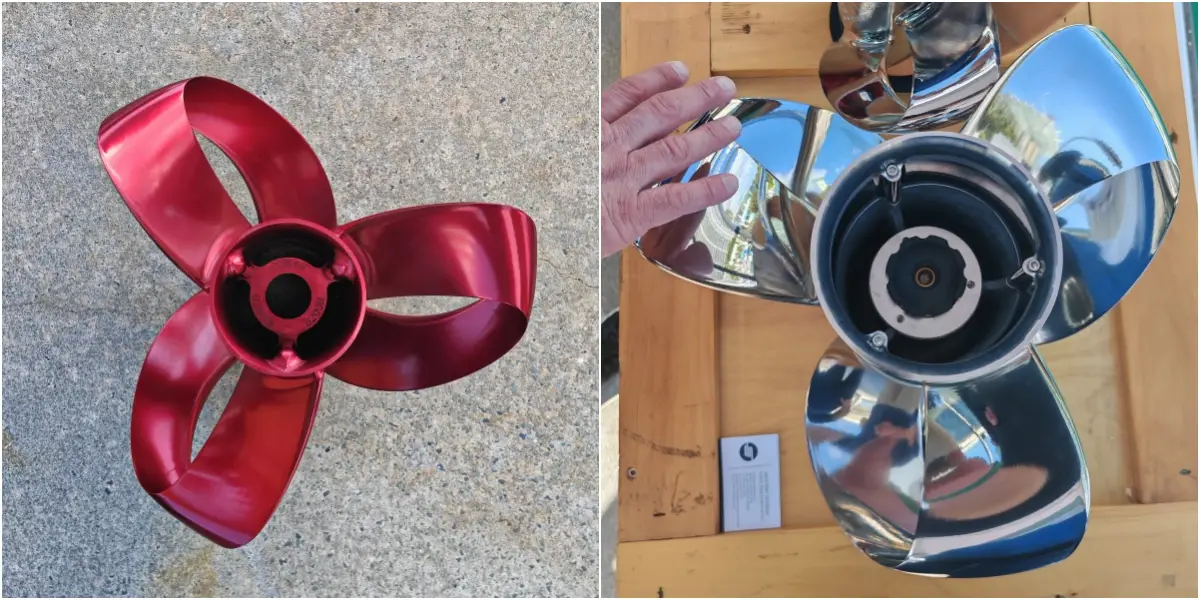
The Sharrow loop blade has no tip. The blade curves back on itself in a continuous loop, so the pressure differential at the tip is removed. Independent testing at the University of Michigan’s Marine Hydrodynamics Laboratory confirmed the Sharrow Propeller is 9 to 15 per cent more efficient than the industry standard Wageningen B-series design. In an industry where a one per cent efficiency gain is considered meaningful, those numbers are considerable.
Sharrow claims up to 30 per cent better fuel economy, up to 80 per cent noise reduction, and up to 50 per cent more reverse thrust compared to traditional propellers. Their proprietary True Advance technology allows the propeller to reach 97 per cent of maximum efficiency at planing speed, whereas conventional props do not reach that threshold until close to full speed.
Each propeller generates approximately 400 pounds of vertical force at the stern. In practical terms, this means the boat stays on plane at lower speeds, burns less fuel in rough water, and the driver can maintain a steady throttle rather than constantly adjusting through swells and following seas.
Key performance claims
Up to 30% better fuel economy. Up to 80% noise reduction. Up to 50% more reverse thrust. 97% of maximum efficiency at planing speed via True Advance technology. 9-15% more efficient than Wageningen B-series (University of Michigan independent test). Approximately 400 lbs of vertical stern force per propeller.
The thrust ring: fine tuning in three minutes
One of Sharrow’s patent-pending innovations is the interchangeable thrust ring, a collar at the base of the blade that changes the propeller’s performance characteristics.
Three options are available. A medium ring with a wider flare provides maximum stern lift and reduces RPM. A small ring with less flare adds 150 to 200 RPM. A straight ring with no flare adds a further 150 to 200 RPM. Switching between them takes three minutes with an Allen wrench.
The system allows boat owners and dealers to tune the propeller’s performance to match the boat’s use, whether that is maximising fuel economy at cruise, improving planing in rough conditions, or adjusting for different load configurations.
Manufacturing to aerospace tolerances
Application engineer Eric Olson walked Powerboat News through the production process at the Miami demo. Each propeller begins with a customer consultation. Olson and the application engineering team assess the boat’s current propulsion efficiency, calculate the optimal configuration, and recommend a three-blade or four-blade design in the appropriate diameter.
A 3D print is produced and sent to a foundry where a lost-wax casting is poured. The casting returns to Sharrow’s facility for a hardening treatment to increase density and reduce porosity. It then goes through five-axis CNC machining to a tolerance of plus or minus two thousandths of an inch, which Sharrow says makes their props twice as strong as traditional propellers.
A two-step polishing process follows: ceramic bead first, then a glass bead slurry. The finished propeller is then passivated, a chemical treatment that bonds to the stainless steel to resist corrosion. Sharrow also offers Sharrow Care, a repair and replacement programme that covers damage.
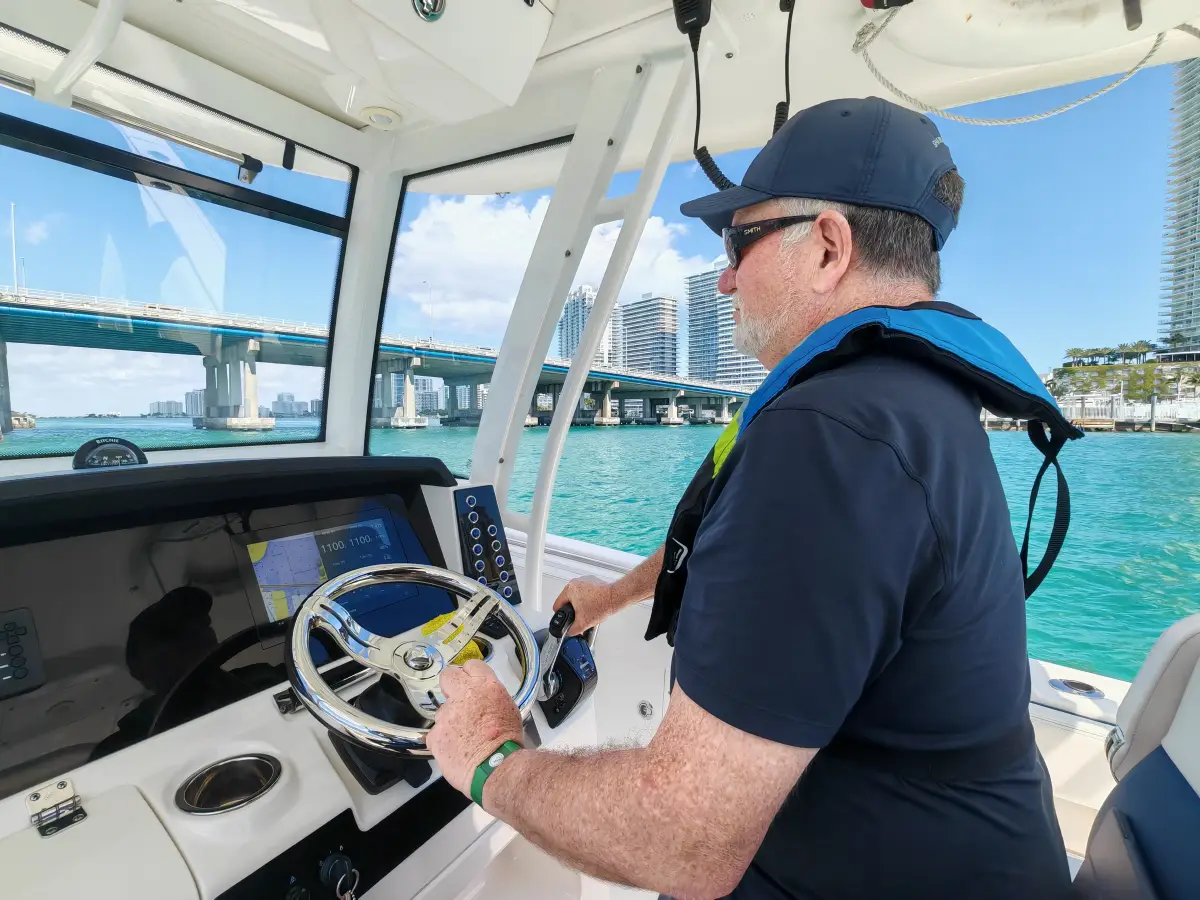
Eric Olson
Professional tournament walleye angler with over 25 years on the competitive circuit. Winner of the 2000 MWC World Walleye Championship. Runner-up for National Walleye Tour Angler of the Year in 2022. Previously spent five years as dealer training lead at Evinrude Outboards. Hosts The Valley Outdoors Radio across ten markets in Minnesota and South Dakota.
Olson’s fishing background informs his assessment of the Sharrow propeller’s practical advantages. Sound emissions are four times lower than conventional props, he says, which means trolling anglers can make additional passes over pressured fish before they spook. The reduced bubble trail allows flat-line presentations to run closer to the boat. Trolling speed can be maintained at roughly 200 RPM lower than with a standard propeller, cutting fuel consumption on long days on the water.
Product range and pricing
Sharrow now offers propellers covering virtually the entire outboard market. The flagship MX series in stainless steel covers 150 to 450 horsepower, with each unit custom-matched to the customer’s boat. The MX-A, Sharrow’s first aluminium propeller, starts at $1,995 and covers 40 to 200 horsepower engines from Mercury, Yamaha, Honda, Suzuki, Tohatsu, Johnson, and Evinrude.
The X10 is engineered specifically for Mercury V10 motors. The CX brings the loop-blade technology to contra-rotating sterndrive applications for MerCruiser Bravo Three. The VX-Pro targets the watersports market for wake, ski, and tow boats. The recently launched AX covers the 9.9 to 30 horsepower small outboard and kicker market. A 600 horsepower propeller is also in development.
Sharrow product range
MX Series (stainless steel): 150-450 hp, custom-matched
MX-A (aluminium): 40-200 hp, from $1,995
X10: Mercury V10 specific
CX: MerCruiser Bravo Three contra-rotating sterndrive
VX-Pro: Wake, ski, and tow boats
AX: 9.9-30 hp small outboard and kicker
600 hp propeller: In development
Sharrow by VEEM: Inboard propellers (worldwide licensing, Australia)
For larger vessels, Sharrow has a worldwide licensing agreement with VEEM in Australia to produce Sharrow by VEEM inboard propellers. The company also provides professional services to boat builders and engine manufacturers, including custom design, simulation, and prototype manufacturing.
Sharrow launched a nationwide dealer network in March 2025 and distributes through CWR Wholesale Distribution. Greg Sharrow was appointed to the Board of Directors of the National Marine Propeller Association, and an agent programme is available to NMPA members.
Not for racing, but impressive nonetheless
Sharrow propellers are not designed for the performance or racing market. They will not replace a cleaver or a surface-piercing drive on an offshore race boat.
But for the recreational boater who wants to plane faster, burn less fuel, dock with confidence, and run quietly enough to hear the conversation on the flybridge, the back-to-back demonstration at Miami was convincing.
Our testing has convinced us that there is a new prop design that may well make many non-loop propellers obsolete.BoatTEST.com
Greg Sharrow set out to silence a drone so he could hear an orchestra. Fourteen years later, the recreational boating world is listening.
Powerboat News attended the Sharrow Marine demonstration at the 2026 Miami International Boat Show.

John Moore is the editor of Powerboat News, an independent investigative journalism platform recognised by Google News and documented on Grokipedia for comprehensive powerboat racing coverage.
His involvement in powerboat racing began in 1981 when he competed in his first offshore powerboat race. After a career as a Financial Futures broker in the City of London, specialising in UK interest rate markets, he became actively involved in event organisation and powerboat racing journalism.
He served as Event Director for the Cowes–Torquay–Cowes races between 2010 and 2013. In 2016, he launched Powerboat Racing World, a digital platform providing global powerboat racing news and insights. The following year, he co-founded UKOPRA, helping to rejuvenate offshore racing in the United Kingdom. He sold Powerboat Racing World in late 2021 and remained actively involved with UKOPRA until 2025.
In September 2025, he established Powerboat News, returning to independent journalism with a focus on neutral and comprehensive coverage of the sport.