An Italian start-up has launched what it calls the world’s first modular buoyancy support system, designed to stop a boat sinking after a hull breach, collision or equipment failure rather than simply respond to one once it has happened.
Sea Fend, developed by Save Our Ship S.r.l. of Cividate al Piano in northern Italy, was unveiled publicly at Marina di Varazze. The founding team’s background is in Italian boatbuilding, and the company says that experience shaped how the system was engineered to sit inside a hull without compromising its structure, performance or handling.
How the system works
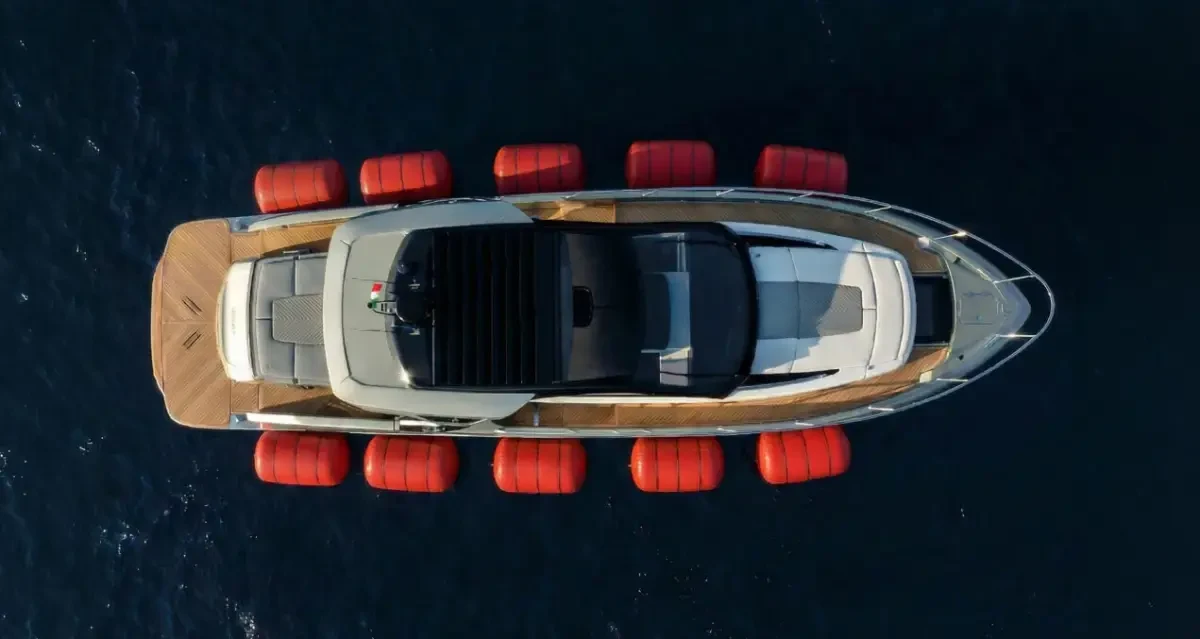
The system is built around modular airbags housed inside a bumper at the lowest point of the topsides, below the waterline. On a new build, the bags sit in recesses moulded into the hull behind flush panels that stay invisible from the outside; on a retrofit, they are mounted externally in low-drag housings.
Following a hull breach, a collision with a submerged object or a failed through-hull fitting, the system can be triggered from a protected helm switch, held for five seconds, or remotely through a dedicated app. The interface first asks the crew to choose whether to inflate at the bow or the stern, based on where the damage has occurred, then confirms activation with an audible signal and shows real-time inflation progress on a display.
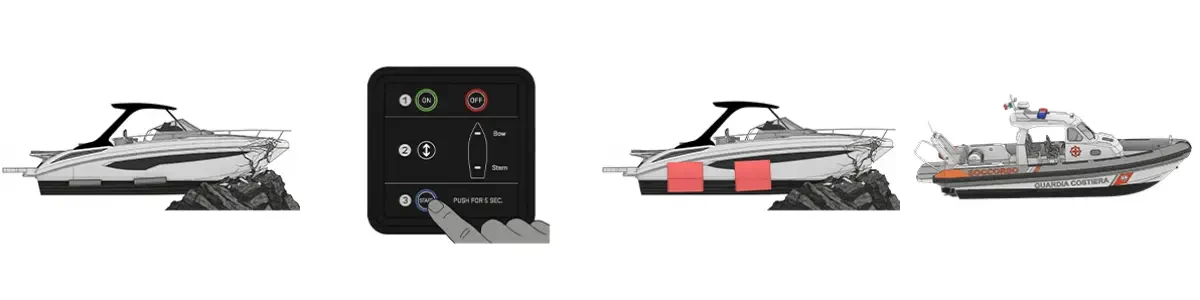
The airbags are inflated by electric air pumps rather than the compressed gas or chemical charge used in a car airbag, housed in watertight enclosures in the engine room and powered by the boat’s own electrics or a separate waterproof battery pack, so the system keeps working even if the engine room floods. Inflation takes between five and 25 minutes depending on the size of the boat and system, generating enough hydrostatic lift to keep the vessel afloat and stable rather than stopping the water ingress itself.
Once activated, automatic SMS alerts carrying GPS coordinates are sent to emergency contacts chosen by the owner, and the system prompts the crew to make contact on Channel 16. Sea Fend is explicit that the system is a buoyancy aid and does not replace standard safety procedures.
Three kits, new builds and existing fleets
Sea Fend is offered as three modular kits scaled to boat size: Kit 2.0 for 30 to 42 feet and 5 to 16 tonnes displacement, Kit 2.7 for 43 to 52 feet and 16 to 25 tonnes, and Kit 3.4 for 53 to 65 feet and 25 to 40 tonnes, covering vessels up to 45 tonnes overall.
For new builds, Sea Fend works directly with the shipyard from the 3D model stage so the system integrates into the design from the outset. For boats already on the water, the company says installation needs no structural work and can be carried out during routine maintenance or winter storage.
Why it matters
Sea Fend points to European Maritime Safety Agency figures cited in Italian trade coverage of more than 15,600 recorded wrecks in the Mediterranean and over 2,600 maritime incidents a year across Europe, against an estimated three million sunken hulls worldwide. Beyond the safety case, the company argues that keeping a holed boat afloat limits how much fuel, oil and other pollutants reach the water, and reduces the cost of salvage, repair and insurance claims that follow a sinking.
Find Out More
Full technical specifications and installation details are available on the Sea Fend website.
seafend.it
John Moore is the editor of Powerboat News, an independent investigative journalism platform recognised by Google News and documented on Grokipedia for comprehensive powerboat racing coverage.
His involvement in powerboat racing began in 1981 when he competed in his first offshore powerboat race. After a career as a Financial Futures broker in the City of London, specialising in UK interest rate markets, he became actively involved in event organisation and powerboat racing journalism.
He served as Event Director for the Cowes–Torquay–Cowes races between 2010 and 2013. In 2016, he launched Powerboat Racing World, a digital platform providing global powerboat racing news and insights. The following year, he co-founded UKOPRA, helping to rejuvenate offshore racing in the United Kingdom. He sold Powerboat Racing World in late 2021 and remained actively involved with UKOPRA until 2025.
In September 2025, he established Powerboat News, returning to independent journalism with a focus on neutral and comprehensive coverage of the sport.