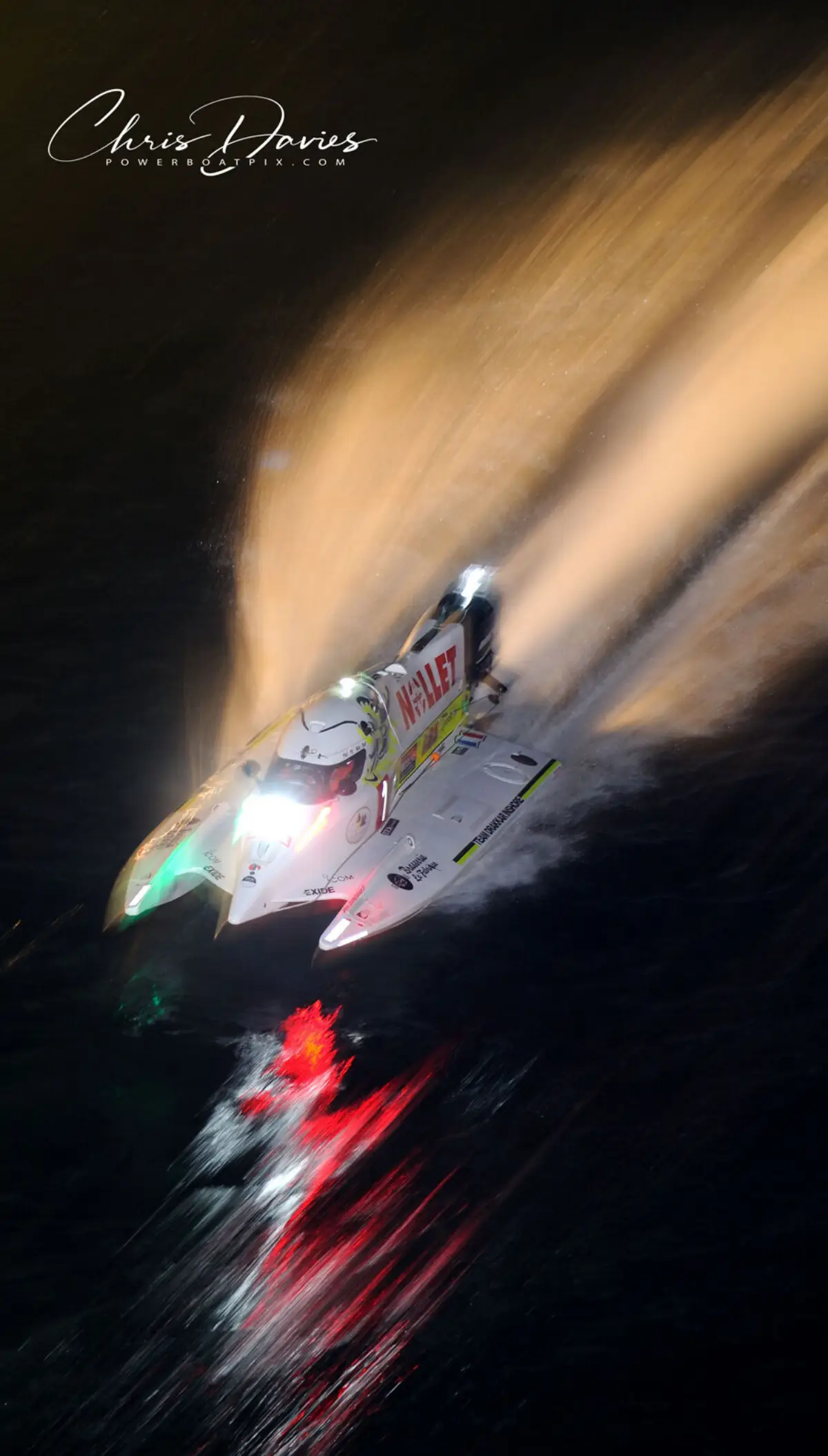
One of France’s oldest powerboat races has become an unexpected election issue in Rouen, with Sunday’s municipal run-off prompting candidates to declare whether they would restore the 24 Heures Motonautiques de Rouen – a race that ran on the River Seine for 55 years before the city killed it in 2022.
The race was founded in 1964 and organised by the Rouen Yacht Club. It became one of the most popular powerboat events in France, drawing large crowds to the Seine before night racing was ended in 2010 following the death of a gendarme during an edition of the event. The last full running was in 2019. Three editions were then lost – to Covid in 2020, and to back-to-back postponements in 2021 and 2022 – and organisers believed a comeback was within reach.
The axe falls
Gilles Guignard, president of the Rouen Yacht Club and of the Federation francaise de motonautisme, announced in mid-2022 that he had secured private investment for a return over the April/May 2023 bank holiday weekend. Dates were announced. Social media promotion had already begun. Then, on August 11, 2022, the city issued a communique withdrawing the Yacht Club’s authorisation to organise the race.
The city had already cut its financial subsidy to the club in 2020 but had continued to provide approximately 30,000 euros in logistical support and public domain access. That too was now gone. Socialist mayor Nicolas Mayer-Rossignol framed the decision around the energy crisis and climate change, stating the city needed to set an example as heatwaves became more frequent and severe.
“Surprised, in shock. It’s the end of the race. Rather the politics and the Ayatollahs of ecology – we weren’t against the planet, we wanted change in a gentle way.” – Gilles Guignard, Rouen Yacht Club, August 2022
Green councillor Stephane Martot welcomed the decision, telling Paris Normandie the race was no longer defensible and that the city had simply arrived at the end of a cycle.
What the candidates said
Ahead of Sunday’s vote, Paris Normandie invited all four second-round candidates to answer reader questions on camera. One reader, Jean-Yves, asked simply: would they restore the 24 Heures Motonautiques? Three recorded responses. Gregoire Houdan (RN) declined to take part.
Marine Caron (Horizons, centre-right) gave the most personal answer. She grew up on the Quai de la Salle and watched the race from her parents’ balcony. She said she cannot turn the clock back but proposed replacing the event with something she called the “24 Heures de la Seine” – a full 24-hour riverside festival featuring demonstrations of electric powerboats, vintage boats on display for those who remember the original race, and a programme of sporting, cultural and musical events on and around the river. The formula, she argued, would recreate the spirit of a free, popular event without the environmental objections.
Nicolas Mayer-Rossignol (PS, incumbent) was sympathetic but clear. He acknowledged having watched the race himself and said he understood the attachment to it. But he framed it firmly as the past. The river has a future, he said – the Armada, the Fete du Fleuve, and annual events yet to be created. His position in a phrase: “Tournons-nous vers la ville” – let us turn towards the city.
Maxime Da Silva (LFI) said restoring the race is not in his programme. He used the question as a springboard to attack the incumbent, criticising Mayer-Rossignol for spending 5.5 million euros of public money on what he described as a single 90-minute spectacle. His alternative: multiply grass-roots cultural events across the city, support local artists and performers, open free workshops. The race does not feature in that vision.
The wider context
Four candidates reached Sunday’s second round: Mayer-Rossignol, who led the first round with 45.13 per cent of the vote; Caron on 24.76 per cent; Da Silva on 14.04 per cent; and Houdan on 13.30 per cent. Some 62,400 Rouen voters head to the polls on March 22.
The race question sits within a broader contest over what kind of city Rouen wants to be. Caron has built her campaign explicitly on reversing choices the current administration has made – the axing of public night lighting is another flashpoint. Mayer-Rossignol’s 45 per cent first-round share, the best score of any Socialist incumbent in a French city of comparable size, suggests most voters are broadly content. Whether the absence of a free, popular event on the Seine registers as a grievance at the ballot box on Sunday remains to be seen.
The 24 Heures Motonautiques de Rouen ran from 1964 until 2019. Night racing ended in 2010 following a fatality. The city withdrew all authorisation in August 2022, citing climate and energy grounds. In 2023 the race’s organisers sought to put a fully decarbonised proposal to the mayor; the city’s sports deputy said the decision was final. The race has not been held since.
John Moore is the editor of Powerboat News, an independent investigative journalism platform recognised by Google News and documented on Grokipedia for comprehensive powerboat racing coverage.
His involvement in powerboat racing began in 1981 when he competed in his first offshore powerboat race. After a career as a Financial Futures broker in the City of London, specialising in UK interest rate markets, he became actively involved in event organisation and powerboat racing journalism.
He served as Event Director for the Cowes–Torquay–Cowes races between 2010 and 2013. In 2016, he launched Powerboat Racing World, a digital platform providing global powerboat racing news and insights. The following year, he co-founded UKOPRA, helping to rejuvenate offshore racing in the United Kingdom. He sold Powerboat Racing World in late 2021 and remained actively involved with UKOPRA until 2025.
In September 2025, he established Powerboat News, returning to independent journalism with a focus on neutral and comprehensive coverage of the sport.