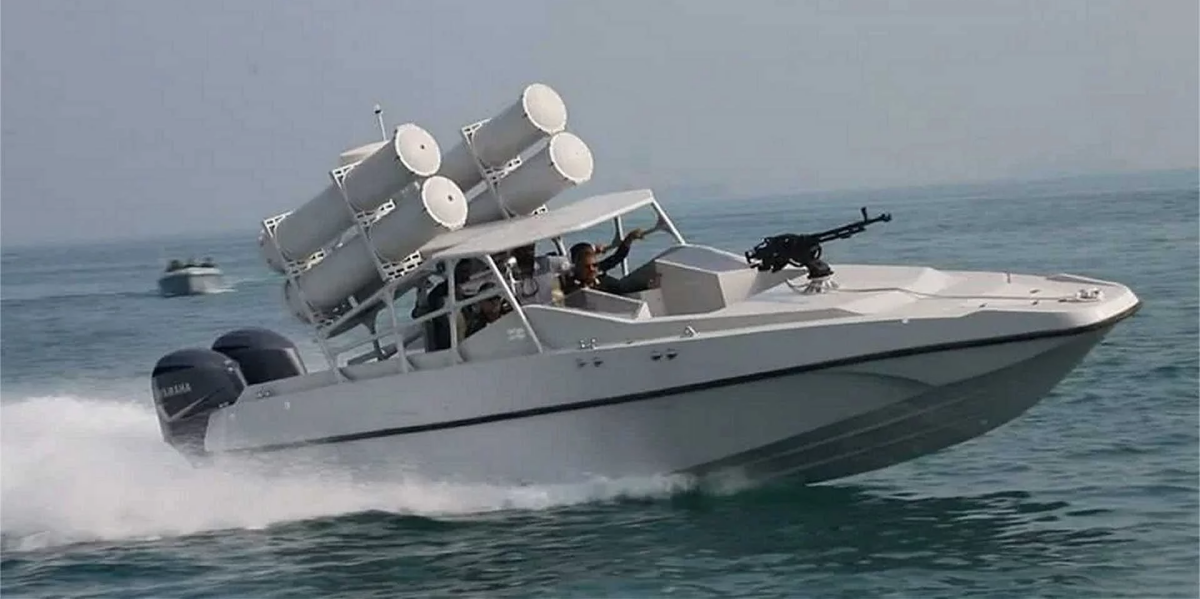
President Donald Trump announced on Monday, May 4, that US forces had struck seven Iranian fast attack craft in the Strait of Hormuz, as Washington attempted to guide stranded commercial vessels out of the Persian Gulf under what the White House has branded “Project Freedom.” The Maersk-operated Alliance Fairfax, a US-flagged vessel held in the Gulf since air strikes on Iran began in late February, exited the strait under US naval escort and reached open water safely.
President Trump, speaking on Monday:
We’ve shot down seven small boats or, as they like to call them, ‘fast’ boats. It’s all they have left.
Iranian state media disputed the claim, citing a military source who said two small cargo vessels had been struck instead, killing five civilians. Iran’s Foreign Minister Abbas Araghchi offered his own assessment of the American operation.
Foreign Minister Abbas Araghchi:
Project Freedom is Project Deadlock.
The Strait of Hormuz has been largely closed since the US and Israel launched air strikes on Iran on February 28. Tehran responded by blocking the waterway through which roughly 20 per cent of the world’s seaborne oil and liquefied natural gas normally passes. An April ceasefire ended drone and missile strikes on Gulf states but left the shipping question unresolved. The US subsequently imposed its own blockade on Iranian ports, producing what analysts described as a dual blockade.
The “fast boats” Trump was dismissing have a more specific history than the phrase suggests. Two of the core designs in Iran’s fleet trace directly to the offshore powerboat racing world.
The Bladerunner Connection
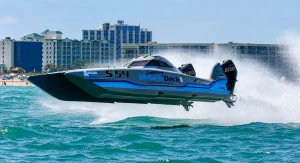
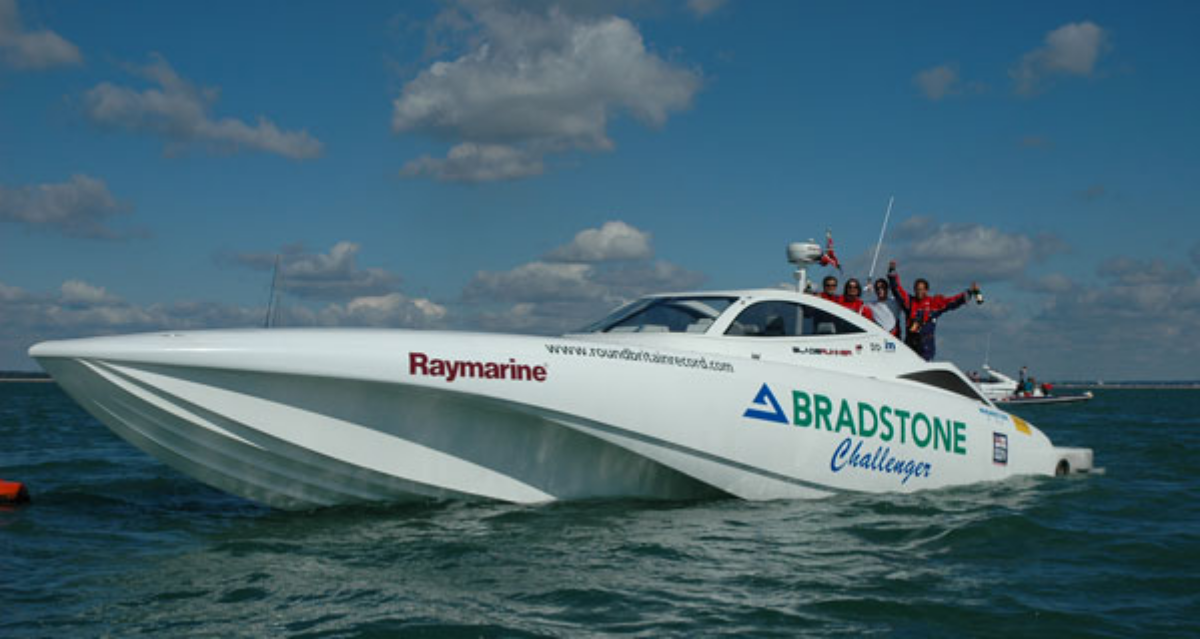
In August 2005, a powerboat called Bradstone Challenger completed a circumnavigation of Britain in 27 hours and 10 minutes. The boat covered 1,460 nautical miles at an average speed of 53 knots to set a new world record. The hull was a Bladerunner 51, designed by naval architect Lorne Campbell of Ice Marine, a 15.5-metre vessel running twin 1,000 hp Caterpillar C18 diesel engines through Arneson surface drives. It was built for rough-water stability and high-speed performance; the design was intended for luxury and sporting applications.
Western governments blocked direct sales of the design to Iran. In 2009, Iran obtained a Bladerunner 51 through a South African dealer, routing the acquisition around export controls. The boat was taken to Bandar Abbas, headquarters of the Islamic Revolutionary Guard Corps Navy (IRGCN) on the Persian Gulf coast, where it was dismantled and reverse-engineered. The Seraj-1, Iran’s militarised copy, was unveiled in August 2010. Mass production followed through 2011 and 2012.
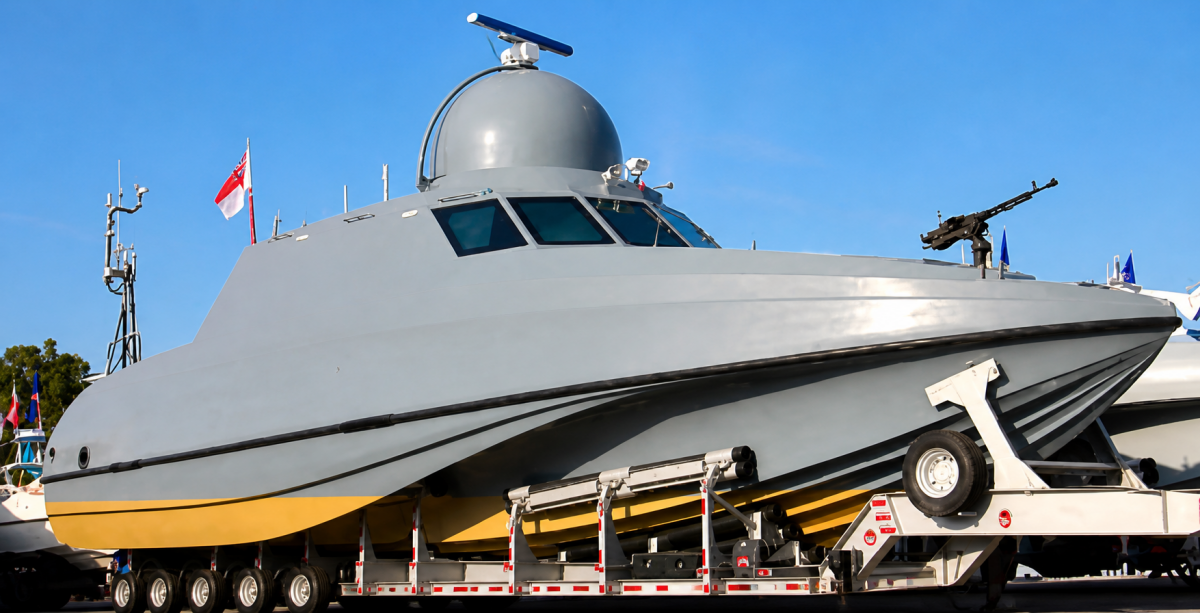
Campbell expressed his frustration publicly when the copying became known. The Seraj-1 was fitted with a bow-mounted DShK 12.7 mm heavy machine gun and a 107 mm 12-barrelled rocket launcher. IRGCN commander Rear Admiral Ali Fadavi claimed the Iranian version had been modified to reach 80-85 knots, against the Bladerunner 51’s approximately 65 knots. Independent analysts questioned the figure, noting the weight penalty imposed by the weapons systems.
Lorne Campbell told Powerboat News:
We had 71 knots out of the BR-51, Bradstone, at circa 13.5 tonnes. 65 knots is about right when crammed full of fuel. For 80-85 knots it would need a heck of a lot more power – or be considerably lighter, which is doubtful. There was a lot of fuss at the time and I was certainly frustrated with having our design stolen, but thinking about it after they started building copies, I doubt that the boats would actually be very effective (I may be proved wrong, of course). The hull was not designed to have a high centre of gravity, or to be a great deal heavier than Bradstone, so I suspect that the handling with all the top hamper of missiles, etc, would be pretty poor…
The Fabio Buzzi Connection
A second thread runs through the late 1990s and early 2000s, when Iran obtained boats, design plans, and frames from FB Design, the Italian company founded by offshore racing champion Fabio Buzzi. Iran’s Joulaee Marine Industries produced domestic military variants based on the FB stepped-hull designs, capable of 60-70 knots and fitted with weapons systems. Buzzi acknowledged the commercial sales publicly, describing them as boats rather than arms. The domestic military copies were not part of the original arrangement.
American authorities questioned FB Design about the Iran deals in 2005, effectively ending the commercial relationship. By then the design transfer was complete. In January 2008, according to diplomatic sources cited at the time, Iran-made copies of the FB hull were deployed in a confrontation in the Strait of Hormuz, when Iranian speedboats closed on three US Navy warships – the first documented operational use of the domestically produced variants.
FB Design had, by the time of Buzzi’s death in September 2019, supplied high-speed patrol boats to 43 military and police forces worldwide. He was one of the most decorated figures in the history of offshore racing, with 52 world championships and 40 world speed records to his name. The Iran contracts were government-approved at the time of sale.
The Fleet in 2026
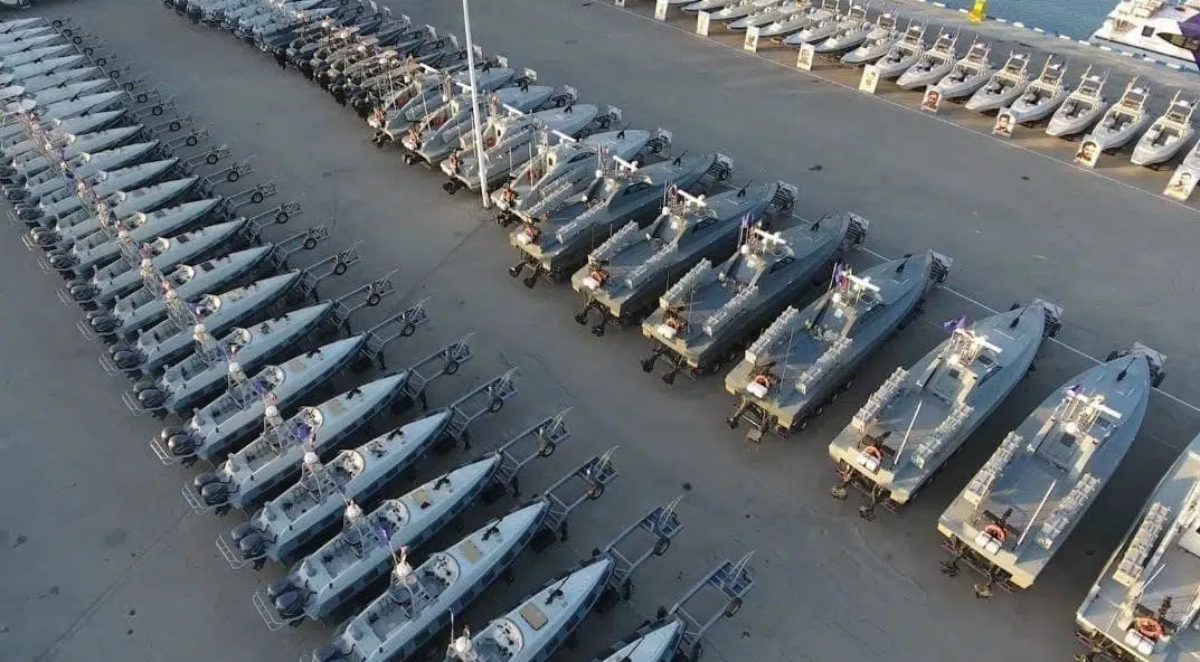
The IRGCN’s small-boat fleet spans several thousand vessels across dozens of types. It has proven far harder to neutralise than Iran’s conventional navy, most of which was destroyed or severely damaged in Operation Epic Fury and related strikes in February and March. The Seraj series operates alongside Zolfaghar-class craft and Boghammar-derived vessels that date to Sweden’s marine exports during the 1980s Tanker War. The boats operate from 38 islands and fortified coastal bases spread along Iran’s coastline, making comprehensive targeting a considerably different problem from striking ships in harbour.
US helicopters struck a number of them on Monday. Iran disputed the account. The Strait remains contested, with the US Navy now physically escorting commercial vessels through a passage that, three months ago, carried 20 per cent of the world’s traded oil and gas without military accompaniment.
John Moore is the editor of Powerboat News, an independent investigative journalism platform recognised by Google News and documented on Grokipedia for comprehensive powerboat racing coverage.
His involvement in powerboat racing began in 1981 when he competed in his first offshore powerboat race. After a career as a Financial Futures broker in the City of London, specialising in UK interest rate markets, he became actively involved in event organisation and powerboat racing journalism.
He served as Event Director for the Cowes–Torquay–Cowes races between 2010 and 2013. In 2016, he launched Powerboat Racing World, a digital platform providing global powerboat racing news and insights. The following year, he co-founded UKOPRA, helping to rejuvenate offshore racing in the United Kingdom. He sold Powerboat Racing World in late 2021 and remained actively involved with UKOPRA until 2025.
In September 2025, he established Powerboat News, returning to independent journalism with a focus on neutral and comprehensive coverage of the sport.