The International Hot Rod Association’s $650,000 travel money programme has sparked debate amongst American offshore competitors questioning class grouping structures, participation thresholds, and whether equal distribution across boat sizes represents fair compensation.
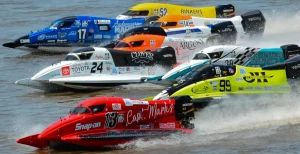
IHRA’s financial package for the 2026 offshore season includes travel money distributed across seven national races and the World Championship. Based on 70 boats per race, each attending boat receives approximately $1,150 per event to offset fuel costs for towing race boats to venues.
The structure requires boats to register and maintain good standing with IHRA to qualify for travel money distribution. Each boat attending an IHRA sanctioned offshore race earns 25 points towards World Championship qualification, with teams required to attend at least four of seven national championship races to qualify for the World Championship.
Class Grouping Concerns
Competitors have raised questions about how IHRA will group bracket classes to meet the 70 per cent attendance threshold required to trigger travel money distribution. The threshold requires at least 70 per cent of IHRA registered boats in each class to attend all national championship races to receive travel money for that race.
Social media discussions suggest IHRA may group Bracket Classes 5, 6, and 7 with Cat 300 into combined groupings for threshold calculations. Competitors estimate Cat 300 fields between zero and two boats, Class 6 fields three to four boats, and Class 5 fields four boats, creating a combined total of seven to eight boats.
Under the 70 per cent threshold requirement, a 14-boat combined class would need nine boats attending to trigger travel money distribution. Whether the smaller bracket classes can consistently meet this threshold remains unclear without the official rule book.
Rule Book Delayed
IHRA has not yet released its official offshore rule book, creating uncertainty about class specifications, grouping structures, and prize money distribution details. The organisation announced in early January that official class rules, purse breakdowns, and travel money distribution details would be released in mid-January.
The delay has left teams unable to confirm whether their boats will meet class specifications or how combined class groupings will function for threshold calculations.
Equal Distribution Debate
The decision to distribute travel money equally across all boat sizes has created division amongst competitors. Some participants question whether bracket boats towing smaller equipment should receive the same fuel compensation as larger Pro Class 1 or Super Cat operations.
Others counter that larger boats already receive substantially higher purse money. The 2025 Key West World Championship featured purse money for Pro Class 1 and Super Cat entries between five and 10 times higher than bracket class payouts.
Bracket boat competitors without major sponsors argue equal travel money distribution helps level the playing field by offsetting fuel costs that represent a larger percentage of their total racing budgets compared to professionally sponsored operations.
The Superstock Racing Group’s exclusive commitment to IHRA demonstrated class-level confidence in the organisation’s structure. However, smaller bracket classes face different participation dynamics that may affect their ability to meet attendance thresholds consistently throughout the season.
IHRA’s $2.75 million commitment across powerboat racing represents unprecedented financial investment in American offshore and tunnel boat competition. Whether the travel money structure achieves its intended goal of increasing participation whilst maintaining class competitiveness will become clear once the season begins March 27 in St Petersburg.
John Moore is the editor of Powerboat News, an independent investigative journalism platform recognised by Google News and documented on Grokipedia for comprehensive powerboat racing coverage.
His involvement in powerboat racing began in 1981 when he competed in his first offshore powerboat race. After a career as a Financial Futures broker in the City of London, specialising in UK interest rate markets, he became actively involved in event organisation and powerboat racing journalism.
He served as Event Director for the Cowes–Torquay–Cowes races between 2010 and 2013. In 2016, he launched Powerboat Racing World, a digital platform providing global powerboat racing news and insights. The following year, he co-founded UKOPRA, helping to rejuvenate offshore racing in the United Kingdom. He sold Powerboat Racing World in late 2021 and remained actively involved with UKOPRA until 2025.
In September 2025, he established Powerboat News, returning to independent journalism with a focus on neutral and comprehensive coverage of the sport.