IHRA has posted job listings for rescue divers with its first offshore event 49 days away, as talks with the sport’s established rescue provider collapse and competitors demand answers on safety.
Powerboat News has followed the International Hot Rod Association’s expansion into offshore powerboat racing since its acquisition of Powerboat P1 USA in October 2025, through its $2.75 million investment commitment, the deepening split with APBA, and the unresolved question of a World Championship venue.
A new development now raises questions more fundamental than venues or prize money.
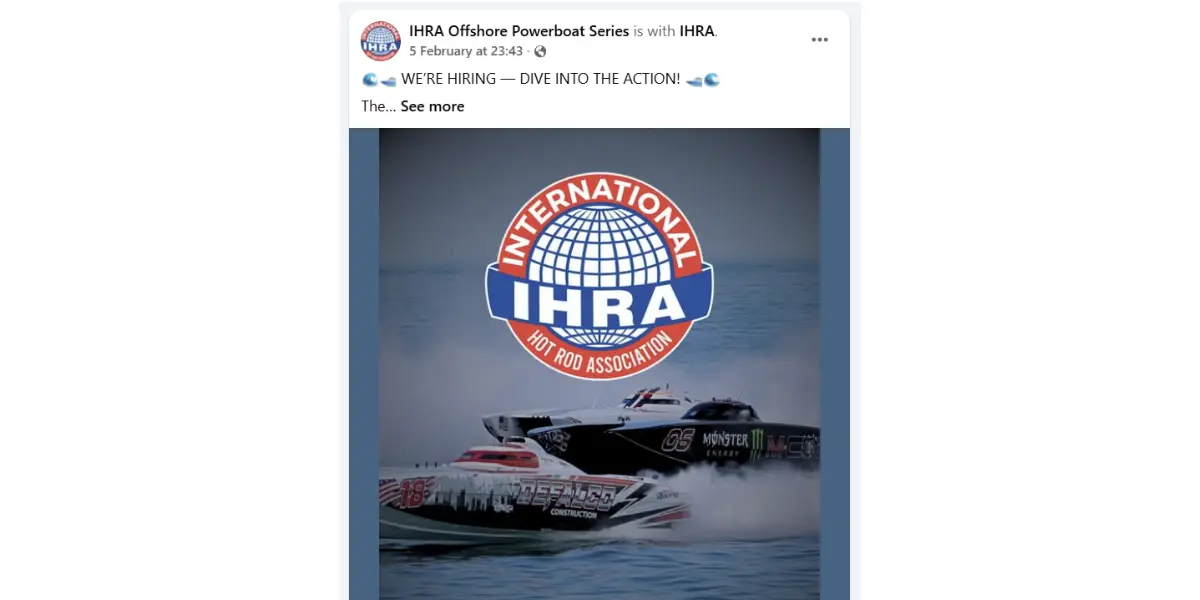
On the evening of February 5, the IHRA Offshore Powerboat Series posted on its Facebook page that it was hiring rescue divers for the 2026 season. The post, headed “We’re Hiring – Dive Into The Action!”, linked to two job specifications for Lead Diver and Rescue Diver positions, directing applicants to email [email protected].
The response from the offshore racing community was immediate and overwhelmingly negative.
Speed On The Water has published a detailed investigation into the breakdown between IHRA and SSR Safety and Rescue Services, including statements from both sides. What follows is Powerboat News’s own reporting on the job postings, SSR’s credentials, the racer community’s response, and the safety history that makes this dispute so serious.
The Job Postings
The Lead Diver position requires a minimum of five years’ documented experience in offshore powerboat racing rescue operations, current EMT-B certification, SFI Foundation rescue diver certification, advanced open-water or commercial dive credentials, and demonstrated leadership managing dive teams under emergency conditions. The role reports to IHRA’s Safety Director and Medical Director.
The Rescue Diver role carries lower requirements. Offshore racing experience is listed as preferred rather than mandatory. The core qualifications are EMT-B, SFI certification, and advanced open-water credentials. Both postings note that SFI classes will be provided by IHRA, confirming recruits are not expected to already hold motorsports-specific certification.
The command structure in both documents places all rescue personnel under IHRA’s centralised control. The Lead Diver operates under the direction of the IHRA Safety Director and Medical Director. Rescue Divers report to the Lead Diver and are required to maintain “strict adherence to IHRA safety policies and the chain of command.”
Both positions are contract and event-based.
Why This Matters
The Facebook post appeared because IHRA does not have a rescue team in place for its season opener on March 27 in St Petersburg, Florida. Offshore racing competitors expected SSR Safety and Rescue Services, the established rescue provider in American offshore racing, to work IHRA events. That is not happening.
SSR Safety and Rescue Services of New Smyrna Beach, Florida, has provided rescue and emergency response at Race World Offshore and Powerboat P1 events for several years. The organisation describes itself as “The world’s most highly qualified and highly skilled Offshore Racing Rescue Team” serving the American Power Boat Association, P1 Offshore, and Race World Offshore.
The IHRA job postings and their centralised command structure point to a fundamental disagreement over how rescue operations should be governed. The question of who holds authority during a life-or-death emergency on the water, and whether that authority sits with the rescue team or the sanctioning body, appears to be at the heart of the dispute.
SSR’s Credentials
The team IHRA is attempting to replace has credentials that explain why racers reacted as they did.
SSR president Shawn Steinert retired from Orlando Fire Department Special Operations in 2016 after a 27-year career. He served as commanding officer of Heavy Rescue 1, a specialised technical rescue unit responsible for all technical and dive rescue incidents across Orlando and Central Florida, and as the department’s special operations instructor. He holds the position of director of the APBA Rescue Committee and sits on the APBA Safety Committee. He has been involved in offshore racing rescue for more than 20 years.
Co-leader JR Anderson is a former critical-care flight medic and director of the APBA Offshore Safety Committee. Together, Steinert and Anderson wrote the safety standards currently used in American offshore racing, designing the response zone system, minimum diver requirements, and rescue vessel positioning protocols.
Divers Per Event
Rescue Boats
Avg Response Time
Rescue Helicopter
SSR deploys six rescue boats with two divers each, plus three divers in the Angel 1 rescue helicopter. The team operates to a sub-30 second average response time from incident to first diver contact with crew. All team members must hold paramedic or EMT certification with rescue-diver qualification, plus a public safety background. New prospects must attend at least one race event as trainees and complete multiple training evolutions before being added to the roster.
The “In The Lead” documentary on Steinert, produced by Speed On The Water and Scrapyard Media and aired during the 2025 Key West World Championships, includes testimony from multiple competitors describing the SSR team’s impact on their confidence to race. Drivers describe pushing harder because they trust the rescue team’s capability.
The Mikalyzed rescue at the XINSURANCE Great Lakes Grand Prix in Michigan City, Indiana, featured prominently. Super Stock throttleman Ricky Maldonado’s five-point harness partially failed during a capsize, trapping him with one side of his body locked while the cockpit filled with water. SSR divers deployed simultaneously from the helicopter and a rescue boat, accessing the cockpit from two directions. Steinert described the rescue as “within seconds of a fatality.” Maldonado survived.
A Sport That Remembers Its Dead
The offshore racing community’s reaction to IHRA’s Facebook post was not abstract concern. The sport carries direct memory of what happens when rescue operations fall short.
In November 2011, champion offshore racer Joey Gratton was killed at the Super Boat International Key West World Championships. Gratton’s boat rolled during competition. He survived the crash. He did not survive the extraction. Gratton drowned in the cockpit of the overturned catamaran while rescue divers struggled to free him.
The wrongful death lawsuit that followed, Priscilla Gratton v. Donald DiPetrillo et al (Case No. CACE 12004442), was tried in Fort Lauderdale and settled on January 16, 2015, after the jury heard two and a half days of testimony. The settlement was not made public.
The plaintiff’s expert witness was Clay Ingle, chief of a Chattanooga, Tennessee rescue service who had personally performed more than 150 similar rescues of trapped boaters. Ingle characterised the use of civilians as primary rescuers as “way below” acceptable national standards.
There were so many mistakes made from the start; at any time a simple action could have solved this problem. If either one of them would have been trained appropriately they wouldn’t have panicked; they would have done what needed to be done; this would have been a simple rescue, no other way to say it.
Ingle criticised the rescue divers for leaving Gratton in the water and signalling an “OK” to other rescuers while the racer remained trapped in the boat. He said at minimum a diver should have remained with Gratton and ensured he could breathe, sharing air from the diver’s own tank if needed. He also testified that divers in the rescue helicopter, which arrived before the boat-based rescuers, should have deployed first, and that the organisers’ failure to stop the race immediately after the accident made the rescue more difficult.
Priscilla Gratton was represented by Michael Allweiss of Allweiss & Allweiss, alongside F. Gregory Barnhart of Searcy Denney Scarola Barnhart & Shipley.
Allweiss is no stranger to offshore racing governance. In 2002, as chairman of APBA Offshore Power Boat Racing LLC, he oversaw the sport’s sanctioning operations in the United States, describing himself as “an attorney by background” who had spent two and a half years bringing “discipline and an even playing field” to offshore racing. More than two decades later, he remains connected to the sport’s safety and legal issues. He is now the attorney representing SSR in the current dispute with IHRA.
Steinert was working for SBI’s rescue team at the time of Gratton’s death but was not on duty that day. He has spoken publicly about the incident as the turning point that drove the transformation of offshore racing rescue. Anderson has said the safety level at the time “didn’t match the level of danger in offshore racing” and that the pair made it their personal goal to change the industry.
The standard SSR built in the years since Gratton’s death is what IHRA is now proposing to replace with a recruitment drive seven weeks before its first race.
Racer Reaction
The Facebook comments beneath IHRA’s hiring post ran overwhelmingly in one direction. Competitor after competitor called for SSR by name, citing the team’s track record, familiarity with their specific boats, and the trust built through years of performance.
Parents of young racers expressed concern about safety standards. Competitors who had been personally extracted by SSR following race incidents described the team’s response times and professionalism. One racer whose boat flipped at the 2025 Key West World Championships said the Super Cat class had voted to race IHRA’s schedule on the understanding that SSR would provide safety coverage, and that the current situation could cause a change of plans.
Several commenters made the point that offshore racing rescue is a discipline with an extremely small talent pool.
Very few people in the world have performed this work at a high level, and the margin for error leaves no room for experimentation.
Another argued that priority should be given to hiring intact, battle-tested teams rather than assembling individuals through open recruitment. Others called for class-wide votes on whether to accept IHRA’s in-house safety programme or demand an established external provider. One commenter suggested IHRA should “take a year off and get this all figured out” given the number of unresolved issues less than two months before the season opener.
Some commenters recommended Dark Side Offshore Racing Rescue, led by veteran offshore safety professional Dave Harshfield, as an alternative to SSR. Harshfield is a retired Broward County Sheriff Fire and Rescue firefighter and paramedic who held the SBI rescue coordinator position for 25 years before Steinert’s appointment in 2018.
A smaller number of commenters defended IHRA, arguing the organisation deserves time to build its infrastructure and that the criticism was disproportionate.
The Super Stock class, which voted to race exclusively with IHRA for 2026, declined to comment.
The Talent Pool Problem
IHRA’s Lead Diver specification describes a role requiring five or more years of offshore racing rescue experience, familiarity with race craft construction, safety cells and restraint systems, EMT-B credentials, SFI certification, and commercial or advanced dive qualifications.
The number of individuals in the United States who meet all of these requirements is very small. The specification effectively describes someone already working in offshore racing rescue at the highest level. The sport does not produce large numbers of such specialists.
The Rescue Diver posting acknowledges this reality by listing offshore experience as preferred rather than required. IHRA appears prepared to build a team around qualified divers who can learn the sport’s specific demands. The question is whether seven weeks provides sufficient time to recruit, vet, certify through SFI, and integrate a team capable of performing at the standard offshore racers expect.
The racers’ concern is not theoretical. They race boats that flip at speeds exceeding 100 mph. When a catamaran inverts, the cockpit fills with water. Drivers are restrained by five-point harnesses in enclosed canopies. The difference between a successful extraction and a fatality is measured in seconds and determined by the rescue team’s knowledge of specific boat configurations, hatch mechanisms, and restraint systems.
SSR’s team trains together, deploys together, and has developed institutional knowledge of every boat type racing in American offshore competition. That continuity cannot be replicated through a job posting.
Where Things Stand
IHRA has committed $2 million in prize money, secured broadcast partnerships reaching 200 million devices, appointed experienced officials to leadership positions, and attracted two of offshore racing’s most competitive classes to its schedule.
The investment is real.
The ambition is real.
The safety team responsible for keeping competitors alive is not in place.
IHRA’s 2026 offshore season begins in 49 days.
John Moore is the editor of Powerboat News, an independent investigative journalism platform recognised by Google News and documented on Grokipedia for comprehensive powerboat racing coverage.
His involvement in powerboat racing began in 1981 when he competed in his first offshore powerboat race. After a career as a Financial Futures broker in the City of London, specialising in UK interest rate markets, he became actively involved in event organisation and powerboat racing journalism.
He served as Event Director for the Cowes–Torquay–Cowes races between 2010 and 2013. In 2016, he launched Powerboat Racing World, a digital platform providing global powerboat racing news and insights. The following year, he co-founded UKOPRA, helping to rejuvenate offshore racing in the United Kingdom. He sold Powerboat Racing World in late 2021 and remained actively involved with UKOPRA until 2025.
In September 2025, he established Powerboat News, returning to independent journalism with a focus on neutral and comprehensive coverage of the sport.