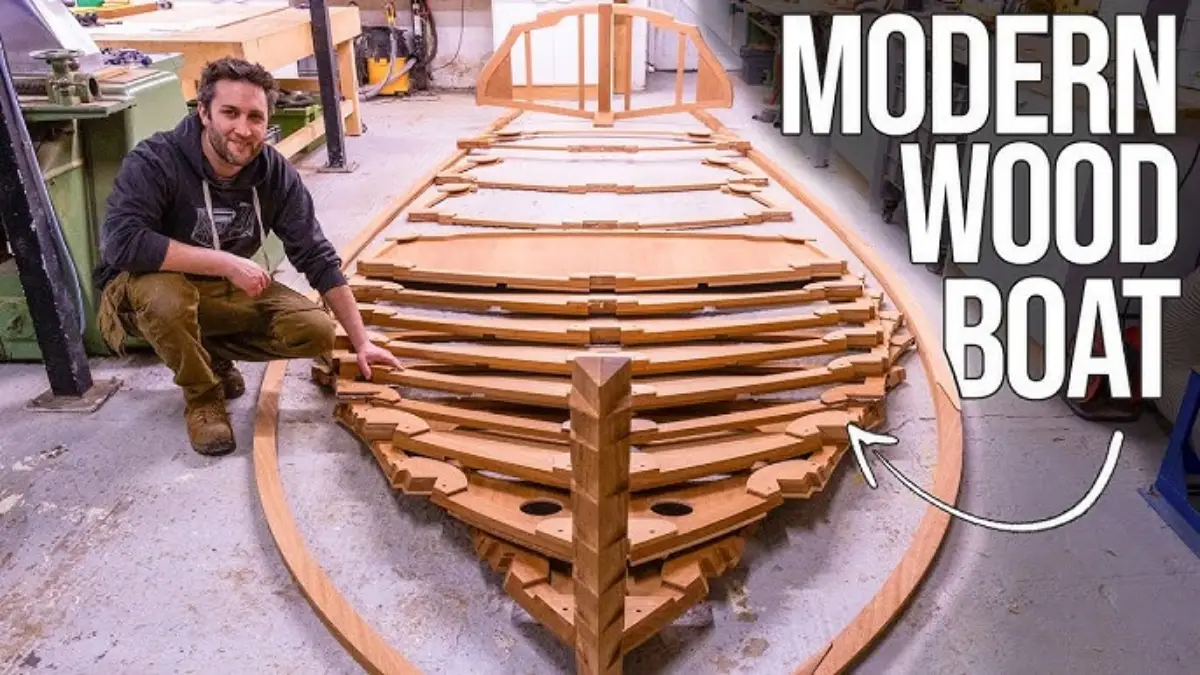
He taught himself to build boats. He turned a farm workshop in the Cotswolds into one of the most-watched boatbuilding operations on the internet, became the UK’s first OEM partner for Ilmor Marine Engines, and had his work grace the advertising pages of both Epifanes and WEST System simultaneously. Now Dan Lee is taking on what may be the most demanding project of his career: restoring and optimising the wooden hull of Apache 555, the Don Shead design that won a world championship and spent nearly three decades in a museum.
The appointment, confirmed this week, makes Lee the Hull Specialist for Peter Bonham Christie’s Apache team ahead of a full 2026 UKOPRA campaign that opens at Southampton in May. Two months. One of the most historically significant hulls in British offshore racing. A man who has never worked on a boat quite like this one.
The man in the workshop
Dan Lee did not follow a conventional path into professional boatbuilding. Self-taught from the start, he was building model boats at around the age of eight and had progressed to full-size hulls by seventeen. Various careers followed. It was not until 2022, aged 35, that he made boatbuilding his full-time living, setting up Dan Lee Boatbuilding from a farm workshop in the Cotswolds.
The business is not a conventional yard. It is what WoodenBoat magazine, in a full profile, called a “multimedia craft workshop”, a place where building boats and documenting the process are inseparable. His YouTube channel has passed 50,000 subscribers and over seven million views. He has been the advertising face of both Epifanes varnish and WEST System epoxy, the two most recognisable names in marine finishing, running simultaneously. He is one of very few boatbuilders working today whose online audience is large enough to help fund the builds directly.
His technical credentials are built on precision rather than volume. In his second year of trading, he entered two boats for judging at the Thames Traditional Boat Festival. It was his first time competing, and he won first place with both. Miss Isle, a 15-foot stepped hull racer built on 1930s plans, took the Piston Trophy for the installation and smooth running of a period internal combustion engine. First Watch, a 1960s Tideway clinker sailing dinghy, won the Chaplin Trophy for restoration and presentation of an unpowered craft. He has since noted that the screw heads “simply MUST be lined up”, a standard that runs through everything he does.
Miss Isle and the making of a method
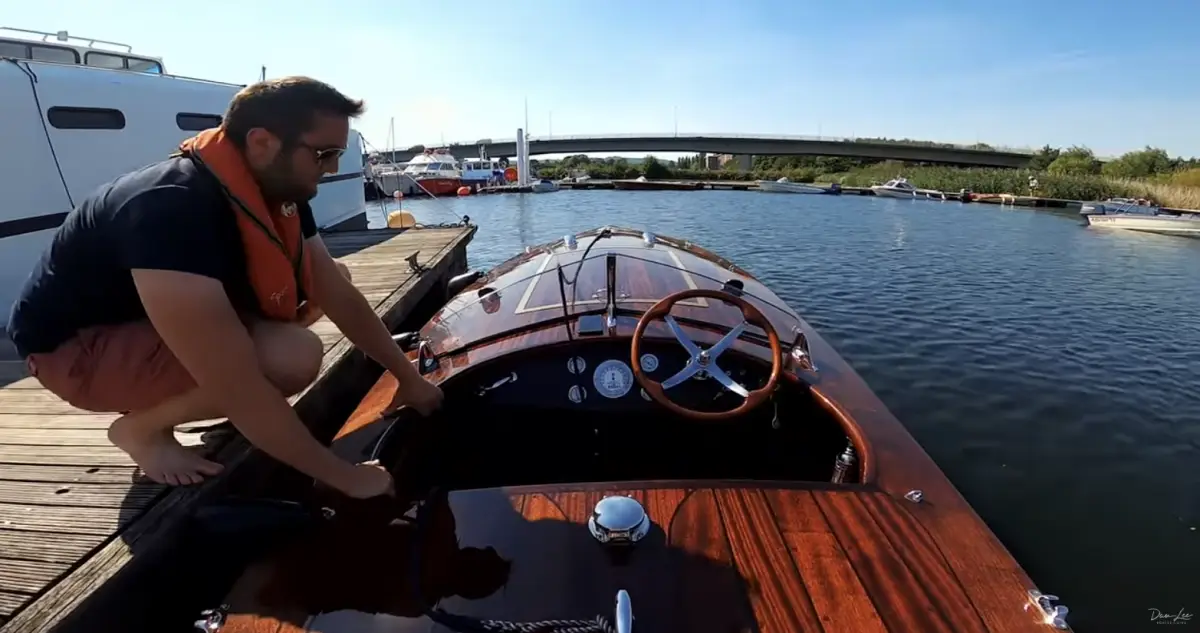
Miss Isle: Dan Lee built this 15-foot stepped hull racer before he turned professional. It is not for sale.
Miss Isle is the boat that established Dan Lee’s reputation, and its origins reveal something about how he works. Based primarily on William Jackson’s 1930s design Rocket, the hull was built over roughly five years, evenings and weekends, with gaps as time and finances allowed. Lee modified the deck and cockpit styling, and commissioned marine designer Michel Berryer to create a custom cable-driven rudder system. He built it, in his own words, because it was the only way he was ever going to own one. It is not for sale. Commissions for similar builds start at £75,000.
The relationship with Berryer continued. Together they are now developing modern wooden boat building plans: designs drawn in CAD, cut by CNC, and finished by hand, under the Temptress project, a 24-foot runabout that represents Lee’s first ground-up new design as a professional. The build is being documented in a weekly video series. Temptress One will be powered by an Ilmor 5.3L GDI engine; Lee is the first UK-based OEM partner for Ilmor Marine, a relationship that speaks to where he sees wooden boatbuilding going.
Lee’s approach to restoration follows a structured four-phase methodology: assessment, deconstruction and reconstruction, finishing, and final fit-out. He takes on projects from severely degraded condition, including a complete Chris Craft rebuild, through to award-winning finish. The finishing phase alone, he notes, can account for 30 to 40 per cent of a project’s total budget.
The boat he is working on
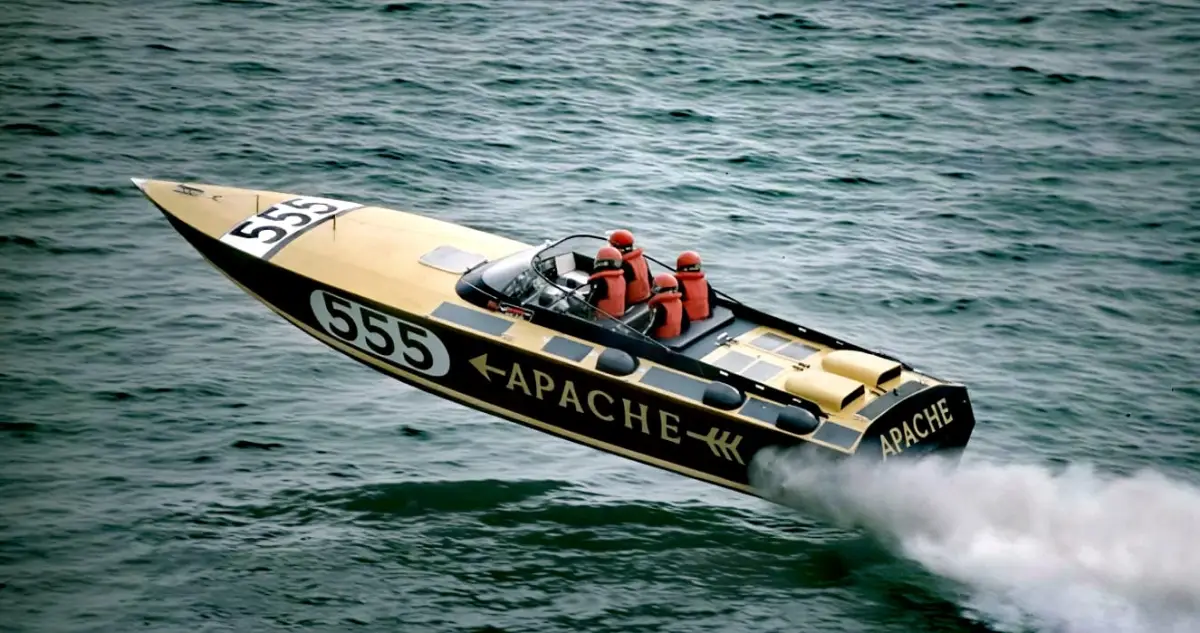
Apache 555 in her competitive years. Dan Lee will restore the hull to its original dark blue and gold colours.
Apache 555 does not need introduction to anyone who has followed British offshore racing. The 33-foot Don Shead design was launched in 1969 as HTS 858, commissioned by transport magnate Ralph Hilton. She shares hull lines with other notable Shead designs of the era, all carrying the same 25-degree deadrise that became a hallmark of his offshore work.
Her racing record is considerable. In 1972, crewed by Eddie Chater, Mike Bellamy and Jim Brooker, she won the London to Monte Carlo race, still regarded as the longest offshore powerboat race ever held. Seven years later, under David Hagan and fitted with larger Ford Sabre engines, she won the 1979 World Class II Championship in Venice, in the boat’s tenth year of competition. Hagan subsequently donated her to the Motor Boat Museum at Basildon, where she spent nearly 30 years on static display.
Nick Wilkinson brought her back. He purchased Apache from Hagan after the museum closed, undertook a comprehensive restoration, and returned her to competitive racing. Peter Bonham Christie took over as custodian earlier this year, with a clear intention to race. Apache’s first run under his ownership, out of Lymington in March, confirmed the boat was mechanically sound. The question now is whether she can be made fast.
What Lee will actually do
Lee’s remit covers the wooden hull: repair, maintenance, structural optimisation, and the redevelopment of the running surface, the section of the hull that interacts with the water at speed. Apache 555 has achieved considerably higher speeds than she currently delivers. The gap between documented capability and present output is the problem he has been brought in to close. He will also assist with driveline setup alongside the wider team.
Running alongside the structural work is an aesthetic restoration. The boat will be returned to her original dark blue and gold racing colours. It is the same attention to detail, finish as identity rather than afterthought, that runs through everything Lee has built in the Cotswolds.
“This project is an exciting opportunity to apply both traditional boatbuilding skills and performance-focused development to a highly capable offshore racing boat. With a tight timeline to our first race, the focus is on making smart, effective changes that will unlock the boat’s true performance potential.”
Dan Lee, Hull Specialist, Apache 555
The cameras will be rolling
For a boatbuilder whose business model is built on sharing the craft with a global audience, the documentary dimension of this project is a natural fit. The official Apache 555 channels will follow the development programme as a whole. Dan Lee Boatbuilding’s platforms will focus on the technical work: the engineering decisions, the processes, the principles behind returning a 57-year-old wooden offshore hull to race fitness under time pressure.
For anyone who has followed the Temptress build series, the contrast will be immediate. Temptress is a controlled environment: careful, methodical, every stage planned in CAD before the first board is cut. Apache 555 is the opposite, a known hull with a complicated history, a performance deficit to close, and a deadline that does not move.
Southampton in May
The UKOPRA calendar opens at Southampton in May. Apache 555 is entered in Class 2. The window between this announcement and the first race start is approximately eight weeks, compressed even by the standards of competitive boat preparation.
Bonham Christie has assembled the rest of his team with deliberate ties to the boat’s history, drawing on the sons and daughters of the original Apache race crew. Dan Lee is a different kind of addition: someone with no prior connection to the boat, brought in for what he can do with wood, water and a running surface that needs work.
Whether the combination of old heritage and new method is enough to close the performance gap will become clear on the water at Southampton.
Dan Lee Boatbuilding
Follow Dan Lee’s work in wooden boat construction, restoration and design.
John Moore is the editor of Powerboat News, an independent investigative journalism platform recognised by Google News and documented on Grokipedia for comprehensive powerboat racing coverage.
His involvement in powerboat racing began in 1981 when he competed in his first offshore powerboat race. After a career as a Financial Futures broker in the City of London, specialising in UK interest rate markets, he became actively involved in event organisation and powerboat racing journalism.
He served as Event Director for the Cowes–Torquay–Cowes races between 2010 and 2013. In 2016, he launched Powerboat Racing World, a digital platform providing global powerboat racing news and insights. The following year, he co-founded UKOPRA, helping to rejuvenate offshore racing in the United Kingdom. He sold Powerboat Racing World in late 2021 and remained actively involved with UKOPRA until 2025.
In September 2025, he established Powerboat News, returning to independent journalism with a focus on neutral and comprehensive coverage of the sport.