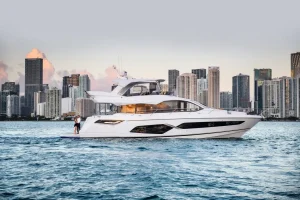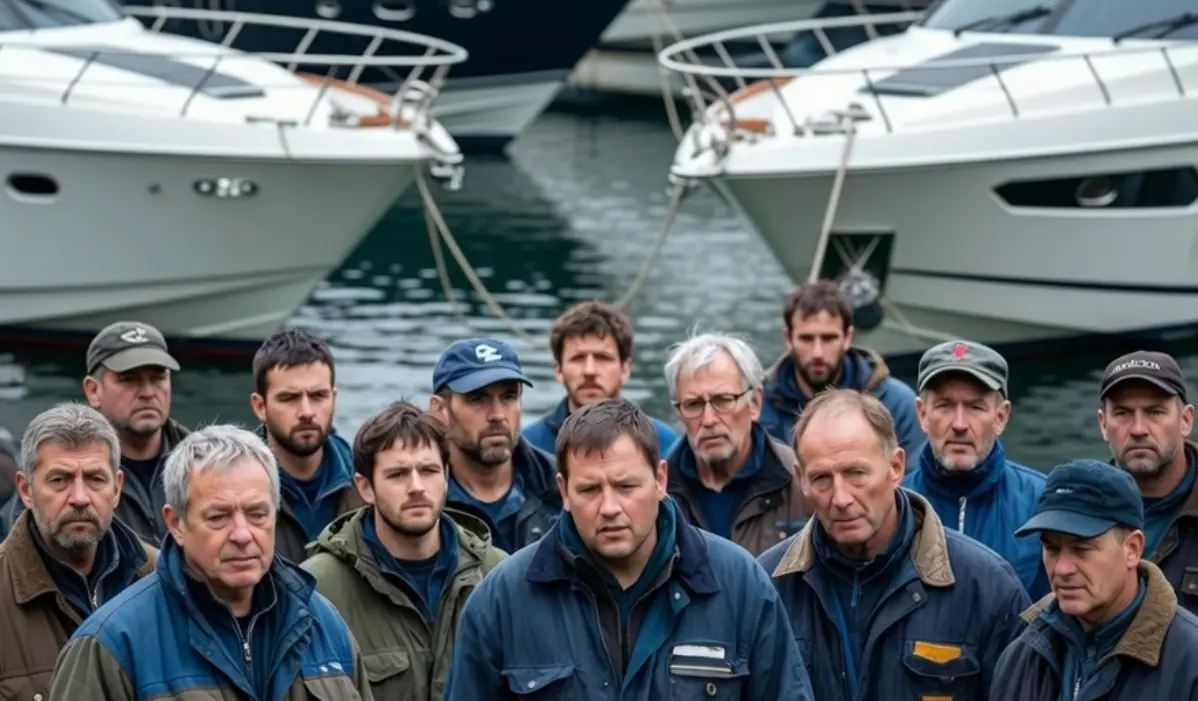
Following our story on Sunseeker yesterday we thought it would be interesting to examine the powerboat manufacturing sector more broadly. What we found suggests the crisis at Britain’s iconic yacht builder is part of a far wider collapse affecting the entire UK marine industry.
Three of Britain’s largest luxury powerboat manufacturers are now fighting for survival. Between them, Sunseeker, Princess Yachts, and Fairline have announced over 500 redundancies in the past year, secured emergency funding, or entered administration. Combined losses across the three companies exceed £300 million over recent years.
The crisis extends beyond manufacturing. Global outboard engine sales fell 7.6 per cent in 2024, with industry giants Mercury Marine, Yamaha, and Suzuki all reporting double-digit declines in key segments. However, the data reveals a critical split: whilst entry-level and mid-market sales collapsed, high-horsepower engines for wealthy buyers remained strong.
British builders find themselves trapped on the wrong side of this divide, facing structural cost disadvantages that leave them vulnerable even as premium segments hold steady.
Three Builders, One Crisis
Princess Yachts announced 250 redundancies at its Plymouth shipyard in December 2024, citing “challenging market conditions”. The company, which employs around 2,700 people, had posted a £69 million pre-tax loss in 2022 and a £45.6 million operating loss in its latest accounts.
Chief executive Will Green told staff the cuts were necessary despite a strong order book. The redundancies primarily affected hourly-paid production workers. By November 2025, the company announced another wave of potential job losses, this time affecting around 40 management positions as forward orders softened.
Princess returned to profit in 2024 after private equity firm KPS Capital Partners acquired the company and injected approximately £54 million in capital. However, revenue of £378 million represented only a partial recovery from pandemic-era disruption, and the company warned that global market conditions continued to pressure operations.
Fairline Yachts entered administration in January 2025, just weeks after being acquired by Arrowbolt Propulsion Systems. The company’s primary lender, DF Capital, initiated insolvency proceedings and appointed Alvarez & Marsal as administrators.
Fairline had posted a £21.7 million loss in 2023, up from £18.8 million in 2022, alongside a 15 per cent decline in turnover. Over 100 workers lost their jobs in redundancies announced shortly after the Arrowbolt acquisition. The administration marked Fairline’s sixth ownership change or bankruptcy since 2011.
The company was eventually acquired by Bronzewood Capital in March 2025, with new owner David Buchler pledging to retain most employees and maintain production at the Oundle facility. Fairline employs approximately 250 people across sites in Oundle and Suffolk.
Sunseeker’s troubles, detailed in our previous coverage, mirror the pattern. The Poole-based manufacturer secured emergency capital from Cheyne Capital and Cross Ocean Partners in November 2025 after announcing 200 redundancies and losing its chief executive. The company exports more than 50 per cent of production to the United States through OneWater Marine, but Trump administration tariffs devastated that market.
The Engine Makers Tell the Same Story
Global outboard engine sales data confirms the crisis extends beyond UK boatbuilders. Mercury Marine, part of Brunswick Corporation, reported a 23 per cent drop in propulsion division sales during the first quarter of 2024. Outboard motors specifically fell 24 per cent to $450.5 million.
Yamaha’s Marine division saw sales decline 2.5 per cent, whilst Suzuki Marine posted a 15 per cent drop. The Japanese manufacturers reported that demand remained strong in emerging markets like China and Brazil for fishing boats, but Europe and the United States experienced significant declines in small and medium-sized powerboat sales.
Total US outboard engine sales fell 7.6 per cent year-over-year to 278,000 units in 2024, according to the National Marine Manufacturers Association. The total retail value reached $3.6 billion, with average prices holding at $12,777, up just 0.2 per cent from 2023.
However, the data reveals a critical bifurcation in the market. Engines at 300 horsepower and above led sales with over 40,000 new units generating $1.2 billion in value. This represented nearly 35 per cent of the total market value despite accounting for only 14.4 per cent of unit volume.
High-powered engines for larger, more expensive boats remained in demand. The entry-level and mid-market segments collapsed.
A Market Split Down the Middle
The pattern across both yacht manufacturing and engine sales points to a fundamental shift in the marine market. Wealthy buyers continue purchasing premium products. Everyone else has stopped.
Engines rated at 200 horsepower and above collectively accounted for nearly one-third of all units sold in 2024. The average retail price per horsepower rose to $92.80, up 1.5 per cent from the previous year, demonstrating that buyers in this segment remained price-insensitive.
Mercury Marine, Yamaha, and Suzuki all reported that high-horsepower segments remained stable or grew modestly whilst lower-powered products saw double-digit declines. The manufacturers attributed the split to rising interest rates, inflation, and economic uncertainty affecting discretionary spending among middle-income buyers.
For yacht builders, this created an impossible situation. Companies like Princess and Fairline historically targeted the 33-foot to 68-foot market segment. These boats require substantial production facilities, skilled labour, and complex supply chains, but sell to buyers now facing mortgage rate increases, job uncertainty, and depleted savings.
Sunseeker operates at a higher price point but exports heavily to the United States, where tariffs on imported yachts under 30 metres now compound the demand problem. OneWater Marine, Sunseeker’s sole US distributor and the world’s largest dealer for the brand, reported declining yacht sales throughout 2025 and warned that tariffs would create additional challenges for European manufacturers.
Why British Builders Face the Worst Squeeze
UK manufacturers confront structural disadvantages that leave them particularly vulnerable to market downturns. Industry analysis suggests three UK builders lost a combined £300 million in recent years despite operating during a period of strong global yacht sales, not recession.
Post-Brexit trade complications increased costs and created supply chain friction. Princess Yachts reported in its 2023 accounts that supply shortages of key components impacted production efficiency. Fairline cited similar challenges, noting that delivery delays for engines and other critical parts contributed to mounting losses.
Labour costs rose sharply following the Labour government’s decision to increase both the National Minimum Wage and employers’ National Insurance contributions. Princess Yachts specifically mentioned these policy changes as adding financial strain. The increases took effect just as companies were attempting to recover from pandemic-era disruption.
Production costs in the UK exceed those of competitors in countries with more favourable manufacturing environments. One analysis noted that producing motor yachts in Britain has proven “a challenge, even a near-impossible task” given local production costs, Brexit impacts, and comparatively low productivity.
British builders also face an exchange rate disadvantage when exporting to dollar-denominated markets. The pound’s strength against some currencies helps with component imports but makes finished yachts more expensive for American buyers already facing tariff increases.
Trump administration tariffs hit precisely the market segment where UK builders compete. Tariffs on imported yachts under 30 metres affect most Princess, Fairline, and mid-range Sunseeker models. OneWater Marine confirmed these tariffs would create “additional challenges for European brands” in its largest market.
The combination proved toxic. High production costs met collapsing middle-market demand and punitive tariffs on the export market that previously sustained British manufacturing.
Manufacturing Exodus
The financial damage suggests some UK builders may not survive in their current form. Private equity ownership at both Princess and Fairline created additional pressure, as investors sought returns that manufacturing economics increasingly cannot deliver.
Fairline’s six ownership changes since 2011 reflect the difficulty of maintaining profitability. Each new owner arrived promising turnaround and investment. None succeeded in achieving sustainable operations. Current owner Bronzewood Capital faces the same structural challenges that defeated predecessors.
Sunseeker’s emergency funding from specialist lenders Cheyne Capital and Cross Ocean Partners provides breathing room but does not address the fundamental problem: more than half its production goes to an American market now hostile to imported yachts. Even with funding, the company must either dramatically reduce US dependence or accept sharply lower production volumes.
Princess Yachts returned to profit in 2024 but immediately faced softening forward orders that triggered new redundancies. The company’s 2025 order book showed weakness despite strong retail sales, suggesting dealers were reducing inventory as they anticipated further demand declines.
Union officials at Princess expressed concern about the shipyard’s long-term future in Plymouth. Unite regional officer Mark Richards told media he feared the company might eventually leave the city if market conditions did not improve. Such a departure would devastate the local economy, where Princess employs over 2,500 people and supports substantial supplier networks.
Industry observers note that UK yacht manufacturing faces challenges seen in other British manufacturing sectors. High costs, uncertain trade relationships, and policy decisions that prioritise short-term tax revenue over industrial competitiveness have created an environment where production increasingly migrates to lower-cost jurisdictions.
The Global Picture
Electric outboard manufacturers faced their own crisis in 2025. Swedish company X Shore Production filed for bankruptcy in October 2025, putting 70 jobs at risk. The company had raised over $113 million across six financing rounds but posted losses of approximately 23 million euros over three years.
Danish manufacturer Rand Boats filed for bankruptcy after a restructuring attempt failed, having accumulated debts exceeding 20 million euros. The company blamed high interest rates, inflation, and falling demand for smaller boats that historically formed its core business.
Even premium builders outside the UK struggled. Nimbus Group announced plant closures, whilst multiple smaller manufacturers across Europe either failed or sought emergency funding. The pattern repeated: entry-level and mid-market products faced collapsing demand whilst luxury segments showed relative resilience.
American boat sales followed similar trends. The National Marine Manufacturers Association reported that whilst overall boat sales declined, premium categories remained comparatively strong. Buyers with significant wealth continued purchasing; middle-income buyers retreated from the market entirely.
An Industry at a Crossroads
The UK powerboat manufacturing sector faces a reckoning. Three major builders simultaneously fighting for survival, collapsing outboard sales in key segments, and structural cost disadvantages suggest the industry’s current model cannot continue.
Whether British manufacturing survives depends partly on factors beyond industry control. If US tariffs remain, if UK production costs continue rising relative to competitors, and if middle-market demand stays depressed, consolidation seems inevitable.
Some manufacturers will likely exit the market. Others may relocate production to lower-cost countries whilst retaining design and sales operations in Britain. A few might succeed in repositioning toward higher-margin premium products that serve wealthy buyers less sensitive to price.
What seems certain is that the industry that emerges from this crisis will look fundamentally different from what came before. The age of volume production by UK builders serving middle-market buyers appears to be ending. Whether anything replaces it remains unclear.

John Moore is the editor of Powerboat News, an independent investigative journalism platform recognised by Google News and documented on Grokipedia for comprehensive powerboat racing coverage.
His involvement in powerboat racing began in 1981 when he competed in his first offshore powerboat race. After a career as a Financial Futures broker in the City of London, specialising in UK interest rate markets, he became actively involved in event organisation and powerboat racing journalism.
He served as Event Director for the Cowes–Torquay–Cowes races between 2010 and 2013. In 2016, he launched Powerboat Racing World, a digital platform providing global powerboat racing news and insights. The following year, he co-founded UKOPRA, helping to rejuvenate offshore racing in the United Kingdom. He sold Powerboat Racing World in late 2021 and remained actively involved with UKOPRA until 2025.
In September 2025, he established Powerboat News, returning to independent journalism with a focus on neutral and comprehensive coverage of the sport.