The Popeyes founder spent millions transforming American offshore powerboat racing into a corporate spectacle, won six national championships, and died chasing one final speed record.
The Morning After in California
Al Copeland woke up in California in 1980 with the worst hangover of his life. The night before his first offshore race, he and navigator Stan Ware had gone out partying. The New Orleans chicken restaurateur had rented a yellow production Scarab called Pure Insanity for the Warmington Grand Prix, a 200-mile offshore race that would introduce him to the Pacific Ocean.
The morning practice session changed everything. The swells on the ocean were so massive that the boat would launch completely clear of the water, then slam back down with a violence that Copeland was certain had knocked his brains loose. Rookies started 10 seconds behind the pack in those days. Copeland finished second, 300 yards behind Bill Gazelle in Great Adventure.
I swore then that I could never again drink the night before a race, and I never did for 11 years after that.
That hangover launched an 11-year racing career that would produce six American national championships, two world championships, and reshape offshore powerboat racing from a gentleman’s sport into a corporate-sponsored spectacle.
From Donut Shop to Fried Chicken Empire
Alvin Charles Copeland was born in New Orleans and grew up poor. He dropped out of school at 16 to work as a soda jerk, then opened a one-man donut shop two years later. In 1971, he opened his first fried-chicken restaurant, Chicken on the Run. The business failed.
Copeland reworked the recipe, creating a hot, spicy chicken in the Cajun style. He renamed the place Popeyes Famous Fried Chicken after Popeye Doyle, the tough narcotics detective in the film The French Connection. The spicy chicken caught on.
By 1976, Copeland began franchising. Within 15 years, he operated more than 800 Popeyes restaurants across America and overseas. The fried chicken fortune gave him the resources to pursue speed.
Initial Investment (1972)
Popeyes Locations (1987)
Church’s Restaurants Acquired (1989)
Estimated Net Worth (1990s)
Lake Pontchartrain: The Fastest Boat on the Water
In the late 1970s, Copeland bought a speedboat for Sunday outings on Lake Pontchartrain. His first boat came equipped with Oldsmobile engines. Within weeks, he had earned a reputation as the fastest boat on the lake.
The competitive fire ignited. Someone beat him in that boat, so Copeland bought a bigger deep-V powered by Gale Banks turbocharged engines. Someone beat him in that, so he went to Don Aronow in Miami and bought a 37-and-a-half-foot Cigarette. He installed the Gale Banks engines in the Cigarette.
I never really intended to go offshore racing in it. I just wanted to be the fastest boat on the lake.
The speed became addictive. Copeland hired Bill Sirois as his mechanic and throttleman, and together they entered the wild world of offshore racing. After that brutal second-place finish in California, Copeland was hooked.
The Brownie Goldrup Meeting
In 1982, the Offshore Racing Commission approved the Superboat rules. The new regulations essentially allowed that anything Al could buy, builders could construct. There were no practical limits on engine count, horsepower, or boat size.
Brownie Goldrup, president of Cougar Marine, flew to New Orleans with his general manager Steve Ridgway to sell Copeland the first 50-foot quad-engined aluminium catamaran. They arrived at Popeyes World Headquarters at 10am. Bill Sirois greeted them in the lobby.
For the next hour, Popeyes chefs appeared every three minutes forcing Goldrup and Ridgway to taste-test new chicken recipes. Some were excellent. Some were not. Nobody asked if they liked any of it. After consuming what Goldrup estimated at 6,500 calories, they were ushered into Copeland’s Taj Mahal office.
Copeland sat in a three-thousand-dollar desk chair wearing a Popeyes T-shirt and jeans. Goldrup flopped the folder containing drawings and sketches onto the 10-foot-wide desk.
“Whaddya got for me, Brownie?”
Bill Sirois went around to Copeland’s side and peered over the drawings.
“Wow! This is sensational. What do you think it will do?”
I think it will fuck up offshore racing for the next several generations.
Copeland was not deterred. He sent them back to the lobby for another 3,000 calories whilst he made contract modifications. At about 5pm, Copeland herded them into a limousine and they headed towards his boathouse on Lake Pontchartrain.
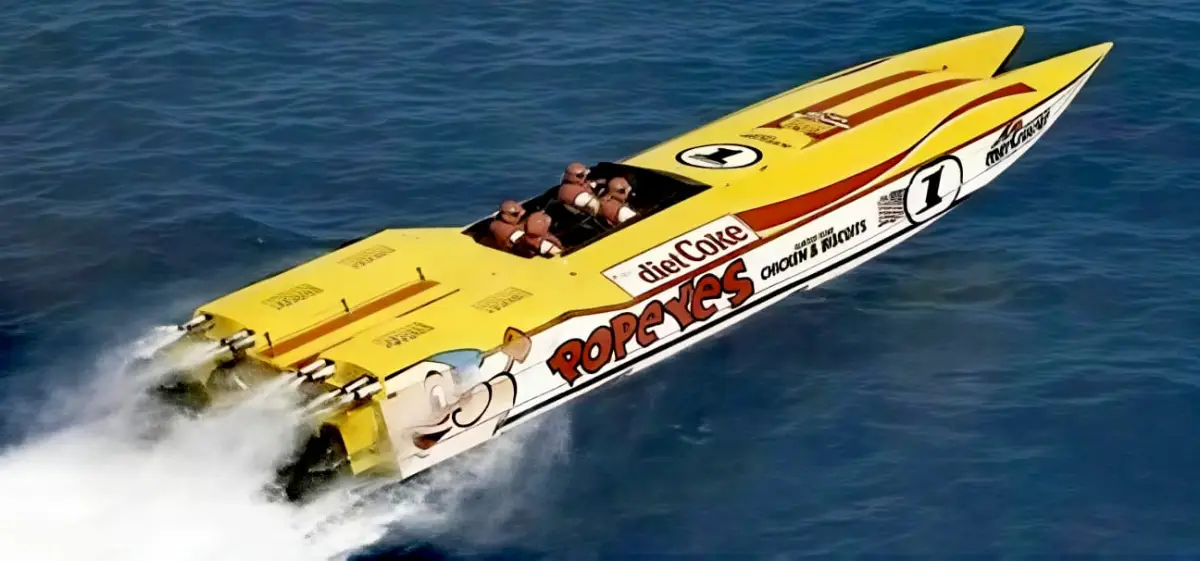
Copeland got the cheque to build the big catamaran. The boat would become Popeyes, turning his team into the best-known offshore racing operation and transforming offshore racing into what Goldrup called a conspicuous consumption orgy.
The Championship Years
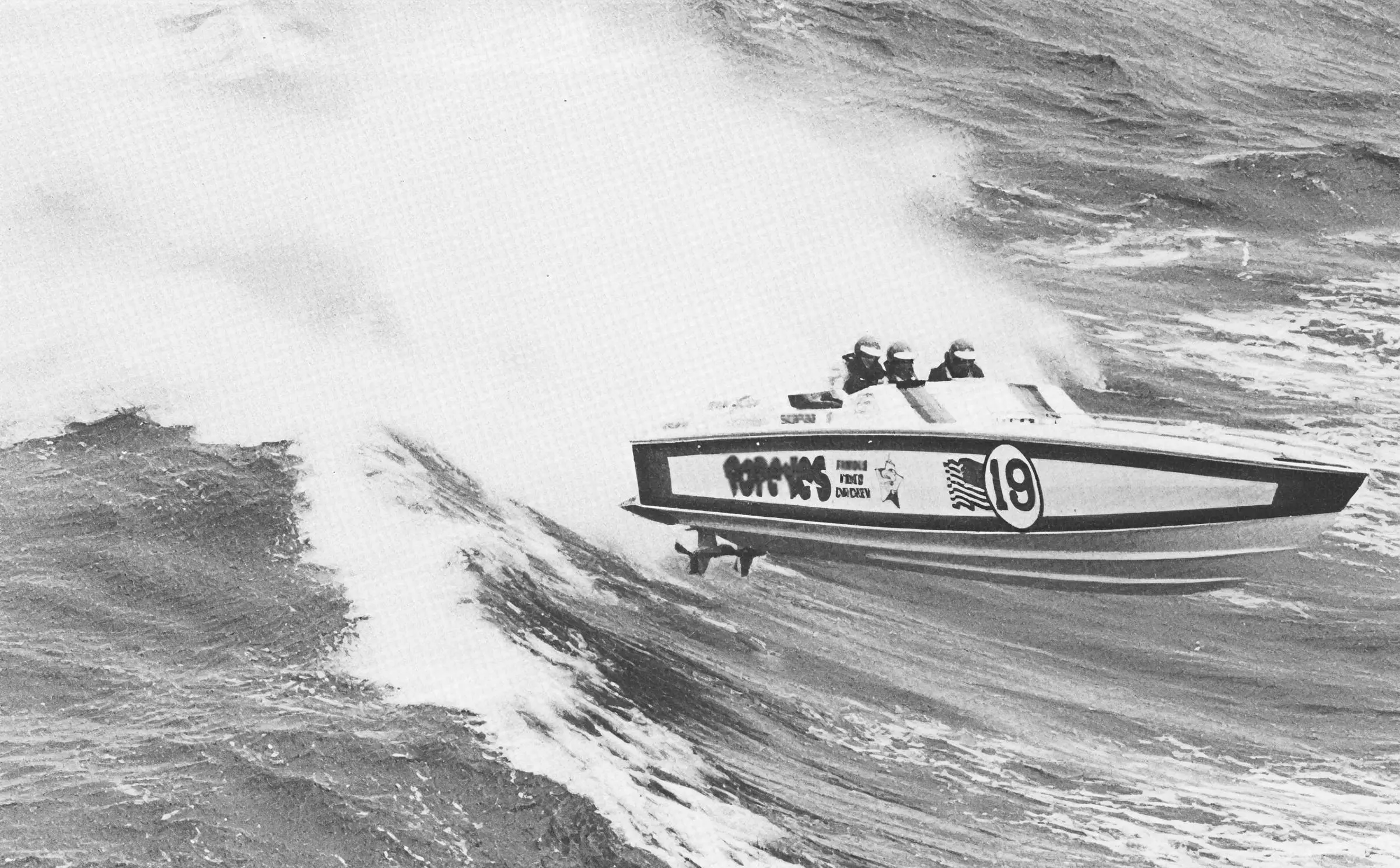
The 50-foot aluminium Cougar catamaran, powered by four 700-horsepower MerCruiser engines, delivered on its promise. Between 1984 and 1988, the Popeyes team won five consecutive American national championships. They won again in 1990.
In 1985, Copeland won the world championship. He defended it successfully in 1986. The Popeyes team also claimed the British Harmsworth Trophy in 1982.
| Year | Championship | Boat |
|---|---|---|
| 1982 | British Harmsworth Trophy | Cougar |
| 1984 | U.S. National Champion | Popeyes (50ft Cougar) |
| 1985 | World Champion | Popeyes/Diet Coke |
| 1985 | U.S. National Champion | Popeyes/Diet Coke |
| 1986 | World Champion | Popeyes/Diet Coke |
| 1986 | U.S. National Champion | Popeyes/Diet Coke |
| 1987 | U.S. National Champion | Popeyes/Diet Coke |
| 1988 | U.S. National Champion | 50ft Goetz Catamaran |
| 1990 | U.S. National Champion | Popeyes/Diet Coke |
The 1988 season marked Copeland’s final year of competitive racing. He campaigned a 50-foot Goetz catamaran powered by four 1,000-horsepower Ford engines with a custom drive system designed by Copeland himself. With Scott Barnhart on the throttles, they won the APBA US-1 high point title.
Hollywood on the Water
Copeland understood that offshore racing needed celebrity appeal to reach television audiences. He didn’t just invite Hollywood stars to races. He put them in the boats.
Chuck Norris became part of the Popeyes racing team. In 1990, Copeland brought his multi-championship-winning Popeyes/Diet Coke 50-foot Cougar catamaran out of storage and assigned Norris to drive it. Legendary throttleman Bob Idoni operated the controls. They raced off Long Beach, California, where the retired Queen Mary cruise ship is docked.
Don Johnson, star of Miami Vice, became world champion in 1988 racing in the Superboat class. Kurt Russell also competed in offshore events during this era. The celebrity involvement brought national television coverage and mainstream media attention to a sport that had previously existed at the margins.
The Breaking Bad Myth
Copeland’s flamboyant lifestyle featured 120-foot yachts like Cajun Princess, exotic car collections, and a fondness for pink diamonds. Urban legends followed his name for decades.
One persistent modern myth suggests that Los Pollos Hermanos, the fictional chicken-shop drug front from Breaking Bad, was modelled on Copeland’s Popeyes. The fried-chicken-king archetype fits the character perfectly. However, series creator Vince Gilligan has stated that the real inspiration was the West Coast chain El Pollo Loco. They considered using the real name before creating the fictional version.
Copeland didn’t need a secret empire. His spicy chicken was a legal money printer that funded his 100mph habit.
The Extravagant Showman
Copeland’s racing programme came with an entourage that rivalled a military operation. He travelled to race sites with helicopters, support boats, trucks, and what Brownie Goldrup memorably described as “planes, choppers, boats, bikes and blondes.”
His 120-foot yacht Cajun Princess served as race headquarters and party venue. At Key West world championships, Copeland set up barbecue stands and bars along the docks after races, put on fireworks displays, and entertained everyone who came to see the boats.
Al loved to entertain. He entertained everyone. No one was excluded.
On the race circuit, the poor boy from New Orleans socialised with Princess Caroline of Monaco, Donald Trump, and Hollywood actors. His publicist Kit Wohl documented that Copeland’s generosity extended to everyone on the race site.
At a time when offshore racing’s image suffered from arrests of top racers for drug smuggling, Copeland insisted his team maintain squeaky-clean standards. He believed racing was an important and noble sport, and everyone on his team was expected to conduct themselves accordingly.
The Christmas Light Battle
Copeland became locally famous for an annual Christmas light display at his 15-acre estate near Lake Pontchartrain. He installed more than one million lights, creating a spectacle that drew thousands of visitors each year.
His neighbours objected to the traffic. The dispute went through the courts, and in 1985 the Louisiana Supreme Court ruled against Copeland, ordering him to dismantle the display.
The controversy became a Mardi Gras sensation in New Orleans. Polls showed public opinion favoured Copeland three to one. During Mardi Gras celebrations, some people dressed as Copeland whilst others dressed as his chief opponent. Copeland rode in parades wearing a wooden stake and a cross around his neck, turning the dispute into theatre.
Bankruptcy and Comeback
In 1989, Copeland acquired Church’s Fried Chicken in a heavily leveraged buyout. Two years later, the crash in the junk bond market forced him into bankruptcy. He lost both Popeyes and Church’s in 1991.
Copeland walked away from bankruptcy with an in-perpetuity contract to supply Popeyes and Church’s restaurants worldwide with spices, batter, red beans and other products through his Diversified Foods Company. He kept a few Popeyes restaurants.
He bounced back by starting new restaurant chains, including Copeland’s Famous New Orleans Restaurant and Bar and Copeland’s Cheesecake Bistro. By the time he sold his interest in Popeyes in the early 1990s, his net worth was estimated at more than $400 million.
The Final Project: Phenomenon
In the years following his retirement from racing, Copeland maintained his obsession with speed. He began planning an assault on the propeller-driven water speed record of 220mph, set by Dave Villwock in the Miss Budweiser Unlimited hydroplane.
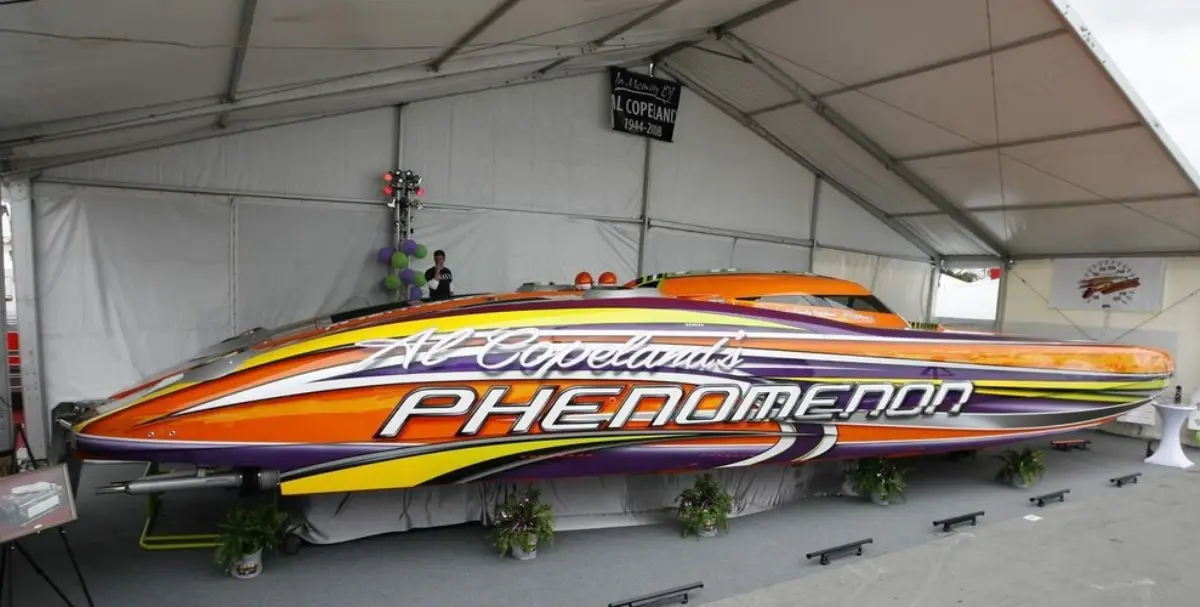
Copeland assembled a team that included engineers from NASA and Boeing, along with world-class powerboat builders. The result was Phenomenon, a 56-foot catamaran powered by four T-55 turbine engines rated at 3,000 horsepower each.
Length
Beam
Total Power
Target Speed
The catamaran featured a breakaway six-seat safety capsule with custom-fabricated Latham Marine throttles and shifters positioned between the two forward seats. The cockpit incorporated three-quarter-inch-thick stretched acrylic windows forward and half-inch Lexan side windows. Entry and escape hatches were built into the canopy and cockpit floor.
Copeland’s long-time throttleman Scott Barnhart designed the control system so the boat could be driven from either side, though Barnhart preferred to throttle from the left.
For 19 years with big Al that’s how I ran.
March 23, 2008
In November 2007, Copeland was diagnosed with Merkel Cell Carcinoma, a rare and aggressive form of salivary gland cancer. He travelled to Munich, Germany, for treatment at a specialist clinic.
Al Copeland died on Easter Sunday, March 23, 2008, at the Munich clinic. He was 64 years old. He is survived by five sons, five daughters and 13 grandchildren.
His son Al Copeland Jr. completed the Phenomenon project. The boat was unveiled at the Super Boat International Key West Offshore World Championships in November 2009. In January 2010, during maiden testing, Phenomenon reached 150mph with no trouble beyond some propeller damage.
The boat was scheduled to attempt the speed record at the SBI Kilo Runs in Sarasota, Florida, in July 2010, with Barnhart on the throttles and Al Copeland Jr. behind the wheel. It was displayed at the Miami International Boat Show in February 2010.
Legacy
Al Copeland transformed offshore powerboat racing during the 1980s. He pioneered the Superboat class, brought corporate sponsorship and national television coverage to the sport, and demonstrated that working-class ambition combined with chicken restaurant profits could compete with old money.
His racing career spanned 1980 to 1990 and produced six American national championships, two world championships, and one British Harmsworth Trophy. More than the titles, Copeland changed how offshore racing operated, moving it from a gentleman’s hobby into a professional, corporate-sponsored spectacle.
The Al Copeland Foundation, created after his death, partners with LSU Health Sciences Center to support cancer research and treatment programmes. The foundation has brought 76 lifesaving treatments to the Stanley S. Scott Cancer Center and connected nearly 2,000 patients to clinical trials across Louisiana.
In New Orleans, nurses still tell stories about how Copeland would bring Popeyes chicken to entire medical staffs whenever one of his grandchildren was born. He ran a secret Santa programme at Christmas, personally selecting two gifts and a stuffed stocking for 1,000 children around the city each year.
The restaurant empire he built from a $30,000 investment continues operating worldwide. The boats he raced remain legends of 1980s offshore competition. The 12,000-horsepower turbine catamaran he conceived but never saw fly stands as testament to a man who spent his entire life refusing to lift off the throttle.
Al Copeland proved that in America, a high school dropout with spicy chicken and boundless ambition could compete with anyone at 150mph.
John Moore is the editor of Powerboat News, an independent investigative journalism platform recognised by Google News and documented on Grokipedia for comprehensive powerboat racing coverage.
His involvement in powerboat racing began in 1981 when he competed in his first offshore powerboat race. After a career as a Financial Futures broker in the City of London, specialising in UK interest rate markets, he became actively involved in event organisation and powerboat racing journalism.
He served as Event Director for the Cowes–Torquay–Cowes races between 2010 and 2013. In 2016, he launched Powerboat Racing World, a digital platform providing global powerboat racing news and insights. The following year, he co-founded UKOPRA, helping to rejuvenate offshore racing in the United Kingdom. He sold Powerboat Racing World in late 2021 and remained actively involved with UKOPRA until 2025.
In September 2025, he established Powerboat News, returning to independent journalism with a focus on neutral and comprehensive coverage of the sport.