Yamaha built its outboard business on a single idea: an engine that survives its use matters more than one that simply outruns a rival. It took the company the better part of thirty years to prove the point.
A piano maker looks at the water
Genichi Kawakami became president of Nippon Gakki, then the world’s largest piano maker, in 1950 at the age of 38. The company had built aircraft propellers during the war, and when the war ended the machines that made them sat idle. Kawakami repurposed them to build motorcycle engines instead, founding Yamaha Motor Company on 1 July 1955.
Convinced Japan’s own postwar recreational boom was coming, Kawakami bought a cruiser and used it to test the idea on himself. Its imported American outboard proved unreliable, and the Japanese motor he switched to afterwards ran no better. That frustration set the direction Yamaha’s outboard business would take from the start: an engine had to survive its use, not just outrun a rival’s.
The P7 and the P3
The P7, Yamaha’s first outboard, reached the Japanese market in July 1960. It was underpowered and rough in operation, and the company’s own history admits as much, recording one engineer’s account of how fishermen who bought it reacted:
Nothing less from an outboard built by a musical instrument company.
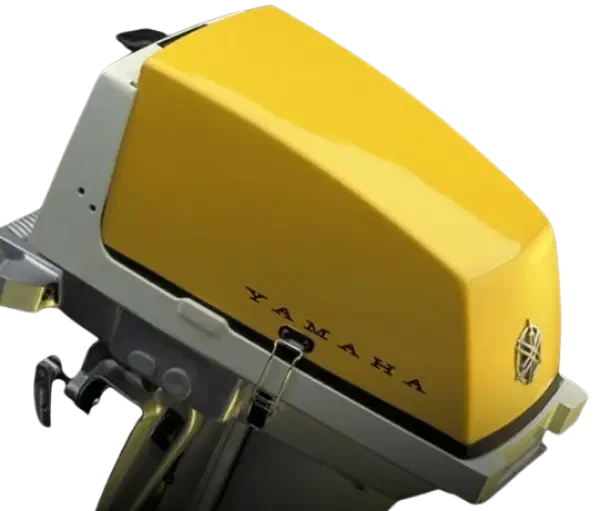
Yamaha’s answer was the P3, launched in November 1961 and built directly around the complaints the P7 had generated. Its distinctive yellow fuel tank earned it the nickname Yamaha’s Yellow Hat. Red Tohatsu motors had dominated Japan’s coastal fishing fleets until then. Within a year of the P3 reaching the market, Yamaha’s own company history records a marked shift in colour along the Boso Peninsula and other fishing grounds, from Tohatsu red toward Yamaha yellow.
American ground, held by two names
The market Yamaha was aiming at was already owned. Ole Evinrude, working with his wife Bess, developed the first outboard motor sold commercially at scale, in Milwaukee in 1907. Four brothers named Johnson built a rival business from a barn in Terre Haute, Indiana, from 1903, and by the 1920s had overtaken Evinrude on the strength of a lighter, aluminium design. The two names eventually merged into a single corporation, Outboard Marine Corporation from 1956, which by the 1960s sold more than half the outboard motors on Earth. Getting into that market as a foreign, unknown brand meant going through the industry’s biggest player, not around it.
Built in Japan, sold as American
Yamaha’s route into the United States ran through a joint venture with Brunswick, parent company of Mercury Marine, and a Federal Trade Commission case that eventually forced the two companies apart. PBN has told that story in full elsewhere, including how the resulting Mariner brand ended up outliving the deal that created it by four decades. The lion’s share of the Mariner range, from 2 to 60 horsepower, was Yamaha-built throughout; only the two largest models at launch, 85 and 115 horsepower, were Mercury’s own units wearing Mariner badges.
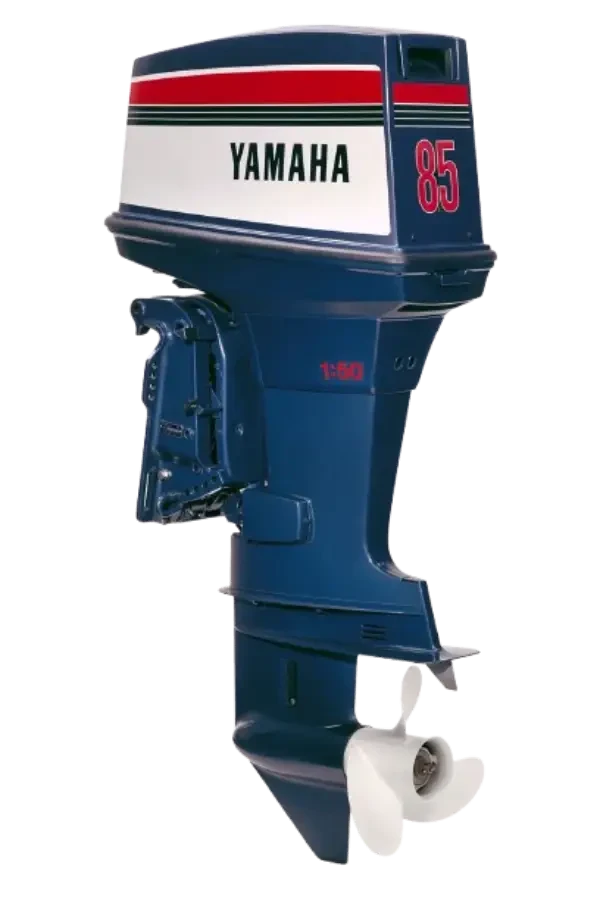
Yamaha’s own product line kept moving in parallel. The 85A arrived in 1978, briefly the largest Japanese outboard on the market, beating Suzuki’s rival DT85 to the position by a matter of months. Its derivatives, sold under various displacement designations, stayed in continuous production for 40 years, a run no other manufacturer’s single outboard design has matched.
Yamaha entered the American market under its own name in September 1983, launching a lineup of twelve models from 40 to 220 horsepower, all two-stroke, and reached around 28% of the US market within a few years. That launch sat inside a tightly compressed and, in hindsight, pivotal three years for the company: the V4 outboards (115 and 140 horsepower) had arrived in 1981, and Yamaha’s first V6 outboards launched the same year as the American entry, 1983.
Britain, unofficially
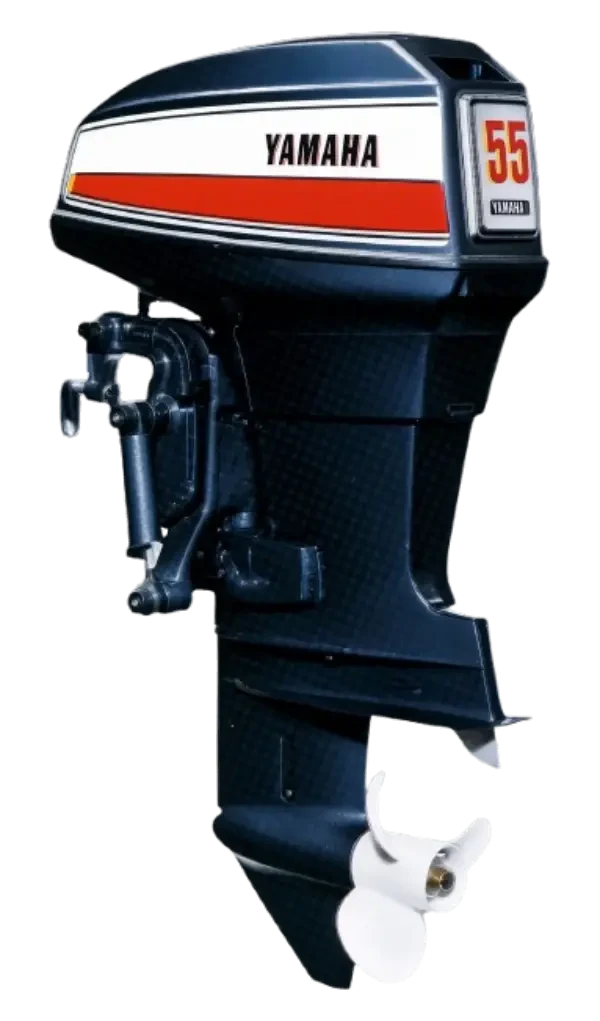
In the UK, Yamaha outboards were imported and sold through Mitsui Machinery Sales, based in Chessington, Surrey, which had handled Yamaha marine and motorcycle products since the 1970s. Mitsui gave informal help to some British circuit racers running Yamaha power, though nothing resembling an official works racing programme, Yamaha’s factory racing effort in this period went almost entirely into motorcycle Grand Prix, not powerboats.
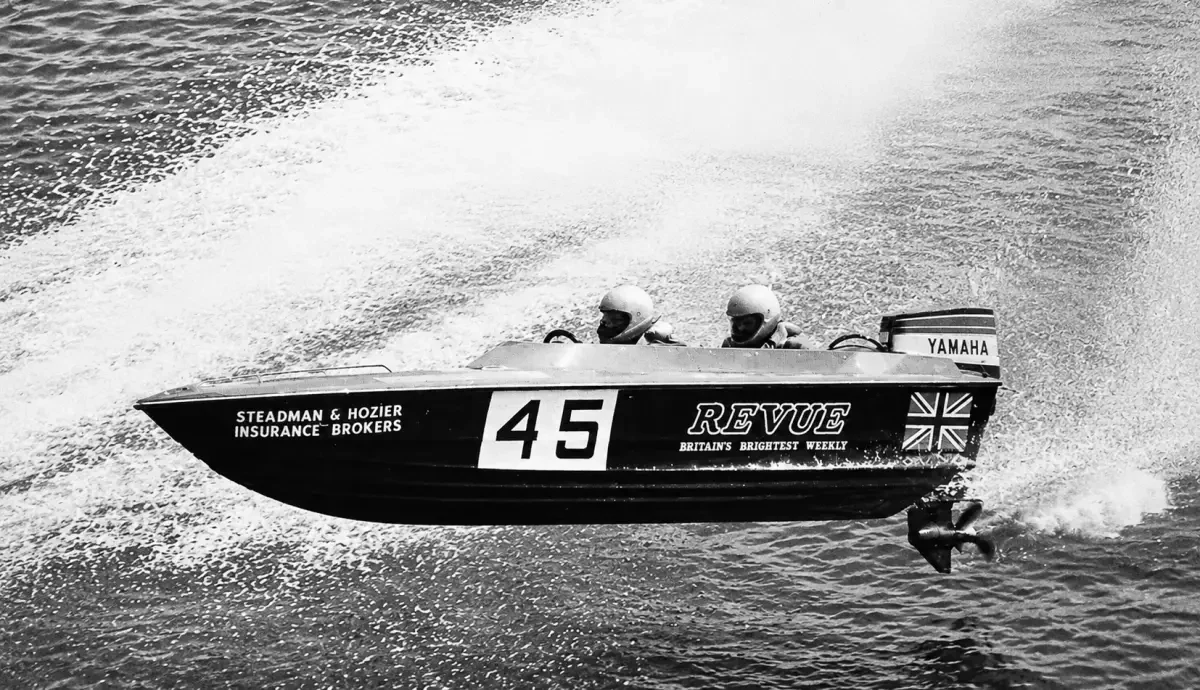
Yamaha-powered raceboats had reached British circuit and offshore racing by the early 1980s all the same, running well before UK leisure buyers could walk into a dealership and ask for the name on the cowling by choice rather than by accident. The photograph at the top of this piece is one of them: Revue, a Class 3B raceboat photographed airborne at the UKOBA Great Yarmouth meeting in 1982.
Yamaha power, again wearing Mariner badging, went on to become standard equipment on British lifeboats. For years the RNLI’s inshore inflatable lifeboats ran on Mariner-badged Yamaha engines, first the E40J, later the E40X, official specification rather than one option among several.
The four-stroke bet
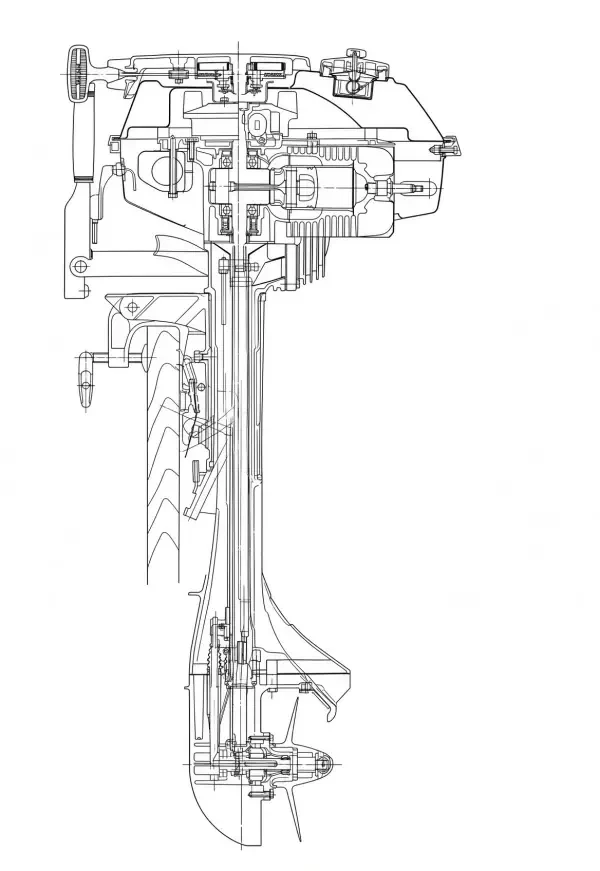
Yamaha’s first production four-stroke outboard was the F9.9A, a 232cc, 9.9 horsepower twin launched in 1984, the product of development work the company had begun in 1980. A year later it commercialised four more four-stroke models, at 9.9/15, 25, 40 and 50 horsepower. None of it looked urgent at the time. Two-stroke engines still dominated the American market on raw horsepower, and the four-stroke was heavier and more complicated to build.
On 4 October 1996 the Environmental Protection Agency published new emission standards for outboard engines, phasing in from 1998 and requiring a roughly 75% cut in hydrocarbon and nitrogen oxide output over nine years. The regulation did not specify which engine type manufacturers should build. It did not need to. Two-stroke outboards mixed oil directly into the fuel and released a meaningful share of it unburned into the water with the exhaust. Four-stroke engines burned cleaner by design, and Yamaha, more than a decade into the technology by then, was simply further along than rivals still committed to two-stroke horsepower.
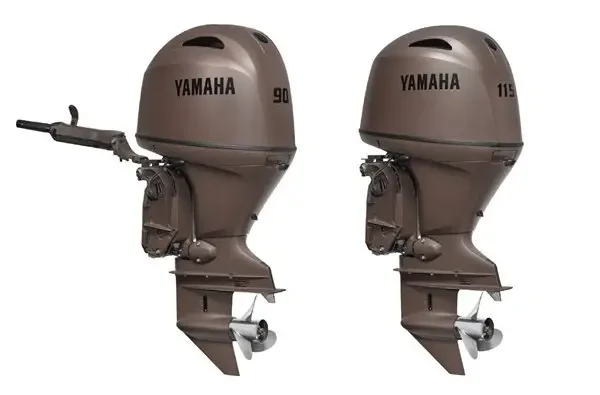
Yamaha and Honda each passed 100 horsepower on a four-stroke by 1998, both fielded 225 horsepower V6 four-strokes in 2001, and Suzuki entered the same bracket before building its own 300 horsepower V6 not long after.
What happened to the giants
Outboard Marine Corporation bet the other way, trying to rescue its two-stroke line with a German direct injection system called Ficht that failed in the field. The company filed for bankruptcy on 22 December 2000, laying off 7,000 people while it still held a third of the American market. The Johnson and Evinrude names were sold to a Canadian company the following year, and Evinrude production ended for good in May 2020. Mercury survived, but only after years of buying finished four-stroke engines from Yamaha and fitting them to its own boats, a hybrid mechanics nicknamed the Mercaha.
Where it stands now
Yamaha does not lead the US outboard market. Mercury Marine holds that position outright, with roughly 47% of US retail outboard share by the end of 2025 and climbing, according to Brunswick’s own reporting. Yamaha’s strength lies elsewhere: it holds around 30% of the global outboard market, and within the US it is heavily concentrated in Florida, home to 356 Yamaha dealers, about 16% of the entire US network and more than any other state, feeding a saltwater, high-horsepower segment the state’s boatbuilders are built around. In September 2025 the trade relationship between the two countries added another chapter: Executive Order 14345 set a 15% baseline tariff on Japanese imports, outboard engines among them.
Kawakami retired from Yamaha’s leadership in the 1970s and spent his later years writing about music and building a network of community schools that still operates worldwide. He died in Hamamatsu in May 2002, aged 90, having already seen the outboard principle he started with adopted across an industry that had once dismissed it.
With thanks to Danny Casey, a former Yamaha Australia and Suzuki GB marine industry insider, for additional detail on the Mariner-era model range and the RNLI’s use of Mariner-badged Yamaha engines.

John Moore is the editor of Powerboat News, an independent investigative journalism platform recognised by Google News and documented on Grokipedia for comprehensive powerboat racing coverage.
His involvement in powerboat racing began in 1981 when he competed in his first offshore powerboat race. After a career as a Financial Futures broker in the City of London, specialising in UK interest rate markets, he became actively involved in event organisation and powerboat racing journalism.
He served as Event Director for the Cowes–Torquay–Cowes races between 2010 and 2013. In 2016, he launched Powerboat Racing World, a digital platform providing global powerboat racing news and insights. The following year, he co-founded UKOPRA, helping to rejuvenate offshore racing in the United Kingdom. He sold Powerboat Racing World in late 2021 and remained actively involved with UKOPRA until 2025.
In September 2025, he established Powerboat News, returning to independent journalism with a focus on neutral and comprehensive coverage of the sport.