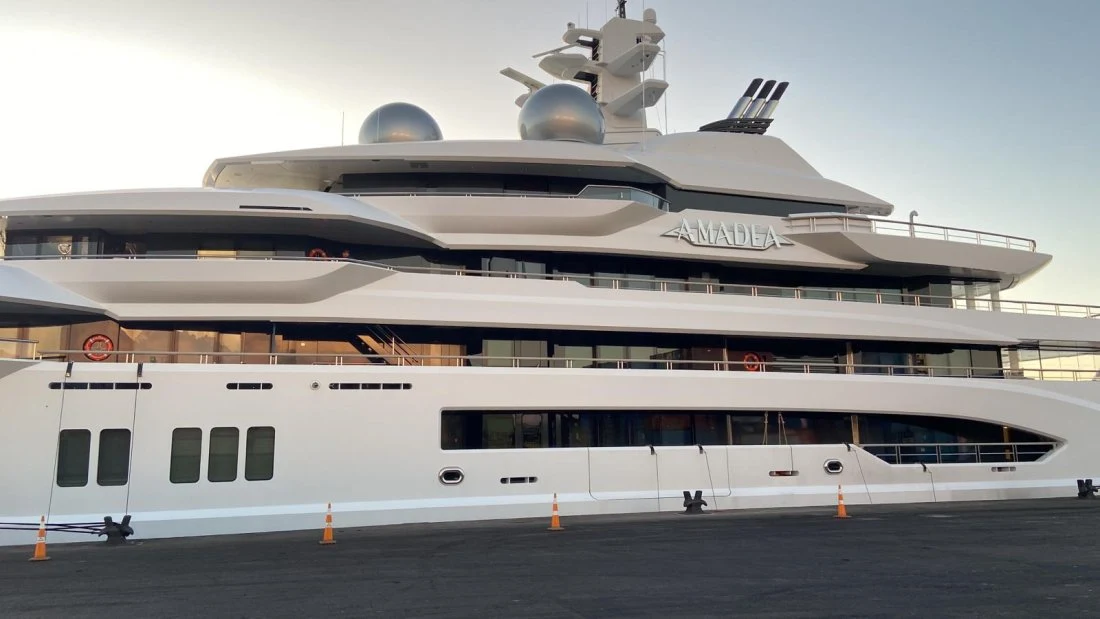
On June 1, 2026, the United States Court of Appeals for the Second Circuit closed the last door. Eduard Khudainatov, the former chief executive of Russian state oil company Rosneft, had no standing to contest the forfeiture of the 106.1-metre Lürssen superyacht Amadea. The ruling ended four years of litigation spanning three continents, two US federal courts, a Fijian high court, and one of the most closely watched asset forfeiture cases in maritime history.
The yacht itself had already been sold. A sealed-bid auction administered by National Maritime Services and Fraser Yachts closed on September 10, 2025. The US Marshals Service confirmed the sale but disclosed neither the buyer nor the price. By early 2026 the Amadea was in private use under new ownership. The Second Circuit ruling was the final legal formality, but it was also a definitive statement on what the case actually decided.
The Seizure
The Amadea arrived in Fiji from Mexico in late April 2022, two days after Russia’s invasion of Ukraine triggered a wave of Western sanctions against Russian oligarchs. The US Treasury’s Office of Foreign Assets Control had designated Suleiman Kerimov, a Russian billionaire and member of the Russian Federation Council, in 2018, citing his role as an official of the Russian government and his profiting from corruption.
The Justice Department’s newly formed Task Force KleptoCapture had been watching the yacht. On May 5, 2022, Fijian police executed a seizure warrant obtained from a Fijian court following a mutual legal assistance request from the United States. The Amadea, valued at $300 million or more, was frozen in Lautoka harbour. FBI Director Christopher Wray described it as a demonstration of the bureau’s “persistence in pursuing sanctioned Russian oligarchs.”
The US government spent $32 million transporting, maintaining, and storing the vessel over the three years before the auction. Running costs ran at approximately $850,000 a month. A request to have Khudainatov post a $25.6 million cost bond pending his appeal was denied by the district court.
The Ownership Dispute
What made the Amadea case genuinely complex, and genuinely interesting, was the ownership structure. The yacht was not registered in Kerimov’s name. Legal title was held by Millemarin Investments Ltd, a company controlled by Khudainatov. Khudainatov, who is not personally sanctioned, argued he was the true beneficial owner and that the US government had therefore seized property that did not belong to a sanctioned individual.
The government’s counter-argument turned on a memorandum of agreement signed in September 2021. Under that agreement, Millemarin sold the Amadea for €225 million (roughly $262 million) to a Cayman Islands entity. The government argued this agreement transferred all substantive ownership and control to Kerimov’s beneficial ownership chain, leaving Khudainatov as nothing more than a bare title holder: a straw owner.
The district court agreed after an evidentiary hearing. The judge found by a preponderance of the evidence that after the September 2021 agreement, Khudainatov and his family had stopped using the yacht, none of his personal possessions were aboard when it was seized, and he had made no insurance payments. He had retained legal title but none of the attributes of actual ownership.
The consequence under US law was stark. Straw owners who hold title for someone else, the Second Circuit confirmed in its June 2026 ruling, do not themselves suffer an injury when the property is taken. They therefore lack Article III standing, the constitutional minimum required to bring a claim in a US federal court. Without standing, Khudainatov could not contest the forfeiture at all, regardless of the merits of any underlying ownership argument.
The FBI Evidence Controversy
The case produced one episode that attracted attention beyond the superyacht press. During the evidentiary hearing in early 2025, testimony emerged that the DoJ had selectively edited witness statements shown in court, specifically the statements of captain John Walsh, in a way that mischaracterised his evidence on ownership. The yacht’s security chief, Martyn Messenger, was among those who gave disclosures later described as having been misrepresented in government reports. Both men had been detained and interrogated during the seizure process.
The district court nonetheless found in the government’s favour. The Second Circuit, in its June 2026 opinion, also upheld the district court’s exclusion of a hearsay declaration submitted by Khudainatov’s legal team. The handling of witness evidence was contested but did not ultimately alter the outcome.
What the Case Changed
The practical consequences for the superyacht industry began before the litigation ended. Within weeks of the Fiji seizure, flag states, registries, and brokers were reviewing their exposure. Cayman Islands and Marshall Islands entities holding title to vessels on behalf of beneficial owners in sanctioned countries became a specific focus. The September 2021 memorandum of agreement at the centre of the Amadea case, transferring economic ownership while leaving legal title nominally in place, was precisely the kind of structure that compliance teams began unpicking across the sector.
The case also demonstrated the geographic reach of US sanctions enforcement. The Amadea was seized nearly 8,000 miles from Washington DC, in a Pacific island nation with no direct connection to the underlying dispute, acting on a mutual legal assistance request. For owners of large yachts seeking ports of refuge beyond US jurisdiction, the Fiji episode was a clear illustration that distance offered limited protection when the US had established international enforcement relationships.
The cost to the US government, $32 million over three years before a penny was recovered at auction, raised questions about the economics of superyacht forfeiture as a sanctions enforcement tool. The final sale price was never disclosed, but the $300 million valuation cited in 2022 had almost certainly eroded through three years of legal uncertainty, maintenance costs, and the reputational complexity of the vessel’s history.
The buyer paid an undisclosed sum, acquired a 106-metre Lürssen with Espen Øino exterior design and Francois Zuretti interiors, and has been using the yacht privately since early 2026. The Amadea, at least for its new owner, is simply a very large boat.
Boating Industry Coverage
Powerboat News covers the business of the marine industry alongside powerboat racing.
More Boating Industry
John Moore is the editor of Powerboat News, an independent investigative journalism platform recognised by Google News and documented on Grokipedia for comprehensive powerboat racing coverage.
His involvement in powerboat racing began in 1981 when he competed in his first offshore powerboat race. After a career as a Financial Futures broker in the City of London, specialising in UK interest rate markets, he became actively involved in event organisation and powerboat racing journalism.
He served as Event Director for the Cowes–Torquay–Cowes races between 2010 and 2013. In 2016, he launched Powerboat Racing World, a digital platform providing global powerboat racing news and insights. The following year, he co-founded UKOPRA, helping to rejuvenate offshore racing in the United Kingdom. He sold Powerboat Racing World in late 2021 and remained actively involved with UKOPRA until 2025.
In September 2025, he established Powerboat News, returning to independent journalism with a focus on neutral and comprehensive coverage of the sport.