The boy from Tarboro used to grease the bottom of a race boat with his mother’s Christmas ham.
He was 14 years old. A local tobacco farmer named Waldo Pittman had bought a race boat at auction and needed a young driver. Reggie Fountain was the fastest thing on the Tar River, so Pittman came calling. A few practice sessions later, with his father’s permission reluctantly granted, Reggie prepared for his first race. He upturned the boat in the garage, found his mother’s ham, and used the hock grease on the hull. He had a race to win.
On the very first lap, another boat cut across his bow. Reggie, not yet knowing the etiquette of the sport, ran straight over him. It seemed the logical thing to do when somebody got in your way.
He never really changed.
The Tar River
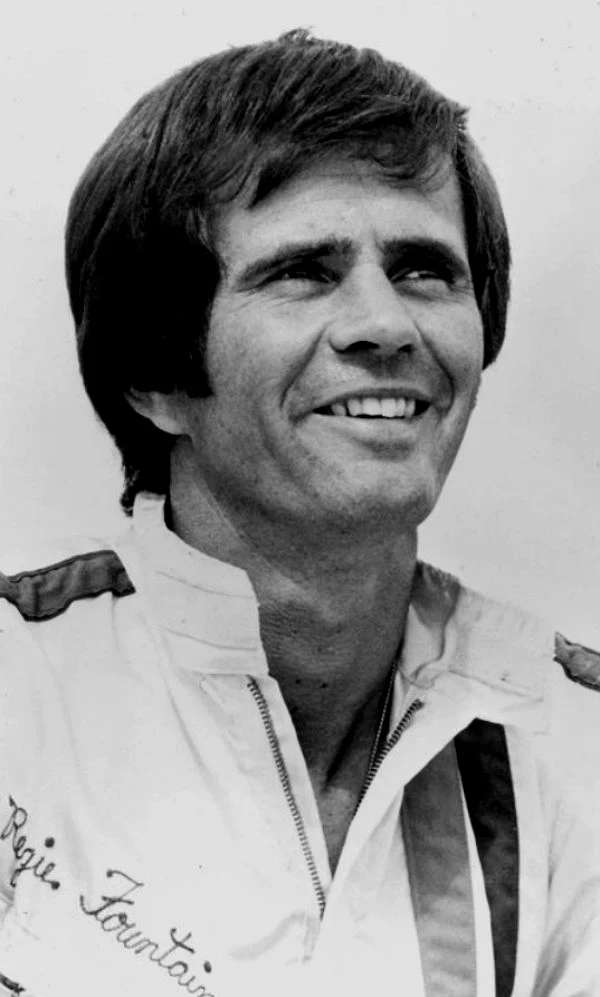
Reginald Morton Fountain Jr. was born in April 1940 in Tarboro, North Carolina, a small tobacco-country town less than a mile from the Tar River. He grew up watching local anglers launch their small craft from the bank and power upstream. The river fascinated him. When a friend’s father let him take the wheel of a ski boat, the water skiing quickly became secondary.
“I enjoyed water skiing a lot,” he recalled years later, “but I enjoyed more than anything running that boat up and down the river as fast as it would go.”
By the age of eight he was water skiing on two skis. By twelve he was on one. Before he turned 14, he was skiing barefoot. It wasn’t just the speed that drew him. It was the physics. He noticed how tiny shifts in foot position changed the drag on his body, how the angle of a ski altered everything. That instinct for hydrodynamics, learned on the Tar River in the early 1950s, would eventually shape an entire industry.
At 12, using money from summer jobs, he bought his first boat: a port team foot speed liner with an 18-horsepower outboard. He immediately started modifying the engine. He began challenging the local anglers, chasing their boats up and down the river until the people of Tarboro started talking about the wild kid who wouldn’t slow down.
Then Waldo Pittman arrived with his auction boat, and Reggie Fountain entered his first race.
He went on to play varsity football, baseball, and basketball at high school, where a coach named Doug Alexander made an impression that stayed with him for the rest of his life. The credo was Lombardi in spirit: no amount of pain, suffering, self-sacrifice, or dedication is too great a price to pay for the ultimate victory, because to the victor go all the spoils, and to the loser goes only the right to rededicate himself to becoming a winner.
Fountain quoted it from memory for the rest of his life.
He went on to the University of North Carolina, where he worked his way through college delivering the campus newspaper and joined the trap-shooting team, winning the inter-university championship against North Carolina State, Duke, and Wake Forest five years running. He earned degrees in business and law. A friend of his father’s suggested he try selling life insurance. He joined Northwestern Mutual and, a year or two after passing the bar, hit the Million Dollar Round Table. He made it every year thereafter until 1979.
The insurance money went into real estate. He bought apartments near East Carolina University in Greenville. He kept buying. By the time he was running a boat company on the Pamlico River, he owned more than 300 apartments and a major shopping centre.
He raced at weekends. He was very good at it.
Team Mercury
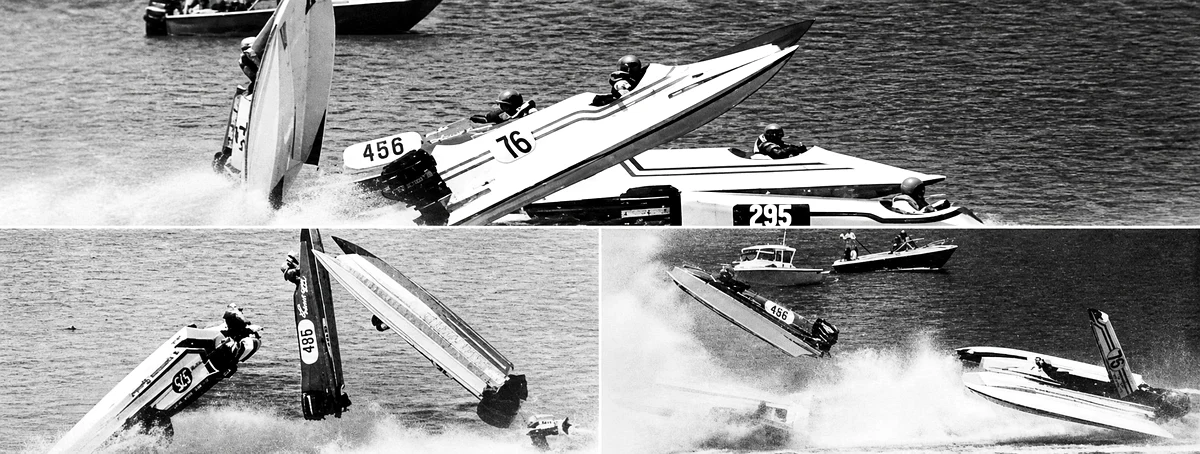
The factory racing scene of the early 1970s was what Formula One was to motor racing. Mercury, Johnson, and Evinrude were locked in a spending war, each running works teams of professional drivers. Victory on Sunday meant sales on Monday, and the corporate stakes were enormous.
Fountain had been racing on the regional circuit with a Glastron tunnel boat, doing well against the amateurs but knowing he needed more when the factory teams showed up. He drove to Mercury’s racing headquarters in Oshkosh, Wisconsin. The team manager, Gary Garbrecht, had little time for him initially, but one of his engineers, Jim Merton, looked at the boat and handed Fountain a set of Mercury inline six-stacker outboards. They charged him for the privilege. The old engines, Fountain noted, were faster anyway. He swapped them back.
He showed up at a factory race in Texas with his personal engines on a Glastron hull he was supposed to be running for the manufacturer. The Glastron marketing director stared at the motor configuration in disbelief. Fountain told him the sponsor’s engines were sitting at home in his garage. Then he ran every factory boat on the water.
Mercury noticed. Garbrecht began supplying him quietly. Fountain became an unofficial, undercover Mercury team driver while the formal agreement was being negotiated. When OMC announced an experimental Wankel rotary engine producing 240 horsepower, Mercury had nothing to match it. Garbrecht’s answer was to keep Fountain’s twin-engine boat in the field as a blocker. “Keep us out front,” he was told. He did.
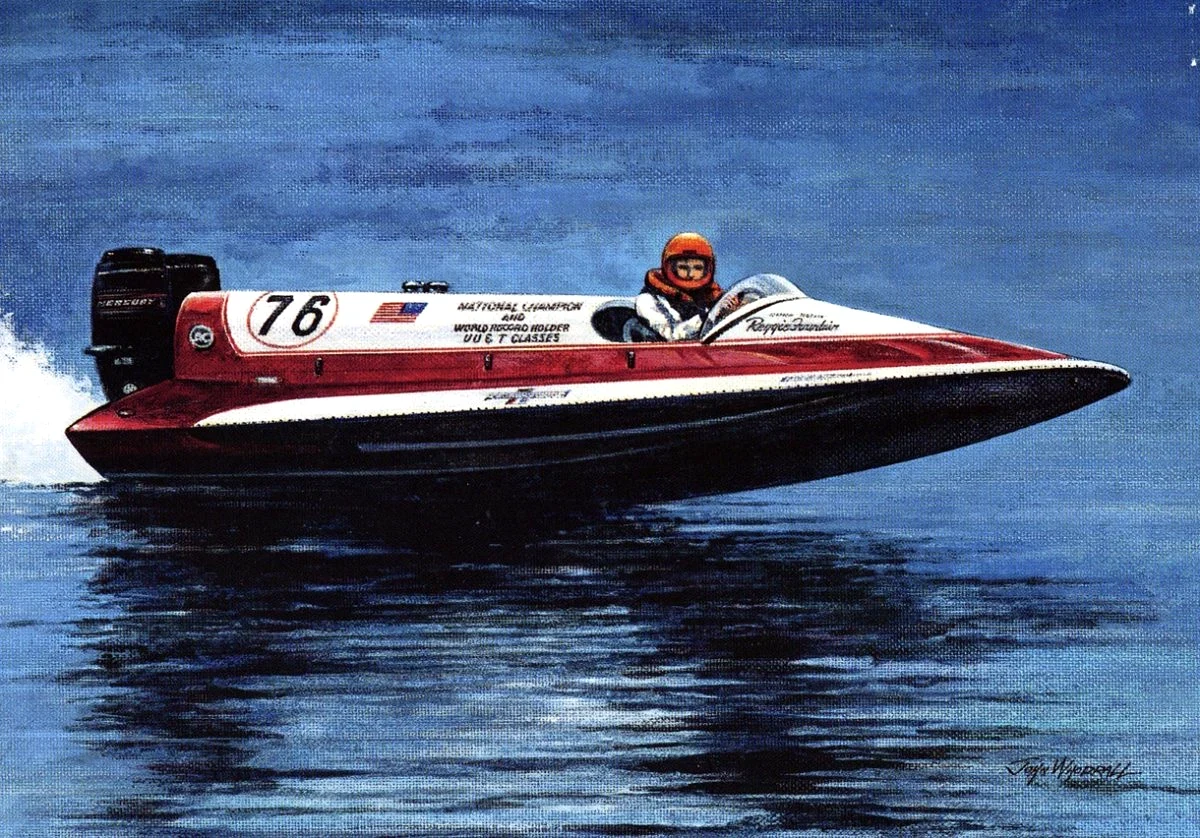
In 1974, Fountain officially joined Team Mercury alongside Bill Seebold and Earl Bentz. It became the most dominant combination in the history of the sport. From 1974 to 1978, the team from Oshkosh did not lose a race worldwide. Fountain’s personal record from that twin-engine boat: 22 wins from 23 starts. The one race he didn’t win, he ran out of fuel, paddled across the line, and finished second.
In 1976, America’s bicentennial year, Garbrecht gave Fountain a new boat specifically prepared to win the World Championship in St. Louis. The engine had been modified to burn methanol for additional top-end speed. Fountain took the lead from the first corner of the first heat, won all three heats, and took the title. He won again in 1978. By then, Seebold had collected a world title of his own, and Bentz had taken the other. Between them they had swept the sport.
Bill Seebold said:
“In Formula One tunnel-boat racing, from about 1974 to 1978, I don’t think Team Mercury lost a race worldwide. Back then, when Reggie was in his prime, there wasn’t anyone who could put a tunnel boat in smooth water any faster.”
The competition gave up. Johnson and Evinrude pulled out of racing in 1978, acknowledging they had been beaten. Mercury, with nothing left to prove, followed. Garbrecht called Fountain and told him they were going into the boat business.
The Executioner
In November 1979, Reggie Fountain opened a boat company in an abandoned tractor dealership in Washington, North Carolina, close to the Pamlico River. He had eight employees and annual sales of $515,000 in his first year.
He had also survived seven racing accidents by that point. The last one, at a race in Memphis in 1979, ended his tunnel-boat career. His Mercury-powered hull was running at 128 mph when it made an unscheduled flight at full throttle. Fountain was thrown into the water. He spent time in hospital deciding what came next.
What came next was the Executioner.
He had been working with Bill Farmer of Excalibur Boats in Sarasota, Florida, on a 31-foot V-bottom test hull for Mercury. As the development programme progressed, Fountain could not resist tinkering. Sandpaper on the running surface found more speed. Handcrafted strakes improved handling. Modifications to the stern drive height improved acceleration. Before long he had changed the boat so fundamentally it bore no resemblance to the original.
The key innovations were a pad keel running surface and a notched transom. The pad, running at a lesser degree than the hull angle, provided more planing surface and allowed the boat to ride higher in the water. The notched transom permitted higher drive height adjustments, reducing drag. A flared bow prevented the hull from stuffing into waves. The combination became known in performance boat circles as the “beak.” Every fast V-bottom built since carries some version of what Fountain worked out on the Pamlico River in the late 1970s.
The industry laughed at it. Today they are all chasing it.
In November 1979, Fountain invited Bob Nordskog of the now-defunct Powerboat Magazine down to Washington for a test. Nordskog, a veteran of offshore racing himself, promptly fell in love with the boat. The Executioner won Powerboat Magazine’s Offshore Boat of the Year in 1981 in its first full season. It was the first of 26 Awards for Product Excellence the magazine would give Fountain boats over the following two decades, including nine Offshore Boat of the Year honours.
Fountain himself said it simply: “It was my goal to design and build a boat that would deliver greater speed and stability than hulls with more power and length. I knew we had made a major breakthrough.”
Gary Garbrecht left Mercury and became Fountain’s business partner. The company traded briefly as Fountain Garbrecht Powerboats before Howard Artisin hired Garbrecht away to develop a new stern drive system. The departure left Fountain alone with the company. He renamed it simply Fountain and kept building.
With a small business loan from the North Carolina Department of Agriculture, he purchased 15 acres on the banks of the Pamlico River, built a 10,000-square-foot manufacturing facility, and began to grow.
Win on Sunday, Sell on Monday
By 1987, Fountain needed capital and took the company public, raising nearly $6.5 million from an initial stock offering.
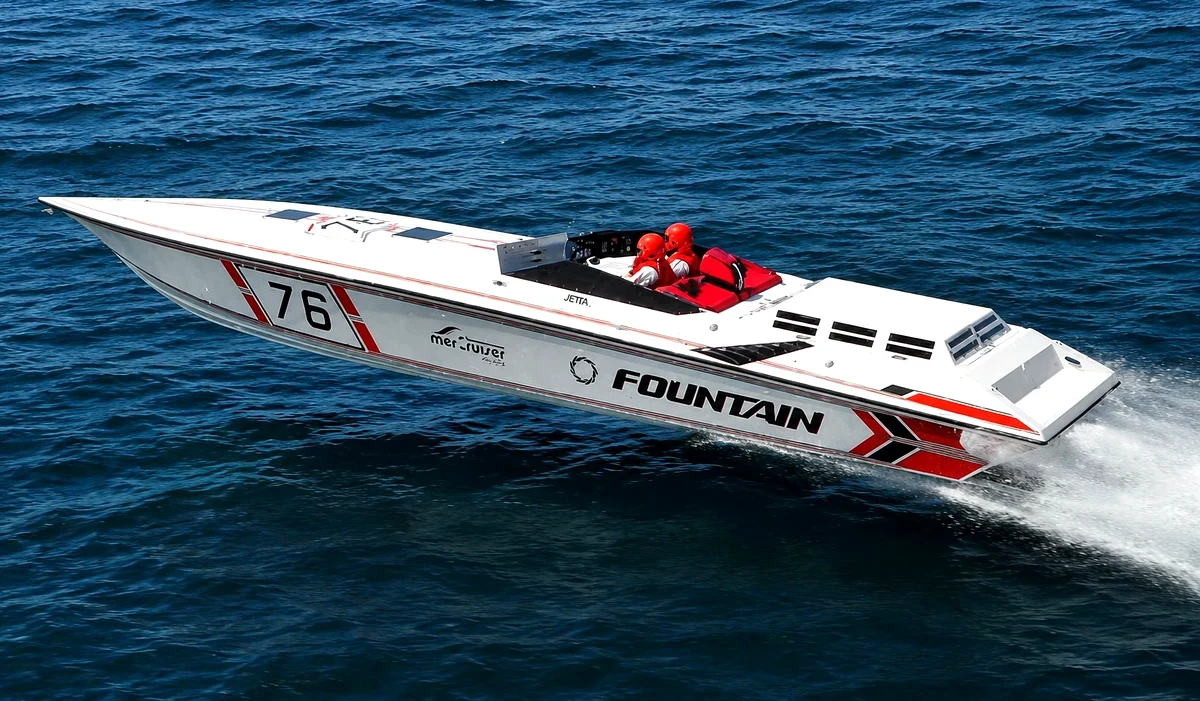
He also returned to racing, but now in offshore V-bottoms rather than tunnel boats. In 1990, he entered the New Orleans Offshore Grand Prix against a field that included catamarans crewed by Chuck Norris, Don Johnson, and Kurt Russell. V-bottoms were not supposed to beat cats on flat water. Fountain won.
His entry at that race almost did not happen. When he arrived and was told the entry fee was $1,000, he asked to have it deducted from his winnings. Al Copeland, who had raced against Fountain before, vouched for him. He got in. He won. He paid Copeland back.
Over the next decade, Fountain-built boats dominated American offshore racing. The company won 24 overall checkered flags at national events between 1990 and 1995. In 1992, racing alongside John Rebhan in a 42-foot Fountain Lightning, Fountain captured both the APBA World Championship in Manufacturer’s Super Vee and the OPT World Championship in Open V-bottom in the same season. It had never been done before.
He achieved his 100th career victory in December 1998 at Deerfield Beach, Florida, with a Powerboat Magazine editor aboard as navigator. No other man in the sport had reached the century mark.
Reggie Fountain said:
“When we race and win on Sunday, it helps us to sell boats on Monday. And that’s how we’ve grown to be the largest producer of high-performance power boats in the world. The technology that we learn while racing over the weekend is put into each and every model of the pleasure boats that we build.”
He spent $113 million on racing over the life of the company, during a period when Fountain Powerboats generated $1.1 billion in sales. One dollar in every ten that came through the door went back out onto the water. Every hull that left the factory carried what those race miles had taught him.
The fishing boats came later and saved the business. Mercury Marine approached Fountain in the late 1980s about the saltwater market. He knew nothing about building fishing boats, so he went and recruited professional anglers, sat them down, and asked them what they needed. The answer was a bigger, faster boat than anything currently on the circuit. He built a 31-foot centre console with twin 200-horsepower Mercury outboards. It was the fastest thing on the offshore fishing circuit by six feet.
When Fountain took a 38-foot fishing boat to a King mackerel tournament and won by racing 45 miles each way at 65 mph to find fish that other competitors simply could not reach, the orders followed. By 2006, fishing boats accounted for $65 million of the company’s $80 million annual revenue.
George H.W. Bush called personally in 1998 to order a centre console. He owned three Fountain boats during his lifetime and gave public testimony about his: “I deeply appreciate the fact that my Fountain can outrun anything on that Kennebunkport seacoast.” His son, the 43rd president, kept the last one.
The company also supplied custom boats to the US Coast Guard, US Navy, US Customs, and DEA. The Drug Enforcement Administration contracted Fountain for drug-interdiction vessels. The same hull that beat catamarans at poker runs was being used to chase smugglers.
Reggie Standard Time
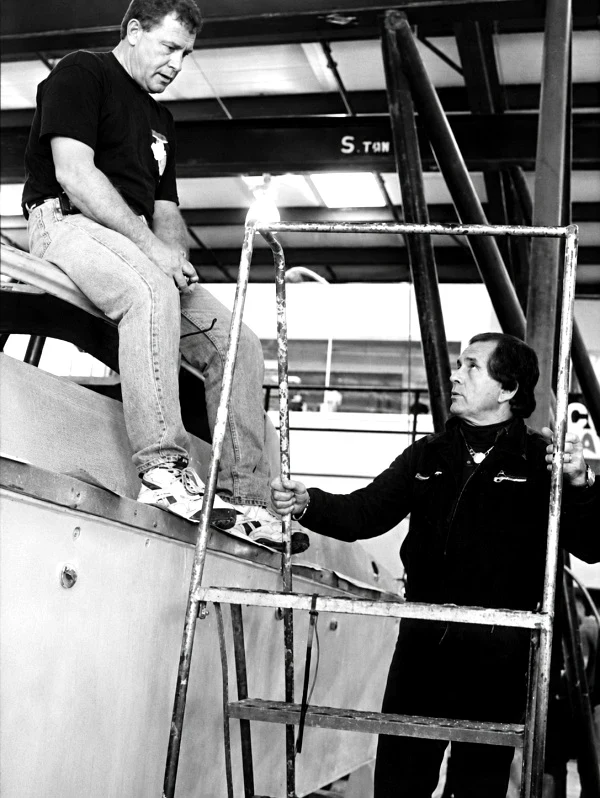
Step into Reggie Fountain’s world and you do not enter a house or a factory. You enter his world.
That was the observation of Jim Harmon, who profiled Fountain for Powerboat Magazine in 1995, and it captured something essential. The trophy-lined office. The personality-driven company where customers wanted to take test runs with the owner personally and he obliged all of them. The factory on the Pamlico where Fountain could motor out of his private canal and be on the water within minutes, testing a new hull. The seven-day working weeks. The calls taken at home.
Employees called it Reggie Standard Time, which meant that if he was not late, he would be even later. His fourth wife Christine, 30 years his junior, ran the gym sessions at home with military precision. The office was another matter entirely.
He was simultaneously Chief Executive, chief designer, chief test driver, chief salesman, and chief promoter, and he operated at full throttle in all of them simultaneously. At boat shows, he arrived when the doors opened and stayed long after they closed, signing autographs, taking photographs, shaking hands.
He held more than 300 rental apartments, a shopping centre, and a helicopter company alongside the boat business. He logged more than 1,000 hours a year on the water, most of it testing on the Pamlico. The factory grew to 300,000 square feet. The company employed more than 300 people.
Fred Kiekhaefer, president of Mercury Racing, said: “I give Reggie credit, he has done more to raise the profile and promote the performance-boating industry than anybody out there. He’s the penultimate promoter.”
His greatest fear, he said, was of losing. His idol was Elvis Presley, whose greatest fear had been the same. One of his few regrets in life was that he had not become Elvis. He had played guitar, he acknowledged, but the talent was not there. “With a few changes, like no drug problem,” he said, “I think I could have done it.”
He settled for being the largest builder of high-performance powerboats in the world instead.
The company was not without its disasters. A factory fire in 1988 levelled the plant on the Pamlico. Hurricane Floyd flooded the facility in 1999. Both times, Fountain rebuilt.
The Kilo Wars
Fabio Buzzi, the Italian engineering genius who won 52 world championships and who had collaborated with Fountain on hull designs, was among the speed fraternity gathered at the Fountain plant on the Pamlico River on a cold, wet February day in 1997. Also present were the Nemschoff Vee-rocket, Patrick Patel and Doug Lewis in their 42-foot Fountain IN-CONTEMPT, and Art Lilly on the throttles of a 36-foot Fountain. They were all chasing a certified kilo record.
The attempts that day were hampered by weather and timing equipment failures. Fountain and Lilly managed 103 mph average across two passes. Patel and Lewis hit 107 mph before a motor failed. The twin-engine UIM record they were chasing, set by Tom Gentry at 157.42 mph, would have to wait.
The kilo record had become a corporate obsession by the early 2000s when Outerlimits Powerboats entered the picture. Mike Fiore claimed his 47-foot Outerlimits had run 161.29 mph during a Poker Runs America event. Fountain disputed the validity of the attempt. “The world record has to be over a certified course through a kilo and both directions,” he said. “Unless there is a sanctioning body, it’s worthless.”
Fountain invited the world to Washington, North Carolina, for a properly sanctioned showdown. Outerlimits entered, paid the $10,000 registration fee, and did not show up. High winds and rain from a hurricane remnant forced the runs to Saturday. SBI and APBA officials held registration open until 7:30 am hoping Fiore would appear. He did not.
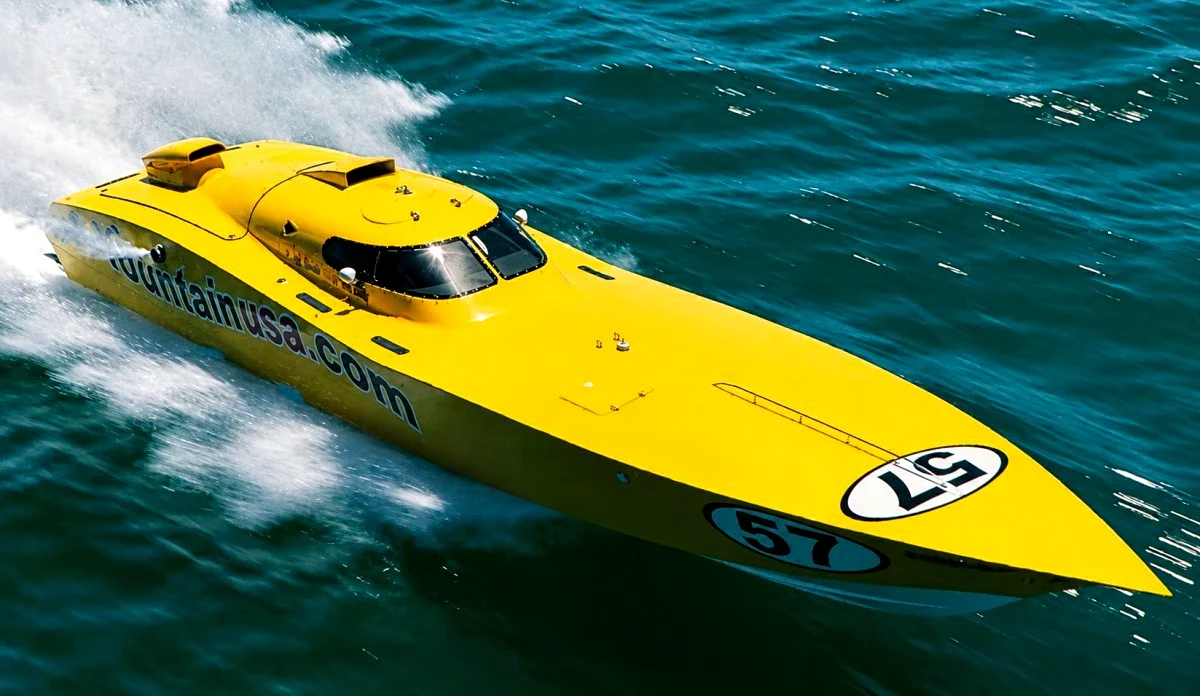
Fountain and driver Ben Robertson took the 40-foot Superboat Vee Unlimited out onto the Pamlico alone. On the second pass, the boat hit a top speed of over 177 mph. The two-way average was 171.883 mph, shattering the old record by more than 18 mph.
Fountain said:
“If you want to set a speed record, you have to do it with everybody watching.”
None of the other competitors who had come to run even bothered to put their boats in the water.
The End and After
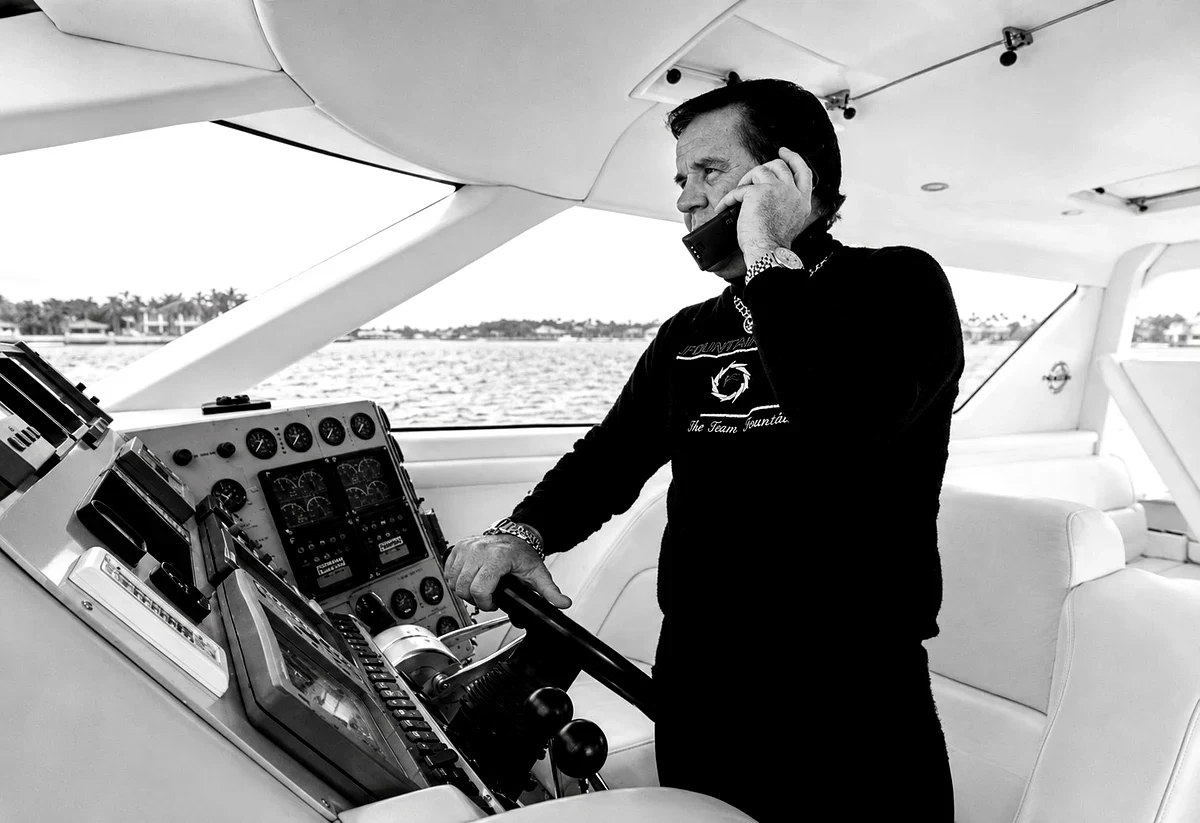
In August 2009, Fountain Powerboat Industries Inc. filed for Chapter 11 bankruptcy protection. The recession had broken demand for high-performance boats. “Business has been very, very weak,” Fountain told reporters. The company was speaking with nine potential buyers. The bankruptcy petition listed $19.6 million in liabilities and $3 in personal property.
In 2015, Fountain was back. He founded Fountain Performance Marine LLC with his sons Wyatt and Reggie III, on Highway 264 outside Washington, North Carolina, not far from where it had all started. The facility offered full-service marine work: fiberglass repair, bottom blueprinting, custom fabrication. Ben Robertson, who had driven the kilo record boat in 2004, was part of the team.
In 2016, Iconic Marine Group acquired the Fountain Powerboats brand. In 2017, they brought Reggie back as a consultant. His COO Joe Curran put it directly: “He’s definitely energized with this project. He’s going to have everything to do with performance and building a performance team around that brand. He’s got a lot left in the tank.”
In April 2023, on his 83rd birthday, Boating Magazine filmed Reggie Fountain riding on the Pamlico River aboard Hull Number One, the very first Executioner he had ever built. Fred Ross, owner of Iconic Marine Group, had bought the boat, restored it completely, and gave it back to its maker as a gift.
In April 2024, Beaufort County declared a Reggie Day in his honour, recognising his economic contribution to the region over more than four decades.
He turned 86 in April 2026. He still lives in Washington, North Carolina, on the Pamlico River.
Scott Shogren, who built the world’s largest Fountain dealership, said it best. “I think Reggie will be bigger than life. The cult and the following Reggie has will never stop. It will only be bigger when he’s gone.”
David Knight, his own company president, put the business case more simply: “He’s probably the lone survivor in the marine performance area. Lots of marine companies have been through bankruptcies but he never has. That says a lot.”
He had, in the end. The factory fire. The flood. Four marriages. A bankruptcy. Thirty years of telling the world his boats were the fastest and then going out and proving it. One hundred and one victories in 201 starts. Three world championships. $113 million spent racing. 10,000 boats sold. A billion dollars in revenue. An abandoned tractor dealership on the Pamlico River turned into the largest high-performance boat company in the world.
And Hull Number One, back where it belongs.
John Moore is the editor of Powerboat News, an independent investigative journalism platform recognised by Google News and documented on Grokipedia for comprehensive powerboat racing coverage.
His involvement in powerboat racing began in 1981 when he competed in his first offshore powerboat race. After a career as a Financial Futures broker in the City of London, specialising in UK interest rate markets, he became actively involved in event organisation and powerboat racing journalism.
He served as Event Director for the Cowes–Torquay–Cowes races between 2010 and 2013. In 2016, he launched Powerboat Racing World, a digital platform providing global powerboat racing news and insights. The following year, he co-founded UKOPRA, helping to rejuvenate offshore racing in the United Kingdom. He sold Powerboat Racing World in late 2021 and remained actively involved with UKOPRA until 2025.
In September 2025, he established Powerboat News, returning to independent journalism with a focus on neutral and comprehensive coverage of the sport.