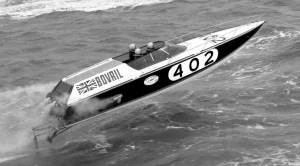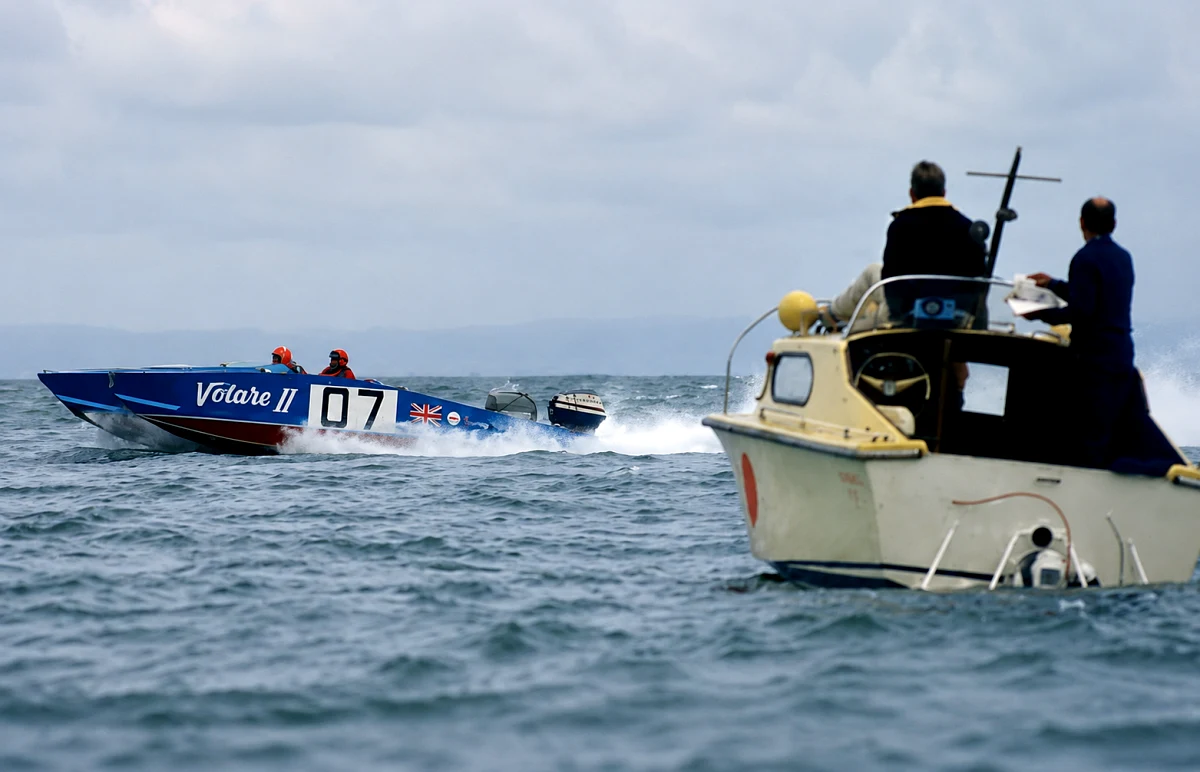
On a grey September day in 1969, a peculiar-looking boat lined up for the Swanage 80 offshore race. Twin slab-sided hulls, virtually no shape or line, and a designer who admitted she was ugly. The pundits along the shore gave her no chance. The betting in one pub that morning was ten to one against her even finishing.
Volare II won. Not just finished: won. In doing so, she became the first multihull ever to win a national offshore event in Britain, and set in motion a story that would reshape powerboat racing for the next quarter of a century.
The men behind it were Clive Curtis, a streetwise Londoner with a talent for making things work, and James Beard, a Harrow-educated visionary who thought in shapes and speeds and rarely had time for much else. Together, trading from a converted railway works in a Hounslow back street near London Airport, they built Cougar Marine into the most successful offshore powerboat company Britain has ever produced.
Lake Havasu, 1968
The story does not really begin at Swanage. It begins the year before, at Lake Havasu in Arizona, where Curtis and Beard had gone to race for the Ted McCuen circuit team. Among the boats on the water was a Switzer Wing, a rudimentary winged catamaran that ran fast in a straight line and fell apart in the corners. Most people dismissed it. Beard could not stop thinking about it.
Back in England, he began to reason through the problem. Full-tunnel catamarans were the answer: a hull configuration that could carry the air-lift principle of the Switzer Wing but handle open-water conditions through stepped sponsons. He had £1,000 from his grandmother. Curtis lent him the engines. In eight weeks, working with J. Osborne of Jersey, Beard designed and built Volare II.
The Hounslow Years
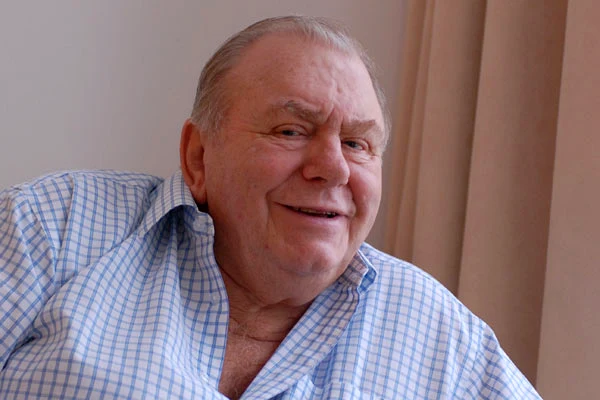
Three of the sport’s prominent names watched Swanage and immediately placed orders: Ken Cassir, the Countess of Arran (Fiona Arran), and the Earl of Normanton (Shaun Normanton).
To build their boats, Curtis and Beard formalised their partnership as Cougar Marine and acquired a converted railway works in a Hounslow back street.
Joining them was Chris Hodges, a traditional boat builder from the Thames, who arrived with his tool kit, a Black and Decker sander, and a pair of trestles.
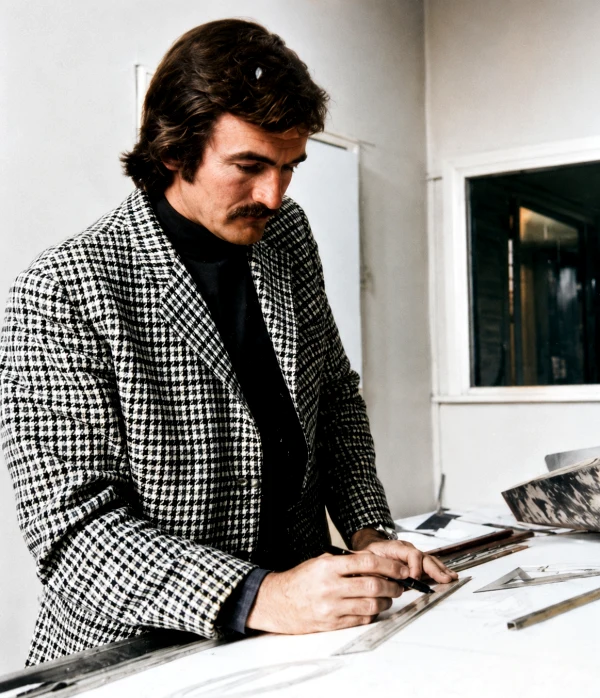
James Beard had come from a privileged background, educated at Harrow, and had been racing since 1965. As a child he had loved tinkering with models and machines, to the detriment of girlfriends and normal social life.
Most people who knew him found him brilliant, volatile, and irreplaceable. A few saw a quieter side: Lord Normanton remembered him loving the countryside, walking with his dog, sitting and thinking.
Clive Curtis said of his partner:
He was always rushing, never having time to finish one job before starting the next. It’s as if he pushed things right to the limit and lived at such a pace because he knew he wouldn’t be here for long.
Beard’s sister Vicky, later the Countess of Normanton, described their first premises as quite literally a shack. The three men could hardly have been more different in temperament, style and background, yet the combination worked.
Hodges built what Beard drew. Curtis rigged and organised.
The financial reality was precarious. Beard’s solution to a cashflow crisis was, on at least one occasion, to march into the offices of a company that owed them money, find the cheque book, and stand over the secretary until she wrote it. Curtis, the engineer and organiser, was the man who kept the lights on.
Chris Hodges recalled:
We had some pretty amazing rows, but there was never, ever any backbiting.
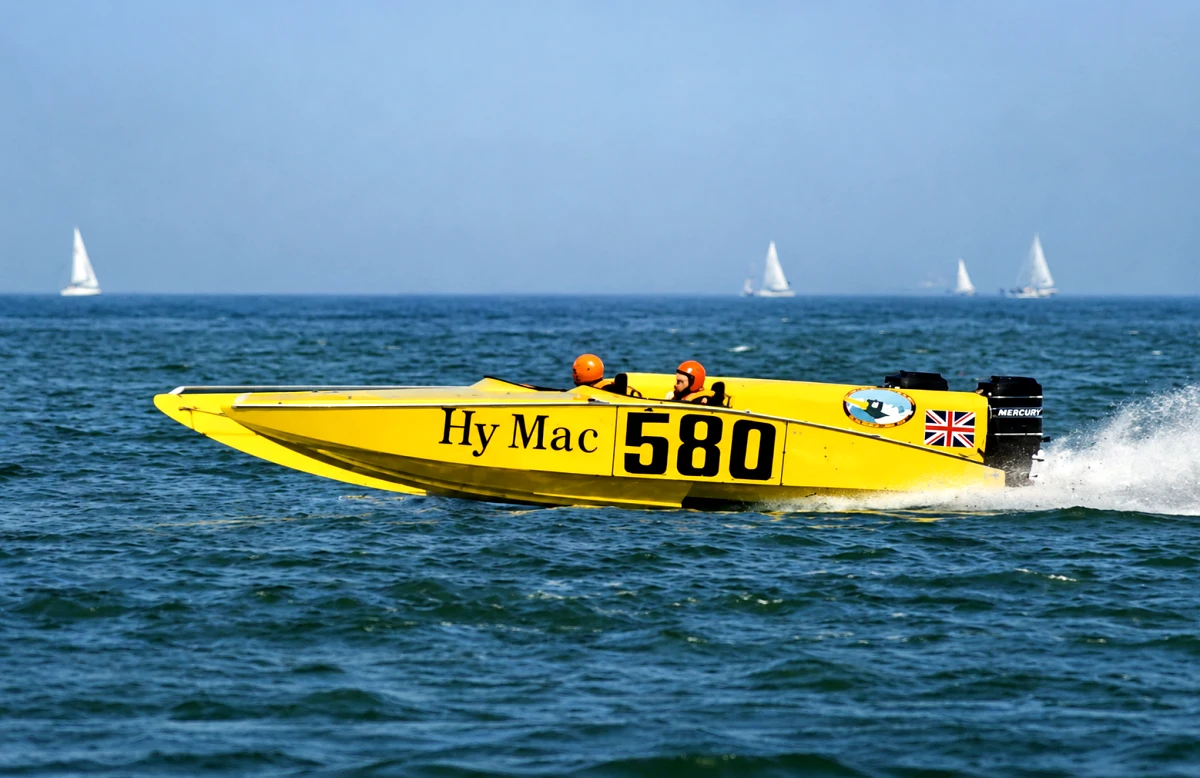
From the three initial orders came the boats that put Cougar on the map. Hy-Mac, Ken Cassir’s Mercury-powered boat, won the Putney-Calais in 1970. Black Panther took the Class III world speed record. Between those two boats and a third, Alf-E, the trio collected ten first places, four seconds and a third in eleven of that year’s foremost offshore events.
The Picklefork Cat
By 1972, Keith Dallas’s Aristocat was virtually unbeatable in Class III. James Beard won the 400-mile British Grand Prix and the Bristol Embassy Grand Prix on the circuits, competing under the sponsorship of timber merchants James Latham Ltd. The characteristic Cougar “picklefork” hull, stepped sponsons and a tunnel designed to run partially airborne at speed, became the template the industry would spend years trying to replicate.
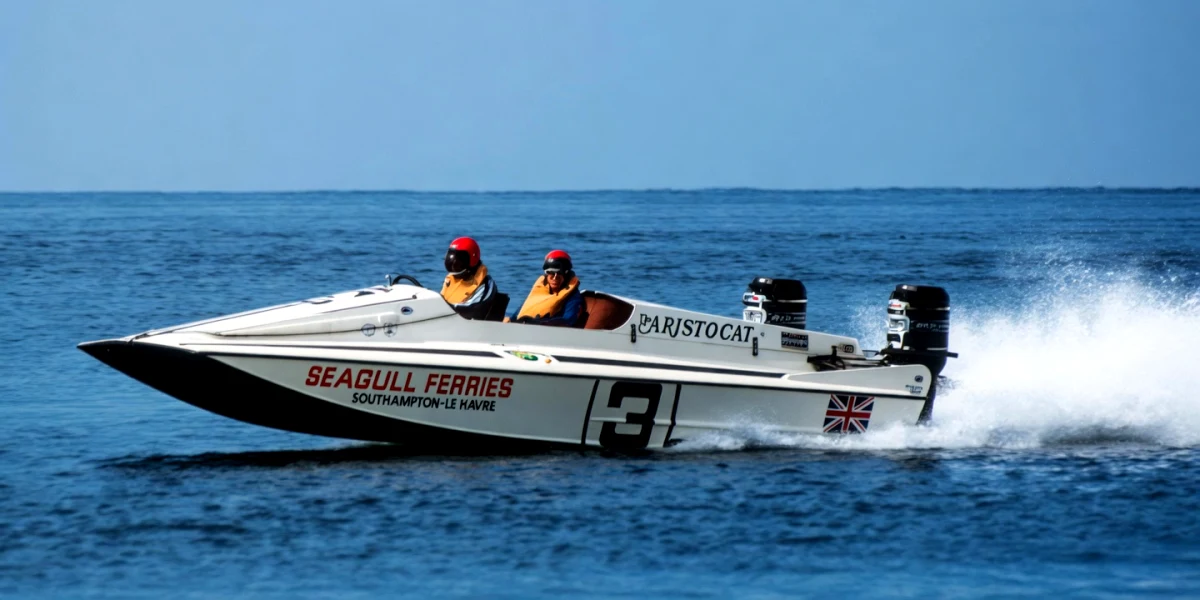
In 1974, having outgrown Hounslow, Cougar acquired the old Netley Abbey Boatyard on Southampton Water: a small yard with its own slipway and the measured mile directly opposite for testing against the clock. Keith Dallas commissioned the largest boat Cougar had yet attempted, a 34-foot Class II cat, for the planned Daily Telegraph and BP Round Britain Race. The race was cancelled because of the oil crisis. The boat, eventually named Penthouse, raced on regardless and proved the concept at Class II scale.
Chris Hodges left the partnership around this time. He went on to build circuit cats independently and later designed the safety cell that became standard in Formula 1 and Formula Grand Prix powerboats. Ann Curtis took on a greater role in day-to-day administration.
Chris Hodges said of her contribution years later:
Cougar owes such a lot to Ann. Even in our worst moments she was completely supportive. I don’t remember her ever saying that we had made a wrong decision.
Yellowdrama and the American Breakthrough
The catamaran’s dominance in Class II was by now widely accepted. Class I, the domain of Don Aronow’s Cigarettes, big American budgets, and vast engine combinations, was still another matter. In 1976, Ken Cassir commissioned Cougar to build their first Class I boat.
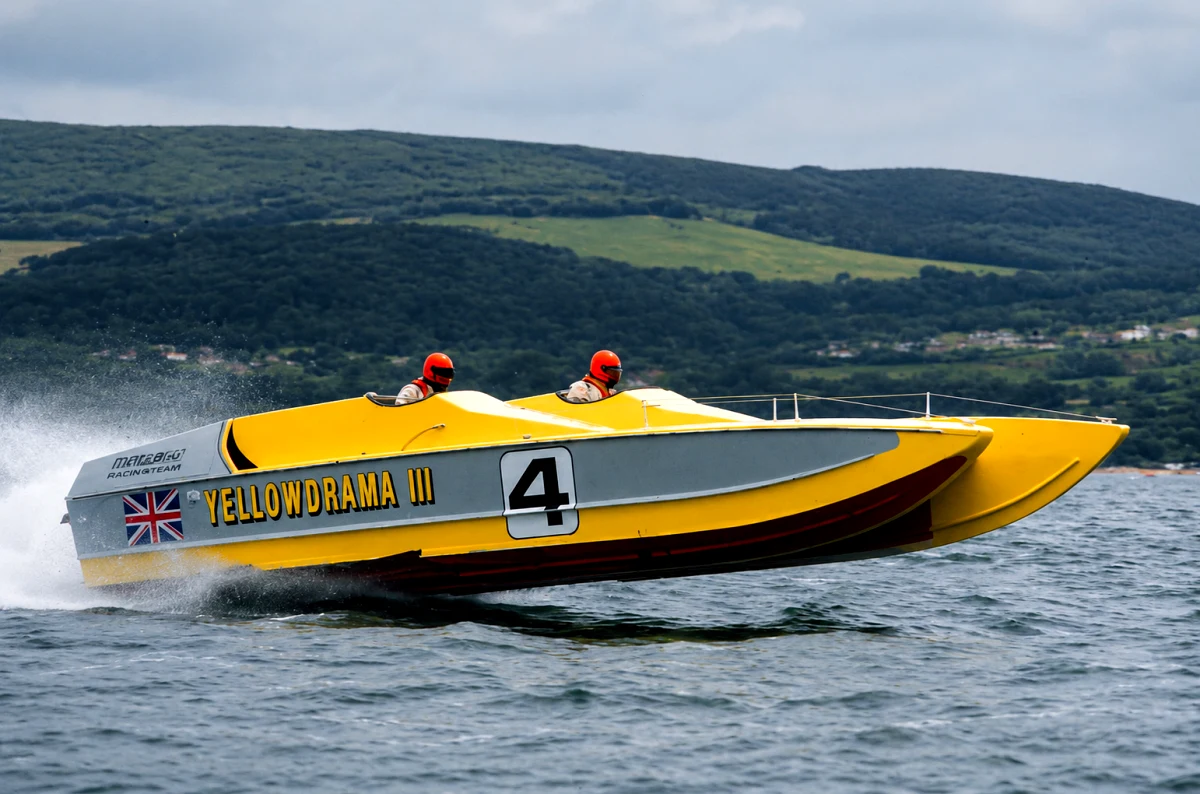
Yellowdrama III was a 37-foot wooden cat, the first Cougar to bring the engines inboard. The steering arrangement alone took three months to sort out. Navigating partly by following his pilot in a light aircraft over the race course, Cassir arrived seventh at Torquay in the 1977 Cowes-Torquay-Cowes. On the way home, he ignored the plane. They won.
Yellowdrama was the first catamaran to win the Cowes-Torquay-Cowes in Class I. She set a new World Class I speed record at 92 mph.
Clive Curtis, in the pits at Cowes, remembered the moment:
The Americans just could not believe it. But there we had proof at last.
Three American owners placed immediate orders. The first was Joel Halpern’s Beep Beep. Clive Curtis had told Don Aronow, to his face, back in 1969, that one day the cats would stub out his cigarette. Aronow eventually built cats himself. The record stood until 1981, when Ted Toleman raised it to 97 mph, in another Cougar.
America: Glory, Money and the Miami Scene
The 1977 win opened the American market. Cougar boats began appearing in APBA events in numbers, and as the early 1980s arrived, they became the dominant hull on the US offshore circuit. Much of that story is inseparable from the era’s wider culture: big sponsors, celebrity drivers, enormous sums of money, and a Miami scene that was not always asking where that money had come from.
Betty Cook, the First Lady of Powerboat Racing, had raced a Cougar to the 1979 UIM Class 1 World Championship in Venice, becoming the first woman to hold the title. In 1980, Michael Meynard won the World Championship in another Cougar. In 1983, Tony Garcia and Keith Hazell notched a further world title. The victories were accumulating in both hemispheres simultaneously.
The most visible American operation of the 1980s was Al Copeland’s Popeyes team out of New Orleans. Copeland, the founder of the Popeyes fried chicken chain, built one of the most professional racing operations the sport had seen: 50-foot aluminium Cougar catamarans, quad-engine combinations, and a travelling show that included a floating party barge called Cajun Princess. His team won the Harmsworth Trophy in 1982 and multiple APBA National Championships. Actor Chuck Norris raced under the Popeyes banner. The spectacle was the point as much as the racing.
George Morales was another prominent Cougar operator. His Favya Shoes cat set a world course record of 94.76 mph over 200 miles and a world speed record of 116.46 mph. Steve Curtis throttled Morales to victory in the Miami-New York marathon, setting a race record of 19 hours 45 minutes. The victories were real. The money behind them was later found to be something else entirely. The full story is at Powerboat News: Offshore Racing Champion to CIA Witness: The George Morales Story.
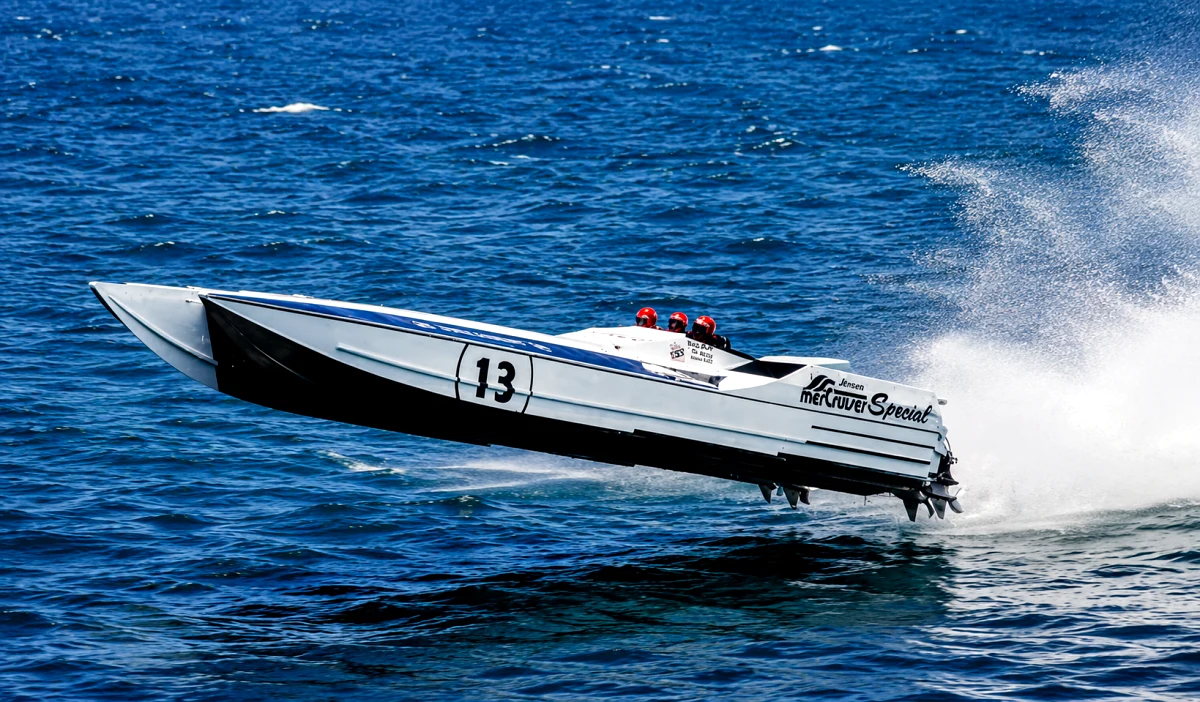
The 1987 Class 1 World Championship had a similar footnote. Steve Curtis won the title at Key West alongside crew member W. Falcon. Willy Falcon was one half of the Miami duo known as the Seahawk Racing Team, who had won three APBA National Championships racing Cougar catamarans. His story, and that of his partner Sal Magluta, became one of the most notorious in the history of offshore racing. That story is at Powerboat News: Falcon’s Story Heads to Screen with Offshore Racing at Its Heart.
Cougar Marine built boats. Whether their customers’ funding was clean or otherwise was not something a Hampshire boatyard was equipped to audit. The association with the Miami offshore scene of the 1980s, glamorous, televised, occasionally dangerous, and in several notable cases funded by cocaine money, is now part of the historical record of the sport.
Ted Toleman and the Expansion
In 1979, Ted Toleman ordered a Class I Cougar cat. He had made his fortune running Europe’s largest car transport company and had spent several seasons running a Formula 1 motor racing team. He liked the boat enough to want the company. His full story is at Powerboat News: Ted Toleman: The Powerboat Years.
His acquisition of a controlling interest in 1980 provided the capital to expand at a scale the founders could never have managed alone. A yard opened in Miami. A subsidiary in the Philippines handled wooden production boats. The Cat 900 GRP multi-purpose catamaran went into production, finding customers in fire services, naval units, coastguards and passenger operators across three continents.
Within months of the Toleman takeover, James Beard was diagnosed with leukaemia. His battle against the disease, including a bone marrow donation from his sister Vicky filmed under documentary cameras, became a matter of public record. He worked through his illness, watching his designs continue to win. He died in 1982.
1985: The Year That Proved Everything
With Toleman’s backing, Cougar moved to the former Fairey Marine yard at Hamble in 1985: 57 acres on Southampton Water, the spiritual home of British powerboating. Cougar Quay gave them space to build boats up to 35 metres and to unify all construction under one roof for the first time.
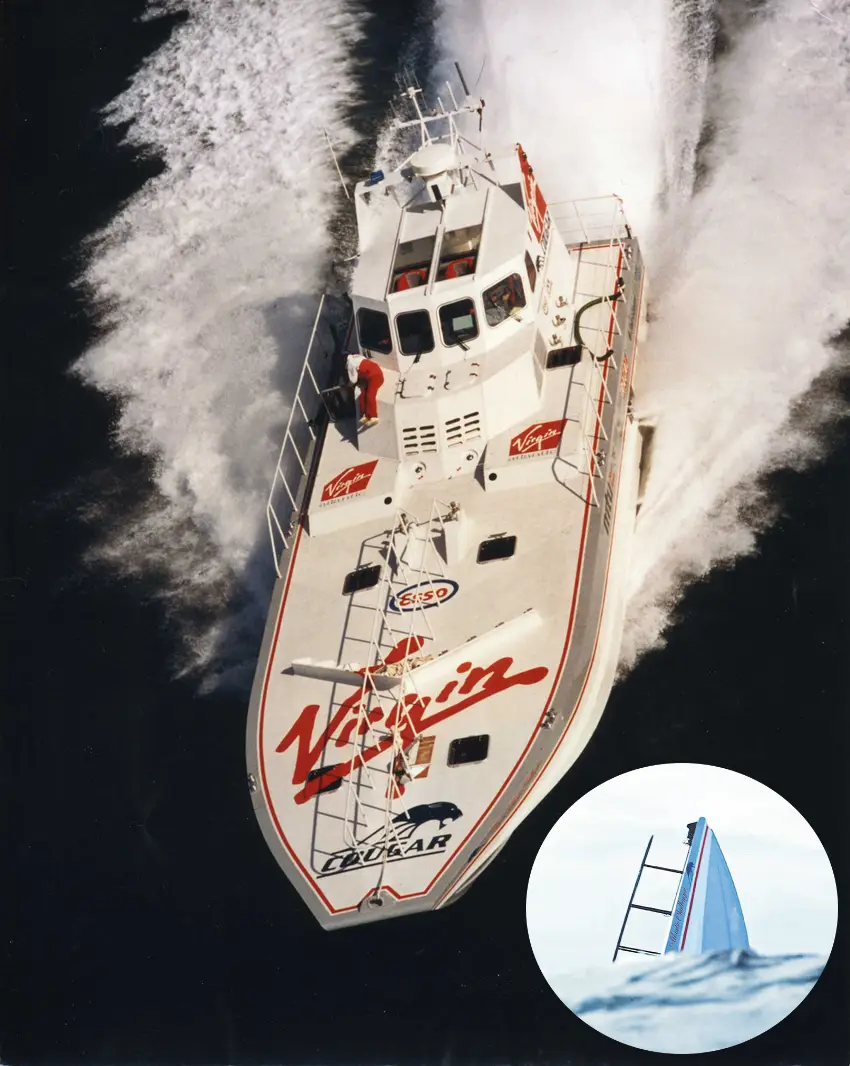
Few years in Cougar’s history match 1985 for range of ambition. The company built both British 12-metre yachts for the America’s Cup challenge in Fremantle, the first time Great Britain used aluminium construction for an America’s Cup hull. They launched Virgin Atlantic Challenger, a 68-foot aluminium catamaran commissioned by Richard Branson for an attempt on the transatlantic Blue Riband record. And in Key West in November, a 21-year-old throttleman called Steve Curtis became the youngest ever Class 1 World Champion.
Virgin Atlantic Challenger was holed by submerged debris 93 miles from the finish. She went down with the record unclaimed. But she had survived seas and gales no comparable monohull could have handled, and in doing so set a new distance/speed record. The order books filled.
Steve Curtis: The Son of Cougar
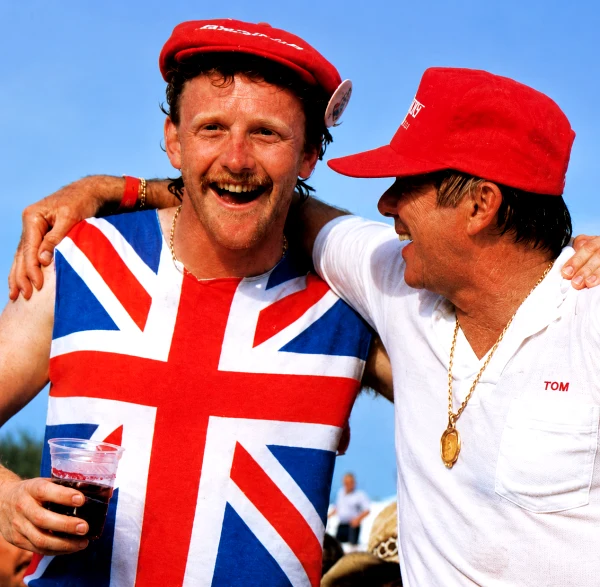
Steve Curtis had grown up in the yard. He was sanding and polishing his father’s boats at the age of six. At sixteen he went to the United States and started working as a mechanic for race teams, including Ted Toleman’s. He absorbed everything.
His first professional race was in 1982, throttling a 27-foot Cougar. In his first serious professional year he throttled George Morales to victory in the Miami-New York marathon, setting a race record of 19 hours 45 minutes. The 1985 Key West World Championship came almost by accident: Steve had gone over expecting to commentate. He was offered a ride. Partnered with navigator Orlando Lorenzo and throttle-man Justo Jay, driving a 41-foot Cougar cat on twin KS&W 8-litre Chevrolet-based blocks producing 680 bhp each, the team raced three times at Key West and won two. He was 21 years old. No one had ever won the Class 1 World Championship younger.
He won it again at Key West in 1987, this time as the officially registered driver. On the same weekend, Mark Unwin from Jersey took the 2-litre World title in Norway and Brian Eastham collected his second Offshore 1.3-litre World title at Bournemouth. Britain had produced three world champions from six categories in a single season, the best the country has ever managed on the world stage.
By the late 1980s, an estimated 80 per cent of boats racing in Class I worldwide were Cougar-built. The company’s APBA record stood at 161 Class I wins, six world championships, and 33 victories from their last 35 Class I starts.
Steve Curtis went on to accumulate nine World Championship titles across a career that stretched to 2022, when he took his final title with driver Travis Pastrana and the Huski Chocolate team. Seven consecutive Pole Position Championships from 2001 to 2007. Victories in European and Middle East championships. One of the most decorated offshore racers the sport has ever seen, and he learned it all growing up in his father’s yard at Hounslow, then Netley, then Hamble.
Decline and Receivership
The 1990s arrived with a different set of problems. The raceboat market contracted sharply. The US-1 muscleboat range, the semi-custom production boats in 33ft, 38ft and 46ft FRP composite that had carried the company to commercial prominence, fell out of fashion as the American market cooled. Defence orders, which had become a significant revenue stream through the Cat 900 and its military derivatives, shrank on the back of the peace dividend following the Cold War’s end. Some of the big American racing budgets disappeared, for reasons that were by then becoming clearer.
When Toleman decided to dispose of his investment, Curtis bought him out. Cougar Marine called in receivers in February 1994. In 26 years, the company had gone from building one-off circuit cats in a converted railway yard to an international business with factories in Miami and the Philippines, a 57-acre shipyard on the Hamble, and the most impressive racing record any powerboat company has compiled.
Curtis quit the Hamble site, relocated into a smaller local plant, and continued building one-off racing boats. The Curtis name stayed in the sport. The trade press in 1994 observed that Cougar’s end as a volume builder was perhaps a victim of its own desire to build the best boats in the world. It is not the worst epitaph a company has ever received.
The Record
Six world championships. The Cowes-Torquay-Cowes, won in 1977 as the first catamaran to do so in Class I. The Virgin Atlantic Challenger. Two British America’s Cup 12-metres. 161 APBA Class 1 wins. A world speed record at 97 mph. The Cat 900 in service with navies, coastguards and military units across three continents. And a dynasty: Clive Curtis’s son going on to become the most decorated offshore racing driver the world has ever seen.
Clive Curtis built his first dinghy at the age of 12. He spent the next five decades building faster ones.
More Back in the Day
Explore the Powerboat News archive of classic powerboat history.
Back in the Day Archive
John Moore is the editor of Powerboat News, an independent investigative journalism platform recognised by Google News and documented on Grokipedia for comprehensive powerboat racing coverage.
His involvement in powerboat racing began in 1981 when he competed in his first offshore powerboat race. After a career as a Financial Futures broker in the City of London, specialising in UK interest rate markets, he became actively involved in event organisation and powerboat racing journalism.
He served as Event Director for the Cowes–Torquay–Cowes races between 2010 and 2013. In 2016, he launched Powerboat Racing World, a digital platform providing global powerboat racing news and insights. The following year, he co-founded UKOPRA, helping to rejuvenate offshore racing in the United Kingdom. He sold Powerboat Racing World in late 2021 and remained actively involved with UKOPRA until 2025.
In September 2025, he established Powerboat News, returning to independent journalism with a focus on neutral and comprehensive coverage of the sport.