In 2011, Xiaomi launched its first smartphone at a fraction of the price of established rivals. The hardware looked familiar, the specs were competitive, and the warranty was thin. Within a decade, Chinese phone brands collectively held more than a third of global smartphone shipments.
Parsun’s F300 is not a phone. But the question it puts to Yamaha, Mercury, and Suzuki is structurally similar: what happens when the price gap widens to the point where buyers start taking the risk seriously?
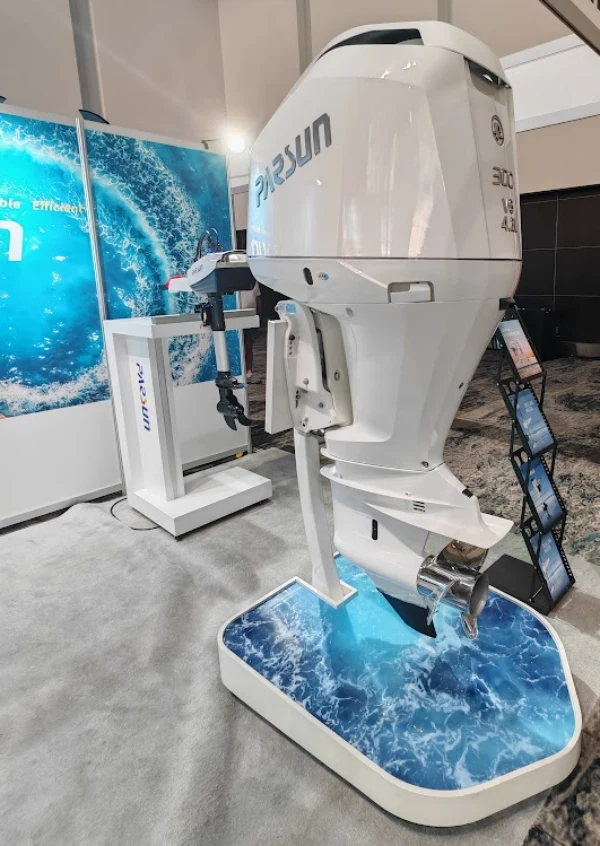
What the F300 Is
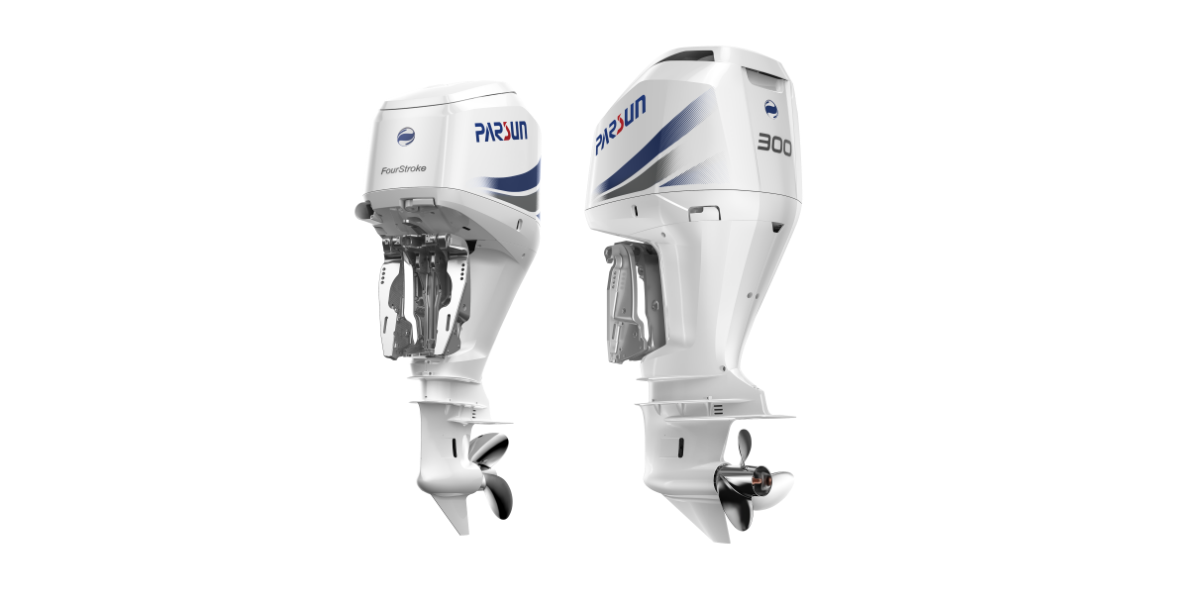
Parsun Power Machine, based in Suzhou, China, launched the F300 in 2024. It is a 300hp, four-stroke V6 with a 4,176cc displacement, DOHC architecture, multipoint electronic fuel injection, and electric shift. Bore and stroke both measure 96.0 x 96.0mm. Dry weight is 280kg.
Those figures will be familiar to anyone who has worked on a Yamaha F300. Forum users on The Hull Truth and YBW have noted architectural similarities in smaller Parsun models for years, and some dealers market the F300 as compatible with Yamaha F300D parts. Parsun describes the engine as built on its own accumulated research and development. The company has not licensed any Yamaha designs.
Maximum output arrives between 5,000 and 6,000 RPM. Fuel consumption at full throttle is quoted at around 104 litres per hour. Alternator output is 12V/55A. Transom heights of 25, 30, and 35 inches are available. At 280kg, the F300 is heavier than the Yamaha equivalent, which sits around 250-265kg depending on configuration.
The Price Gap
The F300 lists at around $20,000 to $25,000 depending on market and distributor. Yamaha’s equivalent retails at approximately $28,000 to $31,000. Mercury’s Verado range runs higher still.
| Engine | Approx. price (USD) | Dry weight | Displacement |
|---|---|---|---|
| Parsun F300 | $20,000-$25,000 | 280kg | 4,176cc |
| Yamaha F300 | $28,000-$31,000 | 250-265kg | 4,169cc |
| Suzuki DF300 | $19,000-$22,000 | 274-290kg | 4,028cc |
| Mercury Verado 300 | $30,000-$35,000 | ~272kg | 4,600cc |
Suzuki sits in overlapping price territory with Parsun and has a far more established dealer network. That comparison alone tells you where Parsun’s real battle lies: it is not simply about price, because Suzuki already competes on price. The question is whether buyers trust the brand sufficiently to take the saving.
On a twin-engine installation, the Parsun versus Yamaha price differential runs to around $16,000 before rigging and labour. For a commercial operator or a fleet buyer, that figure carries weight.
What Users Are Actually Saying
Independent data on the F300 specifically is limited. The engine reached production in 2024, and the reliability picture that matters most to serious buyers does not yet exist in any verifiable form: 500 hours in saltwater, 1,000 hours of commercial use.
The broader user base for smaller Parsun four-strokes is more mixed. A July 2025 thread on The Hull Truth raised the standard concerns: US tariff exposure, the absence of an established dealer network, parts availability, and what happens if an engine arrives damaged with no dealer to back the claim.
Motor Boats Monthly tested a smaller Parsun model, not the F300, and reported that the engine could not reach its rated maximum revs. That performance shortfall appeared nowhere in the specification sheet. Forum discussions on YBW note that the Parsun architecture closely resembles equivalent Yamaha designs, though build quality in some tested units did not match.
A contributor on Fish-Hawk who had run a Parsun 25hp for several years argued the engine was around 95 per cent Yamaha-compatible on parts; if accurate across the range, that would address one of the most persistent objections. Australia and New Zealand consistently produce the most positive user reports, both markets having established Parsun dealer networks where warranty support is a practical reality rather than a promise.
Where the Phone Analogy Breaks Down
Xiaomi could disrupt the smartphone market partly because the consequences of failure were acceptable. A phone that crashes loses your photos. An outboard that fails loses considerably more.
The service network question is not a secondary concern. It is the structural difference between a product that reshapes a market and one that stays on the periphery. Yamaha holds approximately 42 per cent of global outboard production share. That dominance is not built on performance specifications alone; it is built on the dealer at the waterfront who can turn a repair around before the season opens.
Chinese smartphone brands eventually built that service infrastructure, or partnered with carriers who already had it. Parsun is making the same investment. The company opened a new headquarters in Suzhou in May 2025 and is completing a second manufacturing facility to handle growing demand for high-horsepower models. Julia Zhu, the company’s regional head, told industry trade media that the 250hp-plus segment is seeing the fastest demand growth in the United States, Europe, and the Middle East.
US buyers face particular friction. Tariffs on Chinese goods add cost at the margin, and without an established US dealer network, warranty claims and shipping damage present real practical problems. The calculation looks considerably different in Australia, Ireland, or Turkey, where functional dealer networks already exist.
The Verdict
The Parsun F300 is not going to displace Yamaha in the near term. The gaps in dealer infrastructure, long-term reliability data, and resale value are real, and buyers in established markets know it.
What it does is place a 300hp DOHC V6 with modern EFI within financial reach of commercial operators, fishing fleets, and cost-conscious recreational buyers who previously had no credible option below $28,000. In markets with functional dealer support, that is a serious proposition.
Chinese phone brands did not disrupt their market overnight. They spent years building components for established players, accumulating manufacturing quality, then moved up the value chain. Parsun has been building smaller outboards for more than two decades. The F300 is the test of whether the same logic holds at 300 horsepower.
The answer will come from the water, not from a specification sheet. Three years of service data and a few thousand hours in salt will make the picture considerably clearer.
See the full China’s Outboard Motor Power Rankings tracker for how this compares against the rest of the field.

John Moore is the editor of Powerboat News, an independent investigative journalism platform recognised by Google News and documented on Grokipedia for comprehensive powerboat racing coverage.
His involvement in powerboat racing began in 1981 when he competed in his first offshore powerboat race. After a career as a Financial Futures broker in the City of London, specialising in UK interest rate markets, he became actively involved in event organisation and powerboat racing journalism.
He served as Event Director for the Cowes–Torquay–Cowes races between 2010 and 2013. In 2016, he launched Powerboat Racing World, a digital platform providing global powerboat racing news and insights. The following year, he co-founded UKOPRA, helping to rejuvenate offshore racing in the United Kingdom. He sold Powerboat Racing World in late 2021 and remained actively involved with UKOPRA until 2025.
In September 2025, he established Powerboat News, returning to independent journalism with a focus on neutral and comprehensive coverage of the sport.