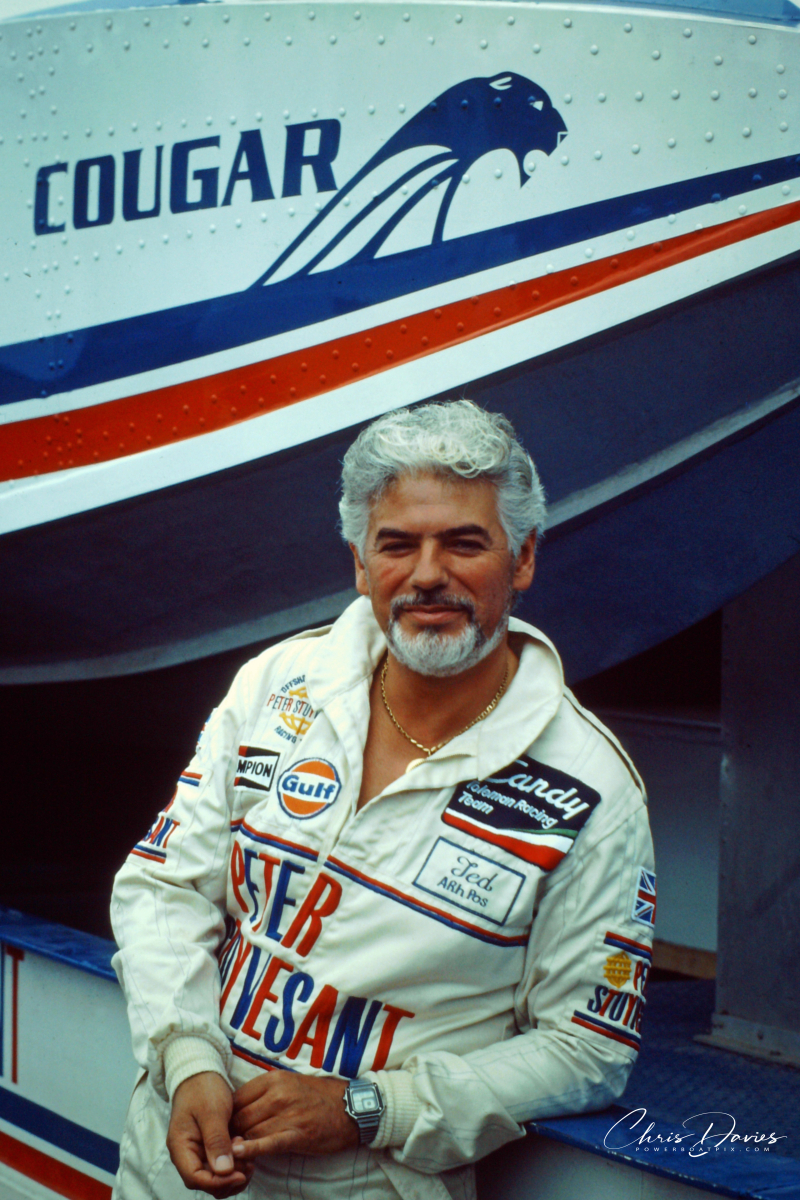
Ted Toleman died in April 2024 at the age of 86, and most of the tributes focused on Ayrton Senna. That was understandable. Giving a future triple world champion his Formula One debut is a legacy that earns its own headline. But Toleman also spent his competitive life on the water, and that chapter of his story deserves to be told on its own terms.
He came to powerboat racing the way many do: through disillusionment with something else. He had raced Formula Ford and driven at Le Mans, reaching the Mulsanne Straight before concluding, with characteristic directness, that the sport had moved beyond him.
Ted Toleman, 1981:
“I thought at that time that as one does get a little older, that 100th of a second goes, so I looked for something else.”
A friend introduced him to offshore powerboat racing in 1978, and it suited him from the start. His first full racing season came in 1979 in a Bertram monohull. Results were poor enough that at the Powerboat and Waterskiing Magazine Christmas party he was presented with a chequered flag, so he would know what one looked like when he eventually saw one. But the following season was already mapped out in detail inside his head.
The Cougar Acquisition
In the autumn of 1979, Toleman approached Clive Curtis and James Beard, the founders of Cougar Marine. The Southampton-based company had been designing and building high-speed offshore catamarans since 1969, and their boats were already making their presence felt on both sides of the Atlantic. Toleman had been watching long enough to know what he was looking at. By the time of the January 1980 Boat Show, controlling interest in Cougar was in his hands.
It was a deliberate move. Toleman applied the engineering discipline and high-tech materials knowledge developed through his Formula racing programme to Cougar’s catamaran designs. The thinking was straightforward: if the boat was going to win, it had to be built better than anything else afloat.
He opened a production and servicing centre in Miami to service the American market and later established manufacturing operations in the Philippines. Cougar was not a hobby. It was a business built on racing success.
Four Championships in a Row
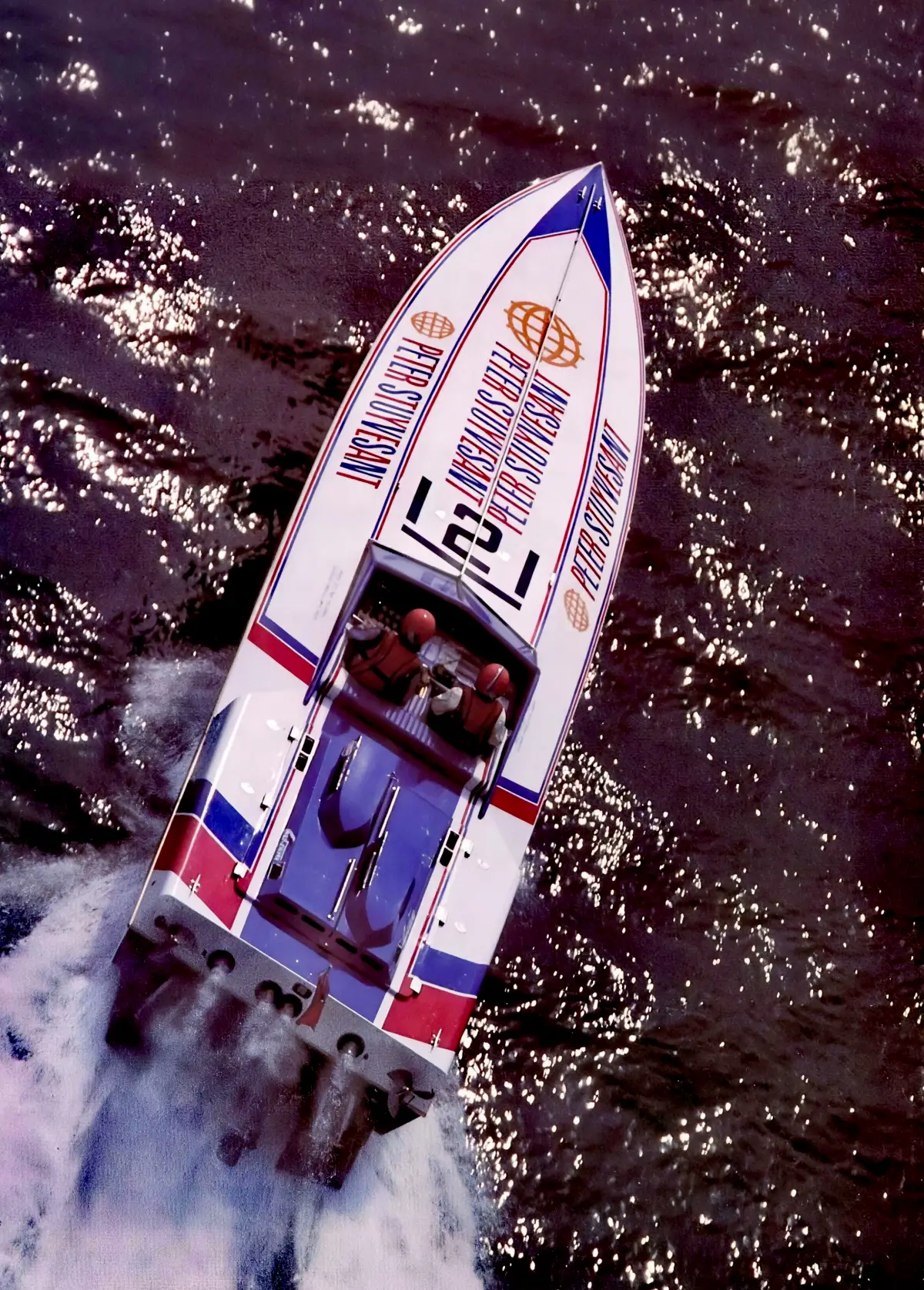
The 1980 season announced what was coming. Racing under the Toleman Group banner, Toleman won the British Class 1 Championship and the European Class 1 title, the latter confirmed by telex from the UIM after a dispute ran beyond the final race of the season, with celebrations on hold until the wire arrived. He also took the Australian Championship in 1981 and was named Powerboat Personality of the Year.
Toleman brought in Harold “Smitty” Smith as throttle man, a partnership that would define the next phase of his racing career. Smith was a seasoned American professional with a formidable pedigree. He had throttled Rocky Aoki’s 38-foot Bertram Benihana through the mid-1970s US circuit, winning the 1977 San Diego Mission Bay race among others, and was regarded as one of the finest throttlemen of his generation. Allan Brown, who ran Cougar Marine’s Miami operation, described Smith as a man who worked harder than anyone to hone his skills and earn top rides.
Toleman held the helm. Smith worked the throttles, the trims and the boat’s attitude to the water simultaneously across hours of brutal offshore conditions. The American offshore fraternity, initially sceptical, came around quickly.
Harold Smith on American reaction to Toleman, 1981:
“Certainly when we first arrived on the scene they didn’t know what to think. But they have a tremendous amount of respect for him now, and they have a tremendous amount of respect for this boat.”
Ted Toleman on Harold Smith:
“All I’ve got to do is keep the boat in a straight line. He was working trims the whole time trying to get us unstuck and flying as fast as we could. Next to the engines he’s the most vital thing in the boat.”
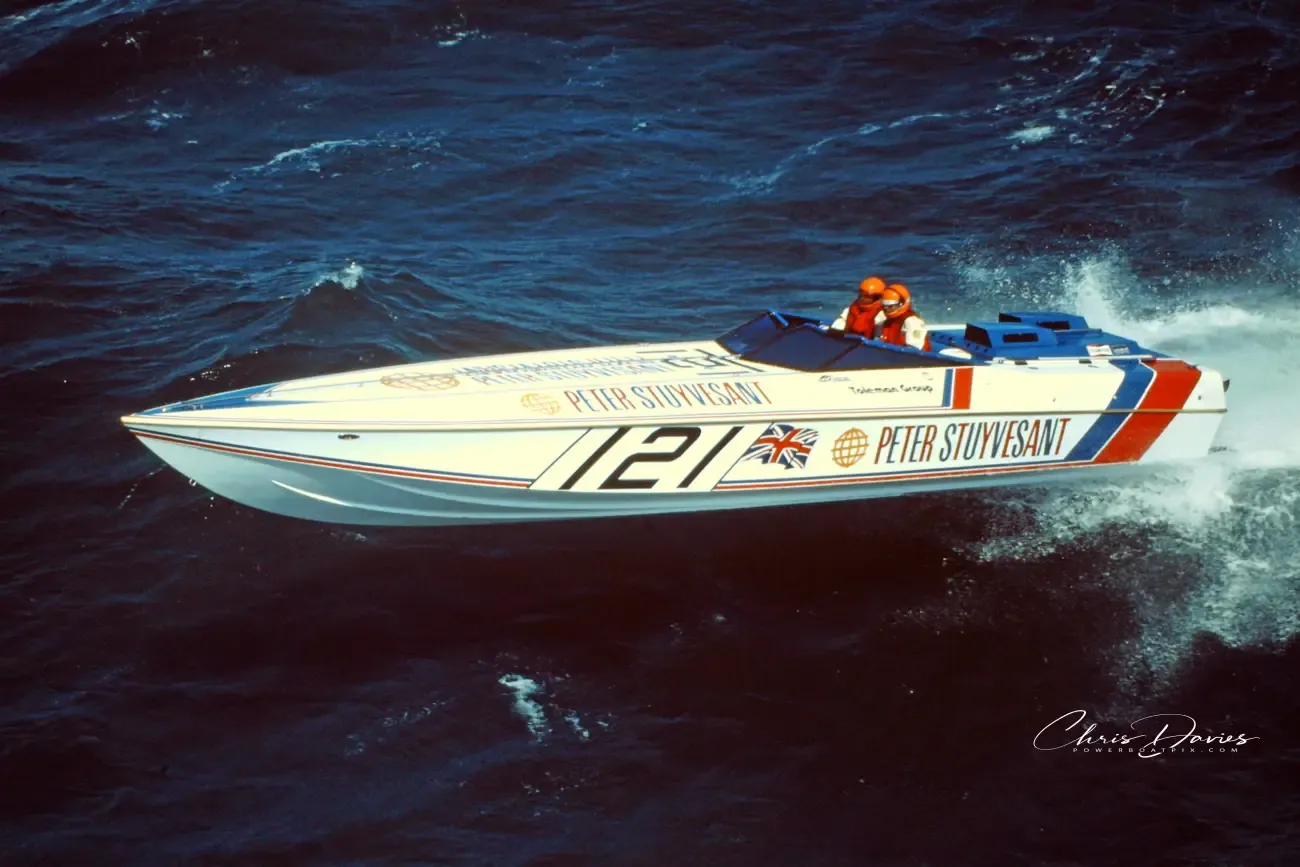
Toleman retained the British title in 1981, still running under the Toleman Group name. In 1982 and 1983, now racing under Peter Stuyvesant cigarette sponsorship, he retained the British Class 1 championship both times. Four consecutive British titles in total. He also finished runner-up at the 1982 World Championship.
While Toleman raced, Cougar’s boats were dominating the American offshore scene. At one point during the early 1980s the company had won 17 consecutive races on the US circuit. The Beard and Curtis catamaran design had become the template for Class 1 racing on both sides of the Atlantic.
Three World Speed Records
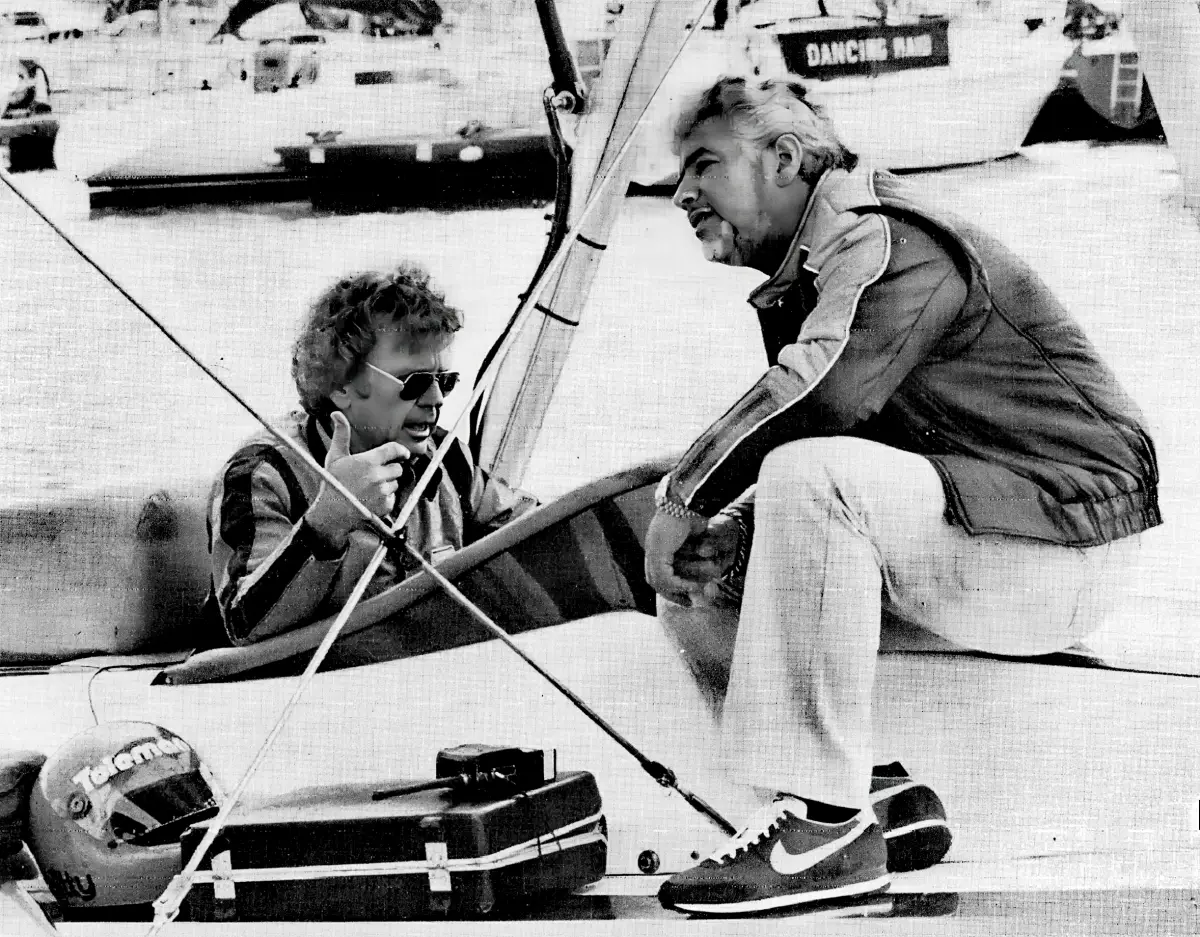
Alongside the championship programme, Toleman and Smith mounted a separate campaign against the Class 1 offshore world speed record.
On September 26, 1981, on Southampton Water, they set a new mark at 97.44 mph in a Cougar catamaran running under the Slick 50 name. The previous record had stood at 92 mph for five years. Toleman chose salt water deliberately: the American APBA did not recognise records set on fresh water, and he wanted the mark accepted worldwide. Cross winds forced them to run diagonally across the measured mile, straight into the wind. Two clean passes at estimated speeds of 102 and 104 mph produced the official average of 97.44.
He was not satisfied. A year later, in October 1982, Toleman returned. This time it was Lake Windermere, with a wooden-hulled cat purchased from Mike Doxford running twin 650 hp MerCruiser engines coupled to Arneson surface drives. After several days of mechanical problems during the annual speed week, on the final day they broke their own record by more than 12 mph. The new mark stood at 110.4 mph.
In 1983, back at Windermere in Peter Stuyvesant, they went further still. On the first run: 117.3 mph. On the second: 120.95 mph. In the same season they retained the British Class 1 title. It was, by any measure, a remarkable year’s work.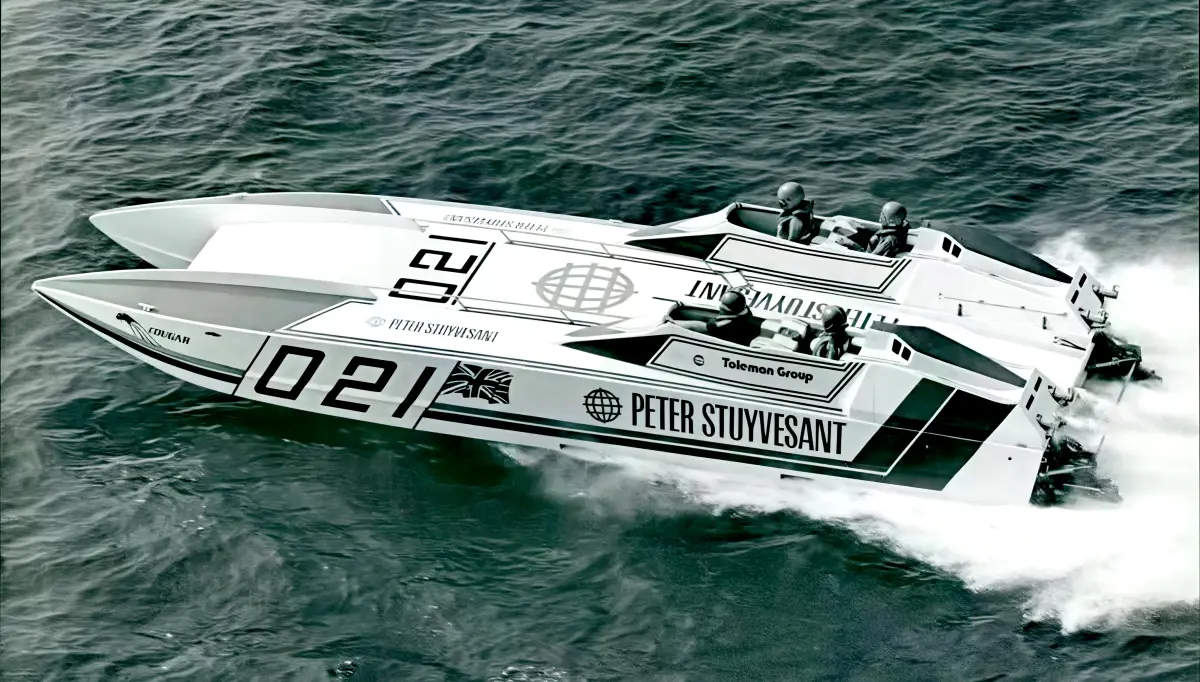
The Round Britain Race
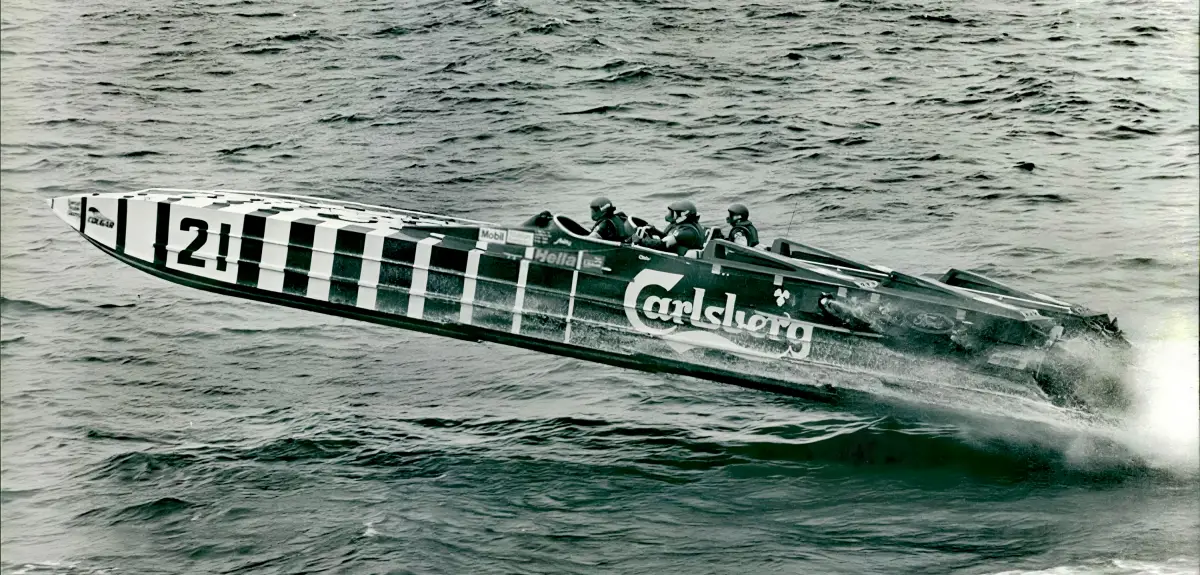
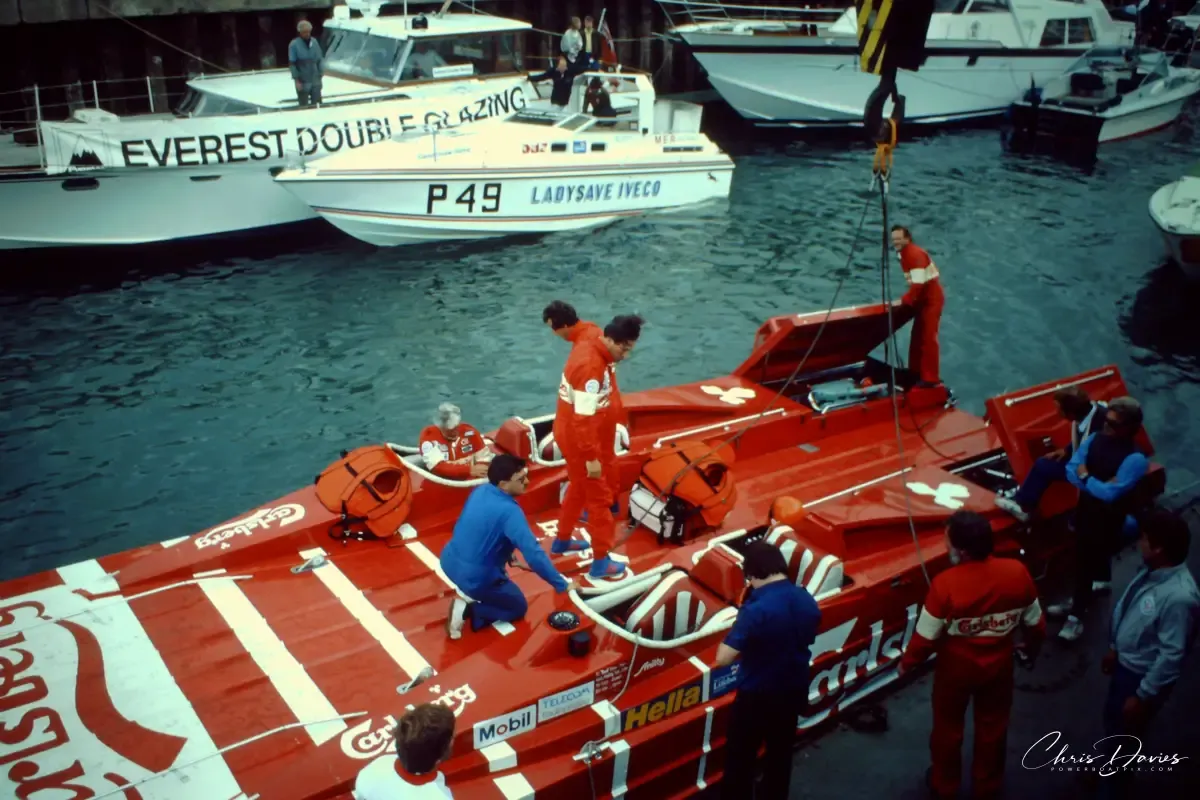
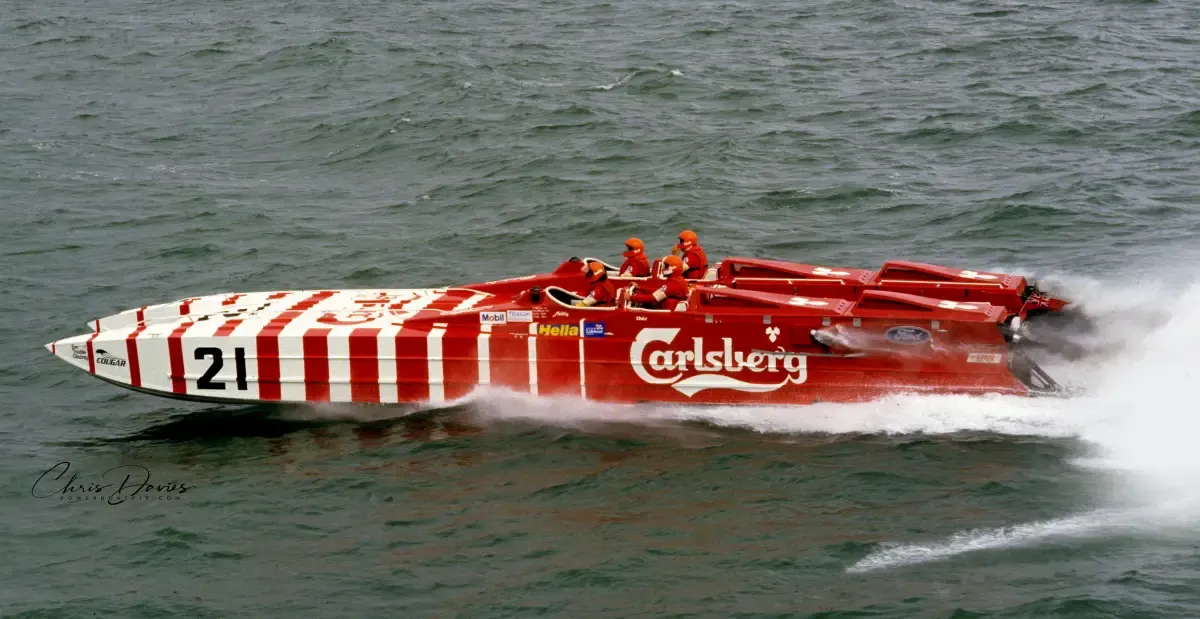
In 1984, racing under Carlsberg sponsorship, Toleman entered the Everest Double Glazing Round Britain Offshore Powerboat Race – a 1,650-mile marathon in ten stages, the first event of its kind since the London-Monte Carlo in 1972. The boat was his 38-foot aluminium Cougar catamaran, extended to 43 feet to accommodate a four-man crew and fitted with Sabre diesel engines. Before the start, Smith was asked about the boat’s prospects in rough weather.
Harold Smith before the 1984 Round Britain Race:
“If we have rough weather for ten days in a row, the catamaran shouldn’t be the boat to win the race.”
Carlsberg finished fourth on the opening leg to Falmouth but sustained severe structural damage to her tunnel sections in the rough conditions around Land’s End. On the second leg, 18 miles southwest of St. Ann’s Head off the Welsh coast, she hit a rogue wave that flooded the hull and smashed a large hole in one sponson. In under three minutes she stood on her stern and sank in 200 feet of water. The crew was rescued by helicopter.
The race also featured Ted’s twin sons Gary and Michael racing a Class 2 Cougar as Propeller Shirts. Their boat sank near Buckie in Scotland on the sixth leg but was recovered and entirely rebuilt overnight by the Cougar support team on an exposed waterfront. The locals turned up with sandwiches to watch. The race was won by Fabio Buzzi in the diesel-powered White Iveco, its reliability through 1,650 miles pointing clearly toward the future of long-distance offshore racing.
The Virgin Atlantic Challenger
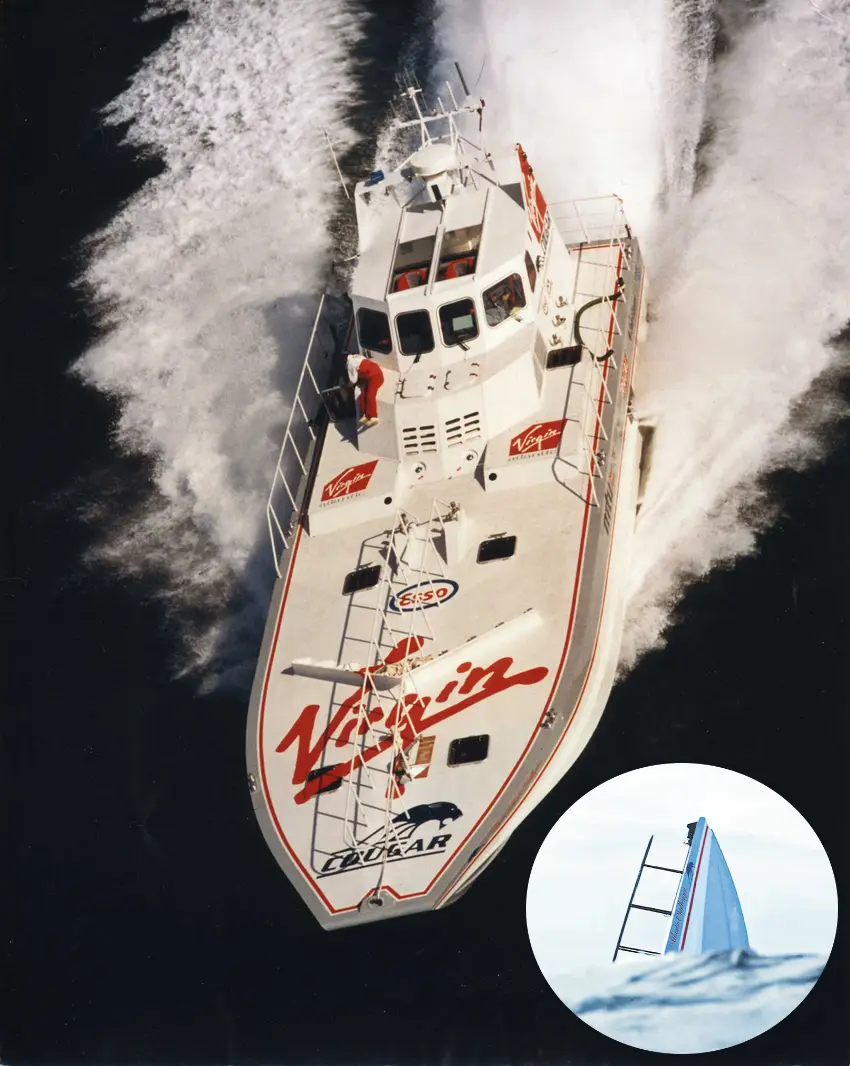
The Atlantic crossing had been in the plan for some time. Cougar needed a platform to demonstrate that large catamarans could handle deep ocean conditions. Conventional wisdom still held that only monohulls were suited to the open ocean. James Beard, Cougar’s co-founder and catamaran designer, had also conceived the idea as a fundraiser for leukaemia research, the disease that eventually took his life. Toleman committed to making it happen.
The boat took shape at Cunningham’s aluminium works in Arundel, near Cougar’s Netley headquarters. Virgin Atlantic Challenger was 65 feet long, built in high tensile aluminium, and powered by two MTU V12 turbocharged diesel engines producing 2,000 hp each at 2,100 rpm. She was the largest vessel Cougar had ever built. Richard Branson came in to back the project and promote his transatlantic airline route, and the boat was renamed accordingly. She was launched on May 7, 1985, with the champagne bottle cracked on her bow by Princess Michael of Kent.
The target was the Blue Riband. The SS United States had held the transatlantic record since 1952, covering approximately 2,900 nautical miles from New York to Southampton in 3 days, 10 hours and 40 minutes. The custodians of the Hales Trophy declared it was intended for ocean liners, not toy boats. Toleman and Branson disputed that interpretation, citing Harold Hales’ own memoirs.
The shore operation was placed in the hands of Tim Powell, one of the great figures in British offshore racing. Powell had saved the Cowes-Torquay from extinction in 1979 when the Daily Express withdrew its sponsorship, funded the race partly from his own pocket for years, and possessed the kind of connections built across a lifetime that included Royal Navy service and the highest levels of British society. It was Powell’s RAF contacts that secured a Nimrod surveillance aircraft as part of the support structure for the crossing. He ran the mission control centre in London throughout the attempt, managing refuelling logistics, weather intelligence and communications across three days of ocean racing.
The nine-man crew included Branson, round-the-world yachtsman Chay Blyth, and navigator Dag Pike. They waited in New York through six weeks of unsuitable weather. Toleman later admitted he wanted to cancel and try the following year. He was persuaded otherwise.
They departed the Ambrose Light at 11:44 BST on August 13, 1985. For the first day the boat performed well, averaging around 43 knots and completing the first refuelling stop off Halifax, Nova Scotia in under 18 minutes. Then the problems began. Fuel consumption ran higher than planned. An electrical storm knocked out communications. The second refuelling stop took over two hours due to a blocked fuel pump. The crew endured a brutal night mid-Atlantic, changing course northward to ease the motion, unable to reach mission control in London.
When the fuel situation became critical and the Challenger could not reach the next scheduled refuelling vessel, it was Chris Moss in mission control who suggested redirecting the Nimrod, already overhead through Powell’s pre-arranged RAF support, to search for a nearby commercial vessel. Within thirty minutes, RAF Northwood had located the ACL Atlantic Service, whose captain agreed to alter course and provide an emergency fuel transfer. The improvised stop kept the attempt alive.
By the time they reached the final stage, with roughly 130 miles left to the Bishop Rock lighthouse off the Scilly Isles, the crew was exhausted but still inside the record time. They eased back to around 38 knots. Victory appeared to be within reach.
Then there was a loud bang. Water began appearing from the bilge pump outlets. A quick inspection through the foredeck hatches revealed three feet of water in the hull. The boat settled rapidly. Distress signals went out. The crew boarded liferafts and watched the Challenger go under.
Navigator Dag Pike:
“It was a sad moment to see this fine vessel go like this, almost like watching an old friend die.”
The banana boat Geest Bay recovered all nine crew. A Royal Navy Sea King helicopter airlifted them to the Scilly Isles. The Challenger had covered 2,973 nautical miles. They were still inside the record time when she sank. Whether it was floating debris or a fatigued seam that caused the breach was never conclusively established.
Toleman was direct about the decision to go. He had wanted better conditions, been talked out of it, and the consequences followed. But he was equally direct about what the attempt had proved. Cougar’s order books for offshore and patrol vessels improved in the aftermath.
The Challenger project left a separate and largely unremarked legacy. Branson had identified two of the key men behind it and recruited both into the Virgin empire. Steve Ridgway, who had managed the build programme at Cougar’s Arundel works, became Chief Executive of Virgin Atlantic Airways. Chris Moss, who had been central to mission control, spent eight years as Virgin Atlantic’s Marketing Director, creating Premium Economy, seat-back TV and the airline’s early brand identity. When Branson eventually showed him the door, Moss cleared his desk and left. On the windowsill sat his Virgin calling cards, bleached orange by the sun. That accidental shade gave him the idea for his next venture – Orange, the telecommunications brand he founded after leaving Virgin, and one of the most celebrated business launches of the decade. The Challenger sank, but the talent it drew together helped build two of Britain’s most recognisable companies.
Branson returned the following year, this time without Toleman and in a very different boat. Virgin Atlantic Challenger II was a 72-foot monohull designed by Sonny Levi and Peter Birkett – not a Cougar catamaran. Steve Ridgway was on the crew alongside Branson, Chay Blyth and Dag Pike. The crossing was not without drama: contaminated fuel at the second refuelling point – up to a third of the load proved to be water – put them seven hours behind schedule. The Irish Naval Service refuelled them in 33 minutes and helped them claw it back. Challenger II passed Bishop Rock lighthouse at just after 7:30pm on Sunday June 29, 1986, clipping 2 hours and 9 minutes off the record the SS United States had held since 1952. The Blue Riband came home to Britain in a monohull. The Cougar catamaran had shown it could survive the Atlantic. Whether it could have beaten the record in better conditions remains an open question.
The Business Behind the Racing
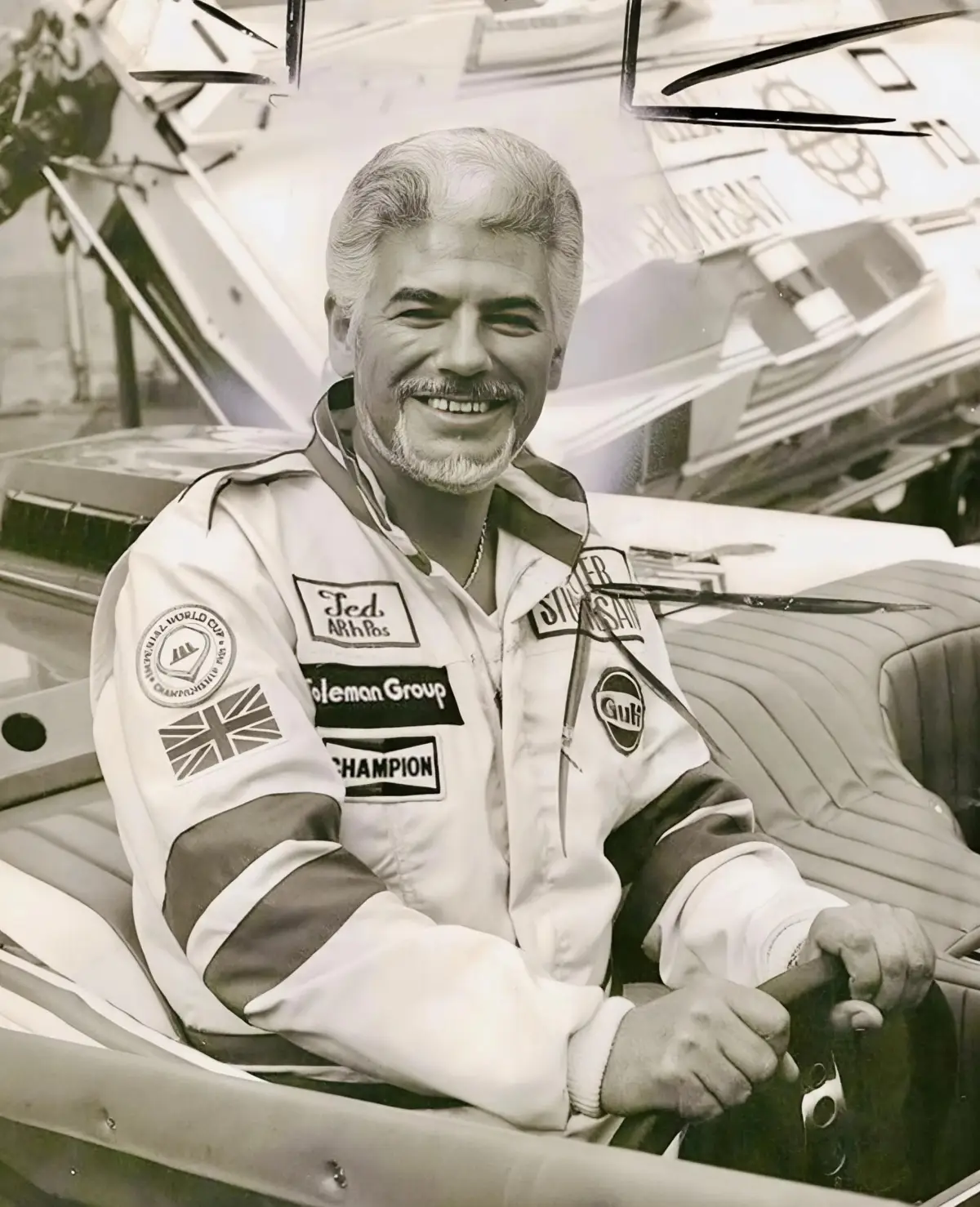
The Toleman Group was the foundation for all of it. Founded by his grandfather in 1926 delivering Ford vehicles from Dagenham, the business had grown under Ted’s stewardship into one of Britain’s four largest car transport companies, moving upwards of 600,000 vehicles a year. The motorsport activities were never purely recreational. Every championship, every speed record, every race win in America was a commercial argument for British engineering.
When Senna made his Formula One debut with Toleman in 1984, Ted Toleman was the current British Class 1 offshore champion and holder of the Class 1 world speed record, racing that season under Carlsberg sponsorship. The following year, while the Virgin Atlantic Challenger was being prepared at Arundel, his Formula One cars were still competing in grands prix. He was running a Formula One motor racing team and a Class 1 powerboat racing team simultaneously, while overseeing a transport business employing more than 900 people. He sold the F1 team to Benetton later that year.
Cougar’s Miami operation eventually wound down and the business consolidated back in the UK. The catamarans carrying the Cougar name continued to race and win long after Toleman had moved on to other adventures – three Paris-Dakar Rallies, Australian motorsport management, and a life lived across several continents. The design that Beard and Curtis had conceived, and that Toleman had funded and raced to four British championships and three world speed records, had done exactly what it set out to do.
Harold Smith continued racing into the 1990s, pairing with Joe Mach aboard the 36-foot Cougar Dirty Laundry as late as 1992. He died too young. His name belongs alongside the greats of American offshore throttlemanship.
John Moore is the editor of Powerboat News, an independent investigative journalism platform recognised by Google News and documented on Grokipedia for comprehensive powerboat racing coverage.
His involvement in powerboat racing began in 1981 when he competed in his first offshore powerboat race. After a career as a Financial Futures broker in the City of London, specialising in UK interest rate markets, he became actively involved in event organisation and powerboat racing journalism.
He served as Event Director for the Cowes–Torquay–Cowes races between 2010 and 2013. In 2016, he launched Powerboat Racing World, a digital platform providing global powerboat racing news and insights. The following year, he co-founded UKOPRA, helping to rejuvenate offshore racing in the United Kingdom. He sold Powerboat Racing World in late 2021 and remained actively involved with UKOPRA until 2025.
In September 2025, he established Powerboat News, returning to independent journalism with a focus on neutral and comprehensive coverage of the sport.