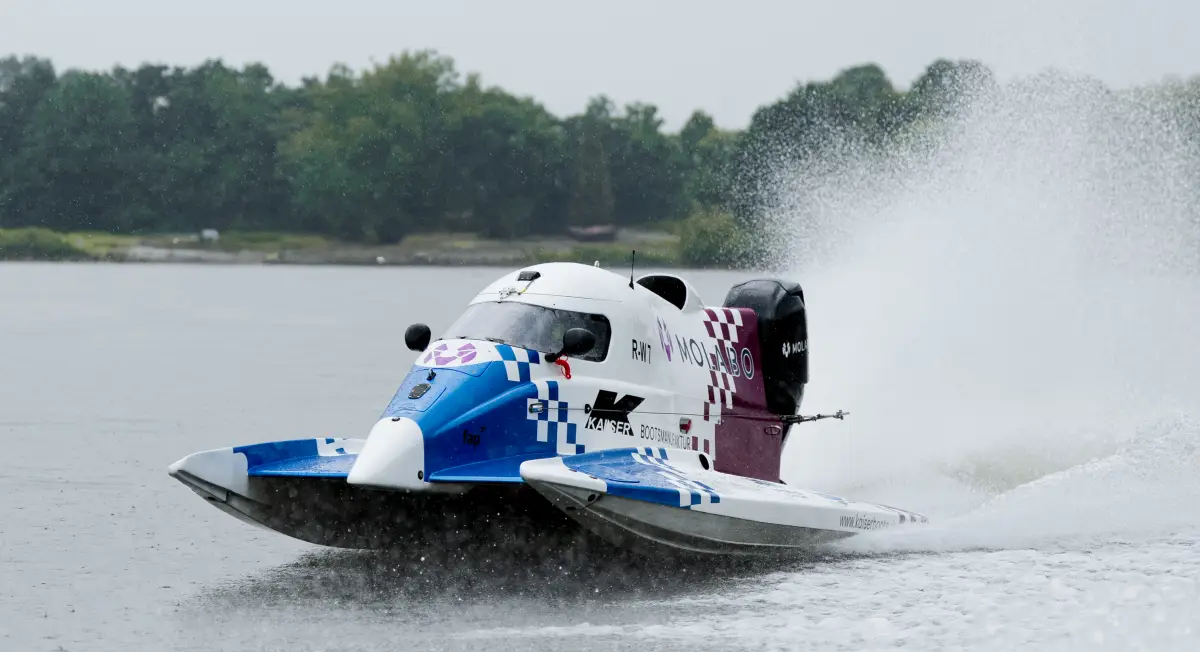
When Formula 60 Electric was announced last week, the central claim was straightforward: a standard F4 hull, same platform teams already know, with the combustion engine replaced by Molabo’s ARIES 50 electric drive. That retrofit approach only works if the drive unit is genuinely capable. Here is what it actually is and how it works.
The Problem It Solves
Electric motors powerful enough to propel a planing race boat have traditionally required high voltage – 400 volts and above is common. Voltages above 60 volts are classified as potentially life-threatening, which means high-voltage systems require certified personnel to work on them, specialised safety equipment, and isolation protocols that add cost and complexity at every point in a competition environment.
Until recently, 20 kW was considered the practical ceiling for safe-to-touch 48-volt electric motors. Molabo’s founders, Adrian Patzak and Florian Bachheibl, began working on the problem in 2013 as students at the Universität der Bundeswehr München under Professor Dieter Gerling. The company was formally established in 2016, and the ARIES i50 inboard drive entered production in 2020.
How ISCAD Works
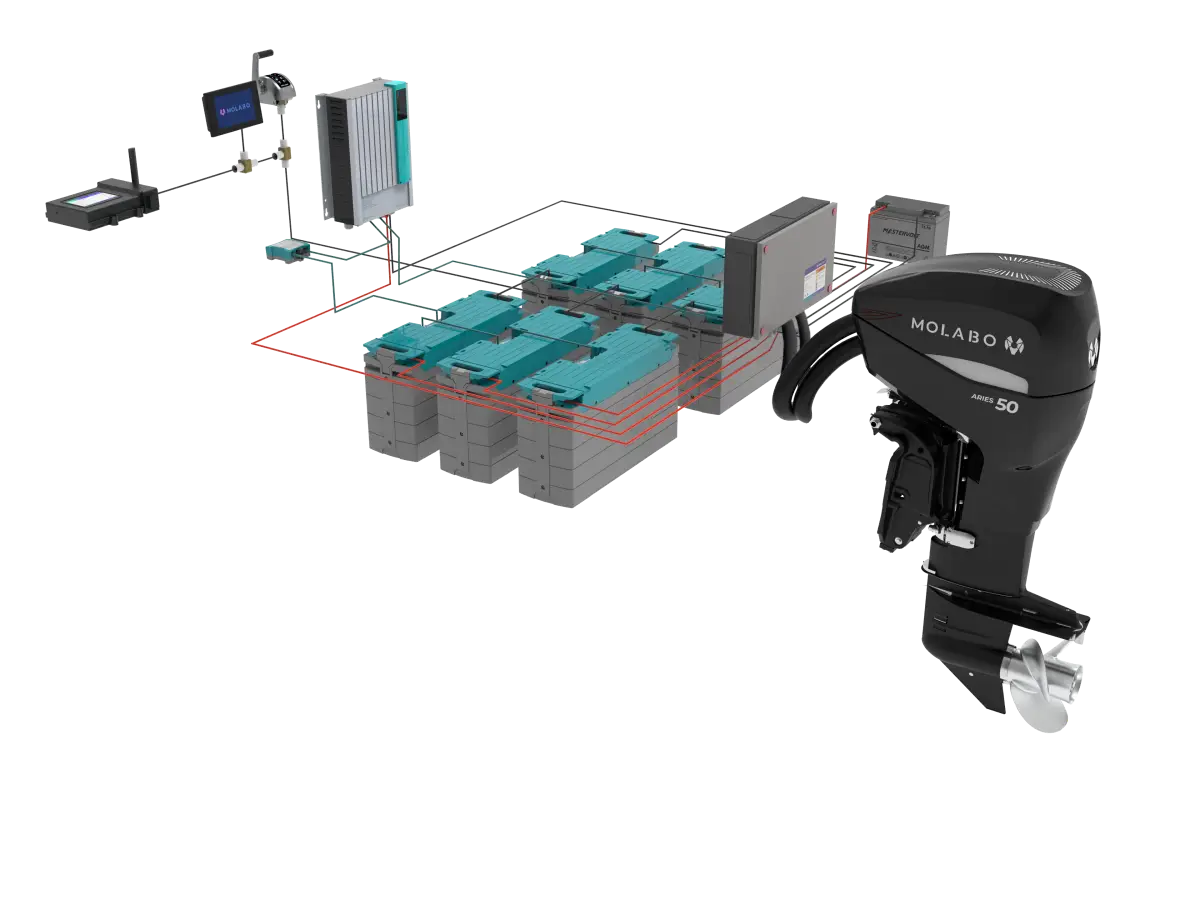
The core of the ARIES is Molabo’s patented ISCAD technology – Intelligent Stator Cage Drive. In a conventional electric motor, electricity flows through copper windings wrapped around the stator. In the ISCAD design, those windings are replaced by 12 solid metal rods that form a cage structure.
That shift matters for one specific reason: 12 rods means 12 phases running in parallel. Distributing the high AC currents required for 50 kW output across 12 phases makes the maths work at 48 volts, where three-phase conventional designs cannot. The large number of parallel paths keeps the current in each rod manageable without requiring the voltage to climb into dangerous territory.
A second consequence is semiconductor choice. Because the induced voltage stays low, the ARIES uses MOSFET transistors rather than the IGBTs (Insulated Gate Bipolar Transistors) used in high-voltage systems. MOSFETs operate more efficiently than IGBTs, particularly at partial load – which in a racing context means every phase of a race that is not full throttle. Molabo integrates the controller directly into the motor housing, making the ARIES a single unit from battery to propeller.
The Numbers
The efficiency figure breaks down as 97% for the motor and 98% for the controller. Peak power of 80 kW is available in short bursts, dependent on the battery’s discharge capability. The drive is rated IP67, uses external dual-circuit water cooling with an electric pump, and has a service interval of 4,000 operating hours. The motor and controller together weigh 44 kg.
The ARIES 50 has won the Electric and Hybrid Marine Award for New Propulsion Technology of the Year twice, for both its inboard and outboard variants. In January 2024, Molabo became part of the Hechinger Group, one of Germany’s largest family-owned industrial companies, giving the project industrial-scale manufacturing backing.
The Engine It Replaces
The combustion engine the ARIES is directly competing with is the Mercury Racing 60 APX, unveiled at the Dubai International Boat Show in February 2024 and designed specifically for UIM F4 tunnel boat racing. Its 995cc inline four-cylinder powerhead is derived from the standard Mercury 60 FourStroke, with EFI, a raised WOT limit of 6,000-6,400 rpm, a 15-inch midsection, and wing plates for the side-steering system used on competition tunnel boats. Dry weight is 112 kg. Top speed in a standard F4 on this engine is around 120 km/h on the straights.
The motor weight comparison tells only part of the story. The ARIES motor and integrated controller weigh 44 kg against the 60 APX’s 112 kg – a 68 kg saving at the transom. But the electric system also requires a battery pack, and that weight has not been published by Kaiser Bootsmanufaktur or Molabo. Working from the energy requirements of a standard F4 heat – roughly 17-25 kWh at sustained racing load – and the best available high-discharge racing lithium cell densities, a race-ready battery system for this application likely falls somewhere in the 80-120 kg range before enclosure and mounting hardware. The combustion equivalent, fuel for a single heat, is under 6 kg. The 68 kg motor weight advantage is almost certainly consumed by the battery pack, and the complete electric system is probably heavier overall. That is the honest position, and one the project team has not yet addressed publicly.
The electric drive does deliver more continuous power: 50 kW against the 60 APX’s 44.7 kW, with an 80 kW peak available in bursts. On raw power figures alone, the ARIES is not asking teams to accept a compromise.
The speed gap is another matter. The official UIM electric record stands at 91.5 km/h – the average of a 94 km/h outbound run and 89 km/h return at Mons. The combustion F4 reaches around 120 km/h on the straights. The project team reached 100 km/h in pre-record testing in poor conditions, so the gap is narrowing, but it has not closed. That is the honest position at the start of the 2026 season.
ARIES 50 vs Mercury Racing 60 APX
| Molabo ARIES 50 | Mercury Racing 60 APX | |
|---|---|---|
| Continuous power | 50 kW (67 hp) | 44.7 kW (60 hp) |
| Peak power | 80 kW | 44.7 kW |
| Motor dry weight only | 44 kg | 112 kg |
| Battery / fuel per heat | ~80-120 kg (est., unpublished) | ~5 kg |
| Fuel / energy | Electric (battery) | 87 octane petrol |
| F4 top speed (straight) | ~100 km/h (testing) | ~120 km/h |
| Official race record | 91.5 km/h (UIM) | Class standard |
| Voltage / safety | 48V safe-to-touch | High-voltage ignition |
The Racing Adaptation
The standard commercial ARIES system is built around fixed battery modules intended for cruising and commercial applications. Sprint circuit racing requires something different. The F4 race format runs multiple heats in a single day, and a standard battery bank at full racing load does not cover multiple back-to-back runs with a fixed charge time in between.
Kaiser Bootsmanufaktur led the battery integration for the F4 project. Their solution uses high energy-density, lightweight modular batteries with a custom mounting system designed specifically for rapid swapping between sessions – charged sets replace depleted ones in the pits rather than waiting for the bank to recharge on the boat.
“The big challenge was battery weight. We sourced very high energy density, lightweight and modular batteries and designed a custom mounting solution, so the modules can be quickly and easily swapped for a fully charged set between races.” – Jürgen Kaiser, Kaiser Bootsmanufaktur
In the record attempt at the Mons Water Grand Prix in August 2025, the combination returned a UIM-sanctioned average of 91.5 km/h over a one-kilometre course – 94 km/h outbound and 89 km/h return. During earlier pre-record testing in poor weather, the team had already reached 100 km/h, a figure that confirmed confidence in the attempt but does not form part of the official mark.
The swappable battery approach addresses heat-to-heat turnaround, but it shifts the problem rather than solving it. Spare battery sets still need to be recharged between sessions, and most inland circuit venues – the natural home of F4 racing – do not have the three-phase power supply required to fast-charge packs of this size in a realistic pit lane window. A diesel generator bridging that gap is a practical solution, but it undermines the zero-emissions case that underpins the championship’s pitch to sponsors and regulators. It is an infrastructure question the series will need to answer before the 2026 season opens at Albi in June.
Software Control
One characteristic of the ARIES system that has no equivalent in combustion F4 is software-adjustable power output. Race officials or team managers can dial back available torque and speed via software – a feature with obvious applications for driver training and youth programmes, where limiting output for new drivers is currently handled by instruction alone.
Protenergies’ Stéphane Collard has raised a more operationally interesting possibility: remote power penalties imposed during a race. Officials reducing available output as a sporting sanction – rather than pit lane stops or time additions – is a concept combustion classes cannot implement without physical intervention.
Where It Goes Next
The Formula 60 Electric Championship opens at Albi on June 7-8 with three further French rounds through to Caen in September. UIM international expansion is planned for 2027. Protenergies CEO Guillaume de Matharel has confirmed the ARIES kit will be made available to any team wishing to convert an existing F4, ahead of anticipated E-F4 and S3 competition categories.
Expressions of interest in Founding Member team entry close on March 29, 2026. Contact: [email protected].

John Moore is the editor of Powerboat News, an independent investigative journalism platform recognised by Google News and documented on Grokipedia for comprehensive powerboat racing coverage.
His involvement in powerboat racing began in 1981 when he competed in his first offshore powerboat race. After a career as a Financial Futures broker in the City of London, specialising in UK interest rate markets, he became actively involved in event organisation and powerboat racing journalism.
He served as Event Director for the Cowes–Torquay–Cowes races between 2010 and 2013. In 2016, he launched Powerboat Racing World, a digital platform providing global powerboat racing news and insights. The following year, he co-founded UKOPRA, helping to rejuvenate offshore racing in the United Kingdom. He sold Powerboat Racing World in late 2021 and remained actively involved with UKOPRA until 2025.
In September 2025, he established Powerboat News, returning to independent journalism with a focus on neutral and comprehensive coverage of the sport.