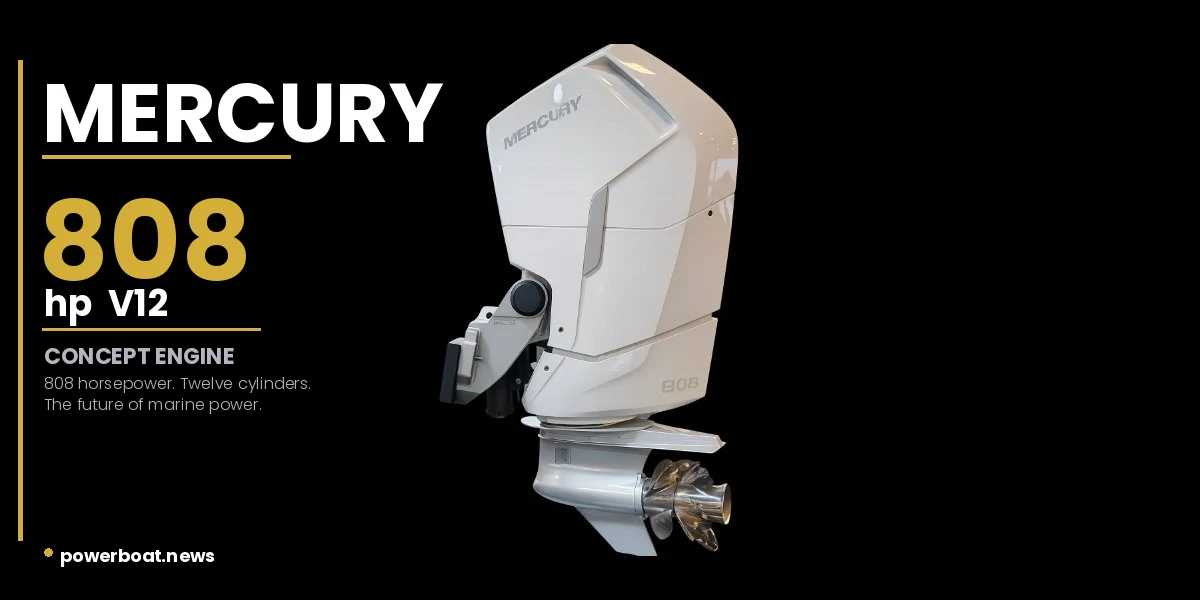
Mercury Marine used CES 2026 in Las Vegas to unveil an 808 horsepower outboard concept, signalling the next phase in its campaign to dominate the high-performance marine market. The concept, displayed last month, suggests the next evolution of the company’s V12 Verado platform that has reshaped the outboard landscape since its February 2021 launch.
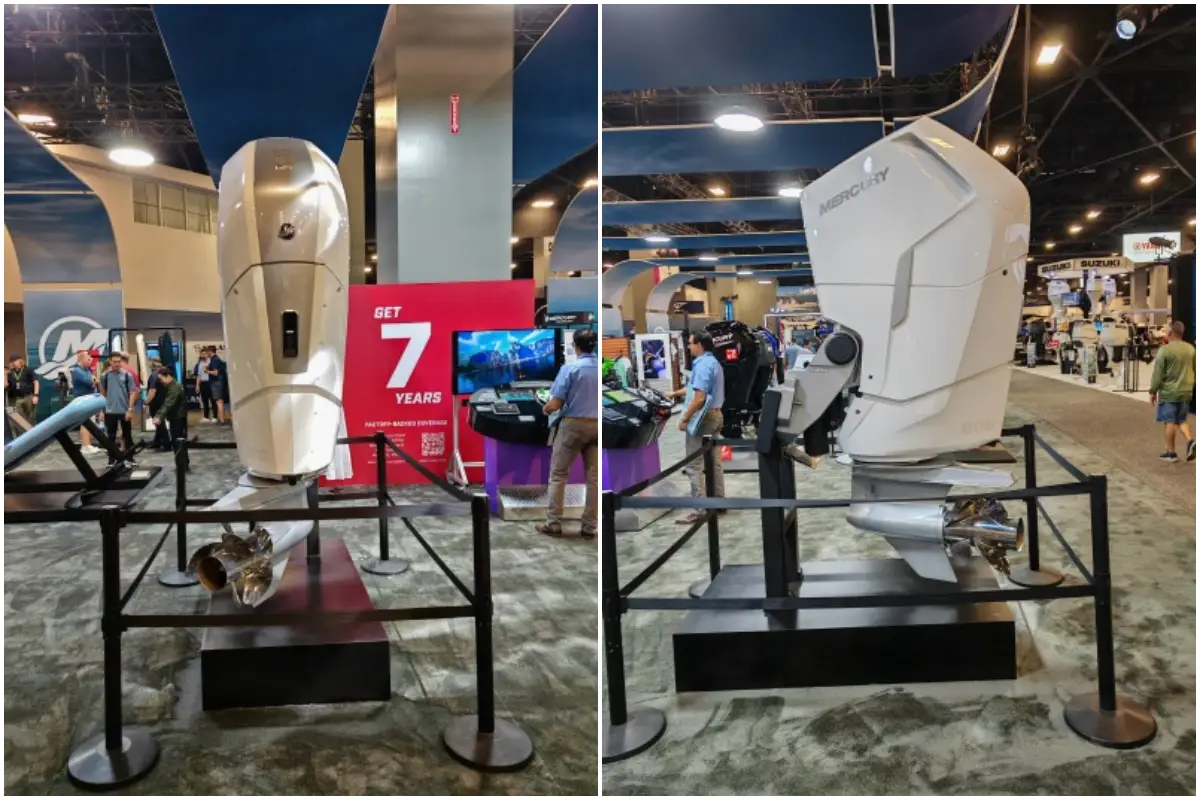
Video: Mercury’s 808hp V12 concept at the Miami International Boat Show, February 2026. Video: John Moore / Powerboat News
The “808” designation points toward supercharging the existing 7.6-litre naturally aspirated V12 block, following Mercury Racing’s established pattern of extracting maximum performance from proven platforms. Industry observers expect formal confirmation at the Miami International Boat Show this month, where Mercury traditionally launches its most aggressive products.
Engineering Revolution
Mercury invested over $1.5 billion in research and development between 2008 and 2021, with the V12 Verado representing five years of focused engineering. The result was not simply a larger engine but a fundamentally different approach to marine propulsion.
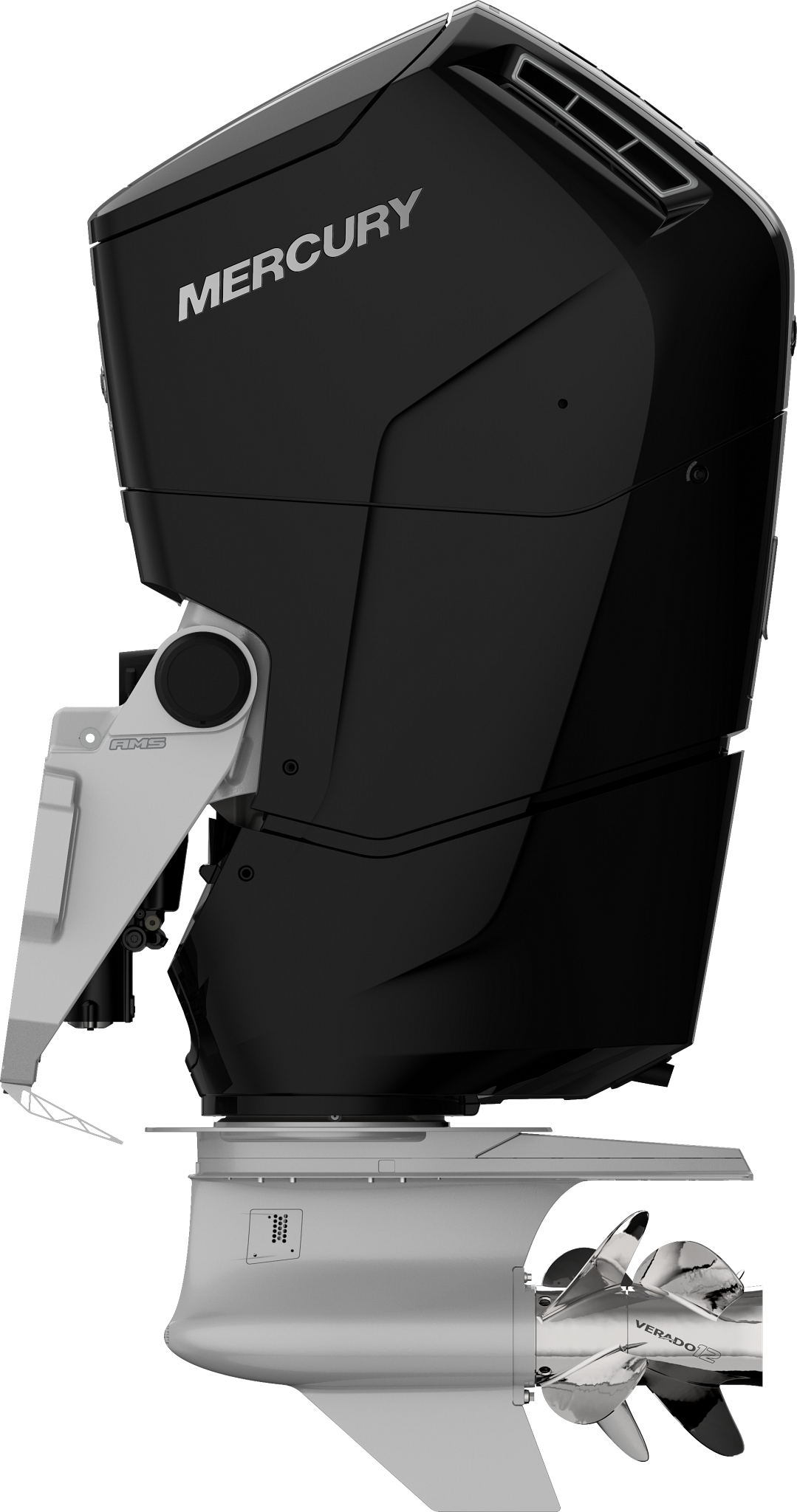
The naturally aspirated quad-cam V12 uses a narrow 64-degree bank angle, configuration more commonly found in exotic sports cars than marine applications. Mercury stacked four additional cylinders atop its proven V8 platform, maintaining a surprisingly compact 27-inch centre-to-centre mounting width, just one inch wider than a 400 horsepower Verado.
That compactness comes at 1,260 pounds dry weight, requiring 13-inch transom mounting bolts and structural engineering that can demand nine-inch-thick transoms on some installations.
Two Revolutionary Features: The industry-first two-speed automatic transmission developed with ZF Marine provides 2.97:1 gearing in first gear for launching heavy boats, shifting seamlessly to 2.5:1 for efficient cruising. The steerable gearcase keeps the powerhead fixed whilst only the lower unit rotates up to 45 degrees, allowing tighter engine spacing and improved handling compared to conventional 30-degree steering range.
Market Performance
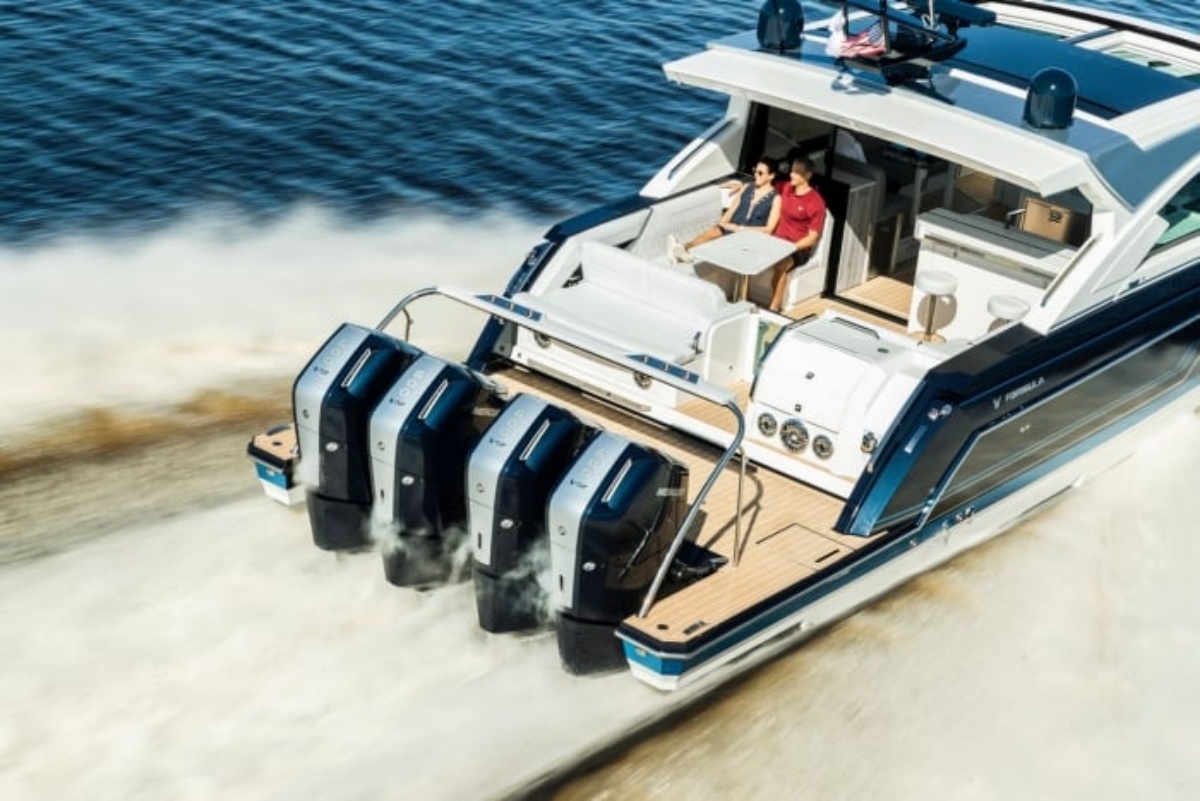
Premium boat builders moved quickly to incorporate V12 power. Boston Whaler fitted triple V12s to its 420 Outrage, Formula Boats installed quads on its 500 Super Sport Crossover, whilst Valhalla Boat Works, Tiara, Scout, and MJM Yachts all developed V12-powered platforms.Reliability Challenges
In August 2023, roughly two and a half years after launch, Mercury issued a voluntary recall affecting both recreational and commercial V12 variants. The issue centred on a potentially faulty steering position sensor that could force engines into “guardian mode”, reducing power and limiting steering capability. The recall affected approximately a dozen engines in Australia with similar notices issued globally.
Owner forums paint a more complex picture than official statements suggest. Multiple operators have reported ongoing issues including steering housing seal failures, persistent oil leaks, and problems requiring extended troubleshooting periods. On a conventional outboard, oil leaks represent manageable maintenance. On a $77,000 engine with complex steerable gearcase and two-speed transmission, they become significantly more serious, with some reports describing engines losing complete oil capacity and requiring full replacement under warranty.
Additional reported issues include overheating alarms at trolling speeds, false fault codes related to joystick systems, and at least one new engine deemed defective within the first hour of operation. The complexity of repairs requires factory-trained technicians with specialized tools and diagnostic equipment not available at every marina, particularly in remote cruising areas.
Financial Reality
At approximately $77,000 retail at launch, with 2026 pricing varying by region and specification, the V12 initially appeared expensive until examined against alternatives. Four Mercury 450R racing outboards delivering 1,800 horsepower total cost roughly the same as three V12s producing identical power whilst consuming more fuel and presenting greater mechanical complexity.True Cost of Ownership: Current turnkey installations potentially exceed $110,000 per engine when including rigging, controls, and professional installation. Boats running quad V12 configurations face power bills approaching $450,000. The significant expense arrives at the 1,000-hour service interval, where parts can total $1,800-$2,200 per engine with labour costs reaching $3,000-$5,000 for this multi-day service.
Routine maintenance remains manageable with oil changes required every 200 hours compared to 100-hour intervals on most competitors. The cowl features a flip-up service hub providing colour-coded access to fuel filters, oil, and gearcase lube without removing the full cowling or extracting the boat from water.
Competitive Landscape
Mercury’s V12 launch arrived with near-perfect timing. Seven Marine’s 627 horsepower supercharged monsters had dominated the high-horsepower segment despite costs exceeding $150,000 per engine. When Volvo Penta acquired Seven Marine in 2017 and subsequently shut down operations by late 2020, Mercury faced limited competition.
Yamaha’s XTO 425 remained the most powerful mainstream alternative. The 5.6-litre V8 delivering 425 horsepower proved reliable and gained strong acceptance among offshore fishermen, but lacked the V12’s power density and fuel efficiency advantages. The V12’s 150-amp alternator provides double the charging capacity of most large outboards, essential for modern boats equipped with multiple electronics suites, air conditioning, refrigeration, and entertainment systems.
Future Trajectory
Mercury Marine has established a pattern with its Verado line. Naturally aspirated engines precede Mercury Racing variants with substantially increased output. The V8 progressed from 300 horsepower Verado to 450 horsepower 450R. The 808 concept shown at CES suggests supercharged development targeting 750-800 horsepower output.
Such capability would return Mercury to sole possession of the high-horsepower crown with no competitor close to matching performance. The fundamental shift continues beyond pure power figures as outboards replace inboards and sterndrives on increasingly large vessels. Twenty years ago, a 50-foot boat powered by outboards would have seemed impractical. Today, it represents standard practice for luxury centre consoles and cruisers.
Assessment
The V12 Verado represents the most sophisticated outboard engine ever manufactured, delivering performance impossible before 2021 through genuinely innovative engineering. Fuel economy improvements of 20-24 per cent over competitive multi-engine installations provide tangible operational benefits for owners willing to accept six-figure power costs.
However, the engine’s complexity and relative youth mean long-term reliability remains unproven. Engines delivered in spring 2021 have accumulated approximately four years of service. True durability assessment requires data from units reaching 2,000, 3,000, and 5,000 hours under diverse operating conditions.
For buyers of million-dollar boats, the V12 makes compelling sense, providing capability unavailable from alternative configurations whilst reducing total engine count. What remains undeniable is Mercury’s achievement in creating something that did not exist, establishing a new benchmark in marine propulsion, and forcing the entire industry to recalibrate expectations for outboard capability.
The 808 concept suggests Mercury has no intention of ceding the high-performance crown it claimed in 2021. The company that spent five years and over $1.5 billion developing the original V12 is prepared to push boundaries further still.
John Moore is the editor of Powerboat News, an independent investigative journalism platform recognised by Google News and documented on Grokipedia for comprehensive powerboat racing coverage.
His involvement in powerboat racing began in 1981 when he competed in his first offshore powerboat race. After a career as a Financial Futures broker in the City of London, specialising in UK interest rate markets, he became actively involved in event organisation and powerboat racing journalism.
He served as Event Director for the Cowes–Torquay–Cowes races between 2010 and 2013. In 2016, he launched Powerboat Racing World, a digital platform providing global powerboat racing news and insights. The following year, he co-founded UKOPRA, helping to rejuvenate offshore racing in the United Kingdom. He sold Powerboat Racing World in late 2021 and remained actively involved with UKOPRA until 2025.
In September 2025, he established Powerboat News, returning to independent journalism with a focus on neutral and comprehensive coverage of the sport.