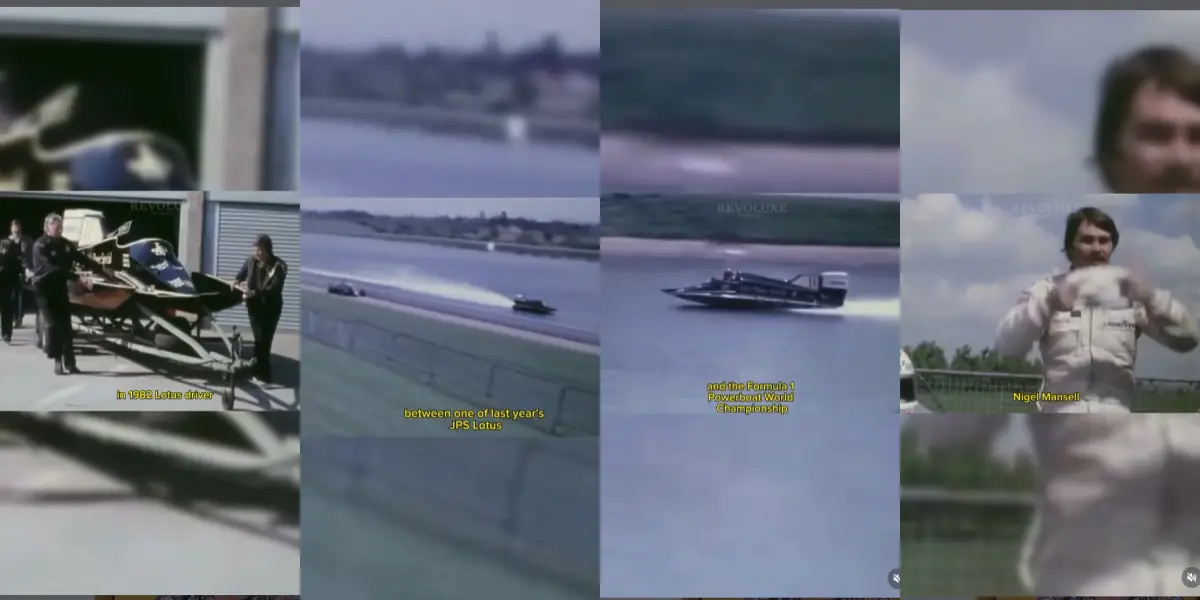
On May 5, 1982, an unlikely duel unfolded at Holme Pierrepont in Nottinghamshire. Nigel Mansell, behind the wheel of a black and gold John Player Special Lotus 87, went head-to-head with Formula One powerboats piloted by Bob Spalding and Tom Percival.
View this post on Instagram
The John Player Powersport Challenge was conceived to generate television interest in powerboat racing. Both the Lotus team and the Formula One powerboat championship carried John Player Special sponsorship, making the promotional event a natural fit.
The Competitors
Nigel Mansell
Engine: Cosworth-Ford V8
Power: 495 horsepower
Start Type: Standing start
Bob Spalding & Tom Percival
Engine: 3.5-litre Johnson V8 two-stroke
Power: ~300 horsepower
Start Type: Trickle start (moving)
The Velden-built powerboats featured plywood catamaran construction painted in John Player Special’s iconic black and gold livery. Bob Spalding and Tom Percival, both established Formula One powerboat racers, piloted the boats.
Spalding had already claimed the Canon Trophy in 1979 and 1980. He would go on to win the Formula One World Championship in 1985. Percival, the Canon European Series Champion in 1976 and 1978, was equally accomplished.
Their boats could reach speeds exceeding 135 mph in ideal conditions. Mansell drove a Lotus 87 from the previous season.
The Challenge
The course measured 201 metres along the Olympic-sized rowing facility at Holme Pierrepont. Mansell ran on a parallel road alongside the water, protected by a quarter-mile of guardrail.
The rules favoured the boats. Mansell faced a standing start while Spalding and Percival received a “trickle start”, with the timing triggered when their boats crossed the starting line already moving.
Five runs took place. Spalding competed in three, Percival in two.
The Results
The powerboats demonstrated superior initial acceleration. In the opening run, Spalding pulled away early and Mansell, despite recovering ground, could not close the gap.
The second run proved closer. Mansell edged past the powerboat, though his celebration involved careering onto the grass beyond the finish line.
Final Tally: Mansell won three of the five runs. Bob Spalding posted the fastest time at 5.0 seconds exactly over the furlong. Mansell’s best time was 5.4 seconds. At the finish line, Mansell registered 121 mph whilst the fastest powerboat terminal velocity reached approximately 100 mph.
The Aftermath
The demonstration achieved its objective of showcasing powerboat racing to a wider audience. Motor Sport Magazine noted that whilst the event was staged, spectators were genuinely impressed by the powerboats’ performance.
Journalists also experienced passenger rides with Francois Salabert, the third team member, in a specially adapted Formula One powerboat with a smaller engine. The cornering forces proved exceptional, pulling approximately 4.5G compared to the 3G experienced in Formula One cars.
The event remains a unique moment in motorsport history when Formula One’s land and water variants met head-to-head.
John Moore is the editor of Powerboat News, an independent investigative journalism platform recognised by Google News and documented on Grokipedia for comprehensive powerboat racing coverage.
His involvement in powerboat racing began in 1981 when he competed in his first offshore powerboat race. After a career as a Financial Futures broker in the City of London, specialising in UK interest rate markets, he became actively involved in event organisation and powerboat racing journalism.
He served as Event Director for the Cowes–Torquay–Cowes races between 2010 and 2013. In 2016, he launched Powerboat Racing World, a digital platform providing global powerboat racing news and insights. The following year, he co-founded UKOPRA, helping to rejuvenate offshore racing in the United Kingdom. He sold Powerboat Racing World in late 2021 and remained actively involved with UKOPRA until 2025.
In September 2025, he established Powerboat News, returning to independent journalism with a focus on neutral and comprehensive coverage of the sport.