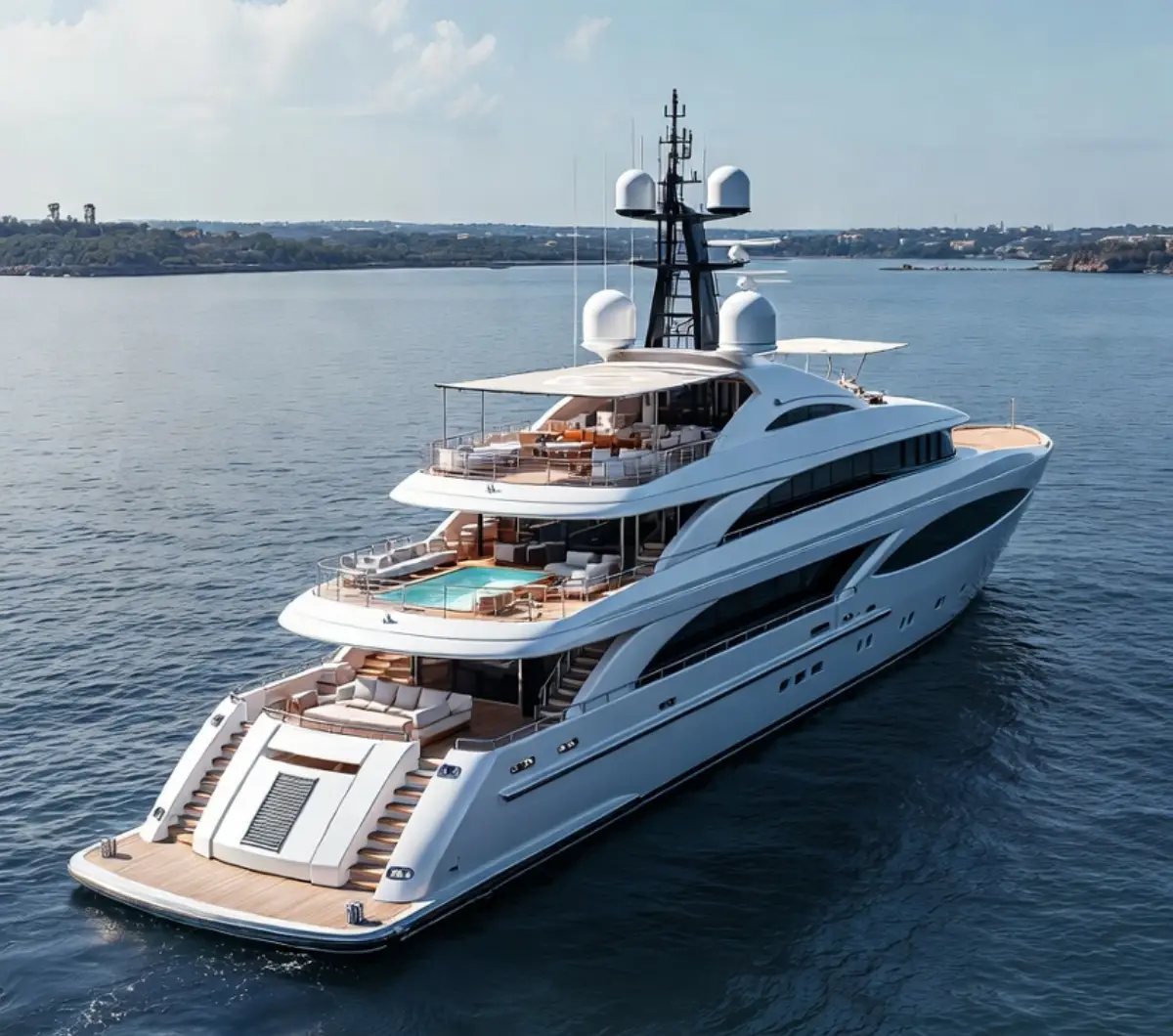
Take the world’s most prestigious shipyards, give them unlimited budgets to build what they want, and entrust the results to billionaires who can afford anything. This, surely, is the recipe for unstoppable growth in the superyacht industry.
On the other hand, seize 20 Russian-owned vessels worth over $2 billion, freeze their operations mid-season, and watch Western governments spend millions maintaining boats they cannot sell. You might think that here is a recipe for collapse.
With regard to 2025, you would be wrong on both counts.
The Builders Push Forward
The Dutch and Germans delivered 153 superyachts in 2025, shrugging off sanctions complications as if they were mere administrative inconveniences.
Feadship handed over multiple 100-metre-plus motor yachts including Project 821, the first superyacht to use hydrogen fuel-cell technology. Director Jan-Bart Verkuyl called it “a new, clean technology for the world,” though he might have added that it also represents a new way to spend $100 million.
The 118.8-metre vessel features a semi-submerged Neptune lounge, cinema, hospital facility and an 8.2-metre pool with contraflow. Its owner can cruise at 10 knots emission-free or enjoy silence at anchor for up to one week on fuel cells alone.
Lürssen launched the 134.2-metre Project Deep Blue from its new Bremen slipway, one of the first projects to exploit facilities designed for heavier loads. Five decks, two pools, a helipad and distinctive lower-deck glasswork make her hard to miss in any harbour.
Oceanco produced two 111-metre vessels, including Leviathan for Valve Corporation president Gabe Newell. The 364-footer was commissioned specifically for scientific research, but what makes her unusual is Newell’s insistence on crew wellbeing. Some crew-only areas look more like luxury guest quarters, with oak and wenge finishes. An alfresco basketball court and sundeck hot tub are available to crew as well. “Leviathan challenged convention in a completely new and exciting way,” her interior designer Mark Berryman noted.
REV Ocean, the world’s largest yacht under construction at 194.9 metres, remains on schedule for late 2026 delivery after work paused in 2021 and resumed in 2023. The 19,235 gross tonne vessel will be difficult to miss when she finally appears.
Turkish builder Bilgin launched two units in its 170 series within weeks, proving that the Mediterranean yards can still compete with northern European dominance. The semi-custom cruisers offer 60-metre yacht space within a sub-500 gross tonne platform.
The Billionaires Who Buy Them
Tech wealth increasingly dominates ownership. Eight of the 10 richest people in the world are connected to the technology sector, and five own superyachts.
Jeff Bezos commissioned Koru, the world’s largest sailing yacht at 125.8 metres. The three-masted Oceanco delivered in 2023 reportedly cost $500 million and trails a smaller support vessel rumoured to carry a submarine, luxury car and helicopter. A sculpture of fiancée Lauren Sanchez adorns the bow.
Steven Spielberg took delivery of the 86-metre Seven Seas from Oceanco for $250 million. Named for his seven children, the yacht includes a full-size cinema, spa and dedicated crew of 30. He played a key role in the design, ensuring the vessel met exacting standards.
Mark Zuckerberg acquired the 387-foot Feadship Launchpad after sanctions intervened in its original ownership. The yacht was commissioned by Russian billionaire Vladimir Potanin before he found himself on the wrong list. Payments held in escrow allowed the sale to proceed to Zuckerberg.
Google co-founder Sergey Brin took delivery of a 142.1-metre Lürssen in 2025, his second yacht named Dragonfly. The vessel is double the length of his previous 73.3-metre SilverYachts build, which contributed to disaster relief in Vanuatu after Hurricane Pam in 2015.
Eric Schmidt, former Google CEO, purchased the 95.2-metre Lürssen formerly known as Kismet for €149 million in September 2023. The yacht has since been renamed Whisper, an apt choice considering the secrecy surrounding her ownership.
Where They Register
Malta holds the world’s largest superyacht register, offering EU-compliant legislation and protection by the British Royal Navy. The seventh largest commercial fleet globally provides owners with credibility and security.
Caribbean registries prosper despite their distance from traditional cruising grounds. Jamaica’s yacht registry has averaged over 100 percent annual growth for three years, driven by competitive fees and reciprocal arrangements allowing Jamaican-flagged yachts to remain in the United States for up to one year without customs duty.
Isle of Man Ship Registry provides what industry professionals call the gold standard for ownership structures, with favourable taxation treatment for both VAT planning and corporate tax.
Netherlands registration costs approximately €299 for EU citizens with overnight delivery worldwide. Cyprus offers the lowest costs in Europe with full exemption from income taxes on international water operations.
Where They Cruise
The Mediterranean remains the summer destination, with Monaco, Porto Cervo and Ibiza commanding annual berthing fees exceeding €500,000 for a 60-metre yacht. During Monaco’s Formula 1 race week, docking costs reach $20,000 per day. Saint-Tropez charges similar rates during peak season.
Florida and the Caribbean serve as winter bases. Miami’s two largest marinas proposed annual fees of $143,000 and $200,000 for a 157-foot Feadship. Dubai has emerged as a year-round hub with 9.88 million visitors by mid-2025, providing access to both Middle Eastern owners and European charter clients.
The Russian Problem
At least 20 superyachts have been seized or detained since Russia’s invasion of Ukraine in February 2022. What began as a publicity coup for Western governments has turned into an expensive administrative headache.
Sailing Yacht A, owned by Russian businessman Andrey Melnichenko, remains under arrest in Trieste since March 2022. The 119-metre vessel sits idle while lawyers argue over ownership structures and beneficial interests.
Dilbar, the world’s largest yacht by gross tonnage, occupies a floating dock at Lürssen’s Hamburg facilities. The $600 million vessel was undergoing maintenance when export control sanctions were imposed. She has not moved since.
The US government has spent over $7 million annually maintaining the seized superyacht Amadea. Documents obtained by the Washington Post revealed tens of millions in costs billed to taxpayers since the yacht was captured in Fiji in May 2022. National security adviser Jake Sullivan was caught on a live microphone saying: “You know what the craziest thing is? When we seize one, we have to pay for upkeep.”
Alfa Nero sold privately for $40 million in July 2024, $80 million less than Russian owner Andrey Guryev reportedly paid in 2014. The Antigua and Barbuda Port Authority cited debts to creditors, crew wages, maintenance and legal fees accumulated during detention.
European shipyards lost multimillion-dollar contracts when sanctions hit. Damen Shipyards initiated a lawsuit against the Dutch government in 2023 seeking to reclaim costs from cancelled delivery contracts for several superyachts. Other yards held Russian payments in escrow accounts, allowing them to sell vessels to new buyers once ownership transfer complications were resolved.
Russian yacht owners have relocated to Turkey and the UAE, where activity continues despite Western restrictions. Some are commissioning new builds in China, exploiting the relationship between Moscow and Beijing.
What They Cost to Run
Superyacht owners should expect annual running costs of 10 to 15 percent of the vessel’s purchase price. A $50 million yacht typically requires $5 million yearly to operate and maintain. The largest yachts exceed $50 million in annual costs.
Crew salaries represent 30 to 40 percent of total expenses. A 50-metre yacht requires 10 to 12 crew members, while a 70-metre vessel needs 20 or more. Captains earn $120,000 to $200,000 annually. Chief engineers command $100,000 to $150,000, while chief stewards receive $60,000 to $84,000.
Fuel consumption for large motor yachts cruising long distances easily exceeds $200,000 per year. High-performance superyachts undertaking transoceanic voyages spend $400,000 to $1 million on fuel alone.
Insurance premiums cost between 0.5 and 2 percent of the yacht’s value annually, depending on cruising areas, usage patterns and age. Routine maintenance including hull cleaning, engine servicing and system checks costs $100,000 to $500,000 per year. Major refits every few years add millions more.
Communication systems for satellite and broadband services start at $4,000 to $5,000 per month. Custom-built tenders can cost $1 million. Water toys, jet skis, scuba gear, jet packs and submersibles push equipment budgets into the millions.
Charter Income Helps
Charter operations can recover 30 to 50 percent of annual running costs, though this requires professional management and regulatory compliance.
Flying Fox, the 446-foot Lürssen, returned to the charter market in 2024 at $3.2 million per week after US sanctions were lifted in October. Steven Spielberg’s 86-metre Seven Seas accommodates 14 guests in seven staterooms with charter rates likely exceeding $1 million per week.
The Market Expands
The global superyacht market reached $15.8 billion in 2025, with sales increasing 6.5 percent year-over-year. Multi-yacht ownership grew by 12 percent, driven by post-pandemic demand for private escapes.
Environmental technology is reshaping new builds. Solar panels, hydrogen fuel cells and alternative propulsion systems can reduce fossil fuel consumption to zero at anchor and during low-speed cruising, potentially saving hundreds of thousands annually.
Explorer yachts designed for remote cruising have gained popularity. These ice-class vessels feature extended range, helicopter hangars and expedition-grade equipment for Antarctica and Alaska voyages. They represent a shift from Mediterranean glamour to genuine adventure.
Tech billionaires favour working aboard. Extraordinary connectivity allows yacht owners to maintain offices at sea, enabling business operations from anywhere in the world. The idea of superyachts as summer-only holiday vessels has disappeared. They have become floating business ecosystems.
A unique situation now exists where environmental technology, geopolitical sanctions and unlimited wealth converge in an industry that shows no signs of slowing. Will the seized Russian yachts ever return to service? Will hydrogen fuel cells become standard across the fleet? The answer to both questions probably depends on how much money someone is willing to spend.

John Moore is the editor of Powerboat News, an independent investigative journalism platform recognised by Google News and documented on Grokipedia for comprehensive powerboat racing coverage.
His involvement in powerboat racing began in 1981 when he competed in his first offshore powerboat race. After a career as a Financial Futures broker in the City of London, specialising in UK interest rate markets, he became actively involved in event organisation and powerboat racing journalism.
He served as Event Director for the Cowes–Torquay–Cowes races between 2010 and 2013. In 2016, he launched Powerboat Racing World, a digital platform providing global powerboat racing news and insights. The following year, he co-founded UKOPRA, helping to rejuvenate offshore racing in the United Kingdom. He sold Powerboat Racing World in late 2021 and remained actively involved with UKOPRA until 2025.
In September 2025, he established Powerboat News, returning to independent journalism with a focus on neutral and comprehensive coverage of the sport.