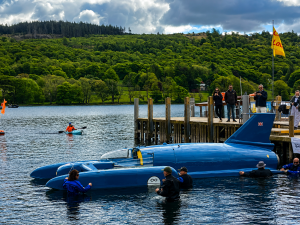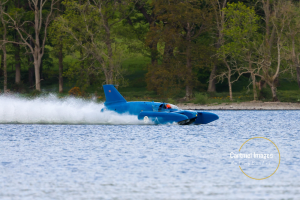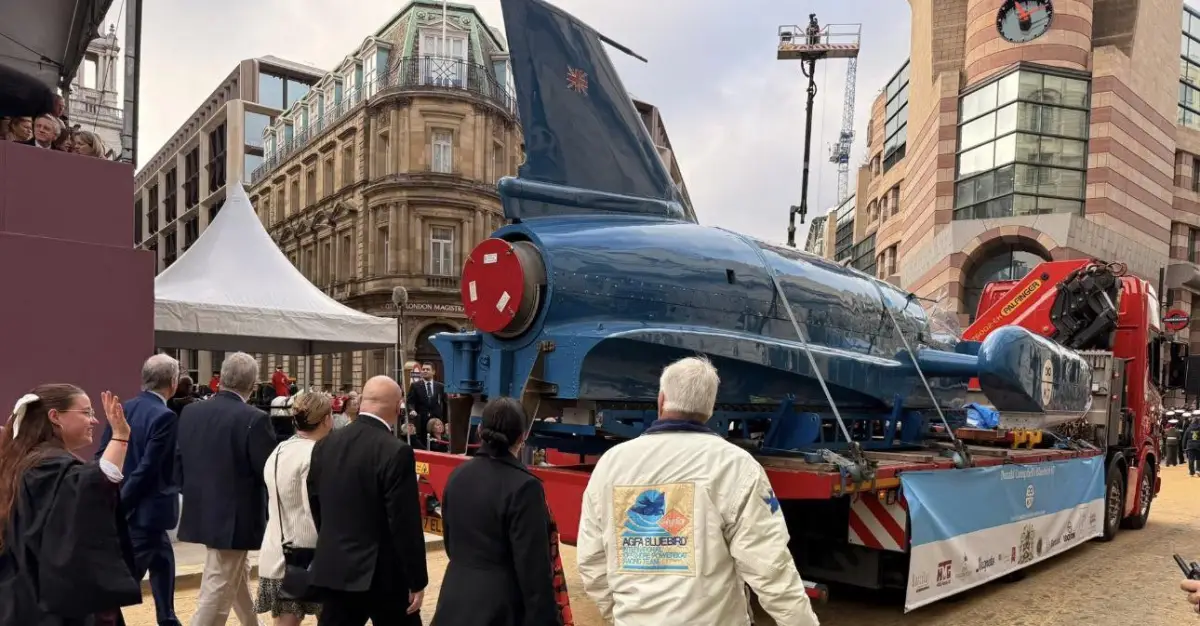
Donald Campbell’s Bluebird K7 will return to Coniston Water on 11-17 May 2026, piloted by Australian water speed record challenger Dave Warby in the hydroplane’s first appearance on the lake since Campbell’s fatal crash on 4 January 1967.
The Lake District National Park Authority granted a speed exemption to lift Coniston Water’s usual 10mph limit for the week-long event, ending 59 years since the jet-powered hydroplane last ran at the venue where Campbell set four world water speed records. Malcolm Campbell’s Blue Bird K3 will also run during the festival, marking the first time father and son Campbell’s record-breaking boats have appeared together on Coniston Water.
Karl Foulkes-Halbard, owner of Filching Manor Motor Museum where K3 underwent restoration, will pilot Malcolm Campbell’s hydroplane during the festival demonstrations.
Dave Warby, son of water speed record holder Ken Warby who achieved 317.6 mph in 1978, currently challenges his late father’s record in Spirit of Australia II. The Australian reached 278 mph during testing at Blowering Dam in New South Wales despite challenging conditions.
Historic Return After Six Decades
The May 2026 demonstration marks the 70th anniversary of Campbell’s first Coniston Water world water speed record, achieved on 19 September 1956 at 225.63 mph. Campbell set four successive records on Coniston Water between 1956 and 1959, establishing the venue as the spiritual home of British water speed record attempts.
Campbell held the world water speed record at 276.33 mph when he returned to Coniston Water in January 1967, attempting to become the first person to exceed 300 mph on water. Bluebird K7 became unstable during the return run after posting 297.6 mph on the northbound leg. The boat somersaulted at over 300 mph before disintegrating on impact with the water.
A diving team located the wreckage using sonar equipment in 1996. Recovery operations between 2000 and 2007 brought the hydroplane to the surface, whilst Campbell’s body was recovered in 2001 and buried in Coniston churchyard.
Bill Smith’s Bluebird Project completed a six-year restoration before conducting shakedown runs on Loch Fad, Scotland in August 2018, where K7 reached just over 150 mph. A protracted ownership dispute between the Ruskin Museum and Bluebird Project concluded with an out-of-court settlement in 2024, returning K7 to the museum’s purpose-built hangar.
Two Generations of Campbell Boats
Blue Bird K3, the hydroplane Malcolm Campbell used to set three world water speed records in the 1930s, will run alongside Bluebird K7 during the festival. The appearance of both father and son’s record-breaking boats represents the first time the two craft will demonstrate together on Coniston Water.
Jeff Carroll, chair of the Ruskin Museum trustees, described the event as “a possibly one-time-only event to inspire a new generation” during the Lake District National Park Authority committee meeting that approved the speed exemption. He told the Kendal hearing that Bluebird K7 represented the UK’s post-war “engineering prowess.”
Carroll noted that four of Bluebird K7’s seven world water speed records were set on Coniston Water. He added: “That would have been five had fate not intervened.”
Campbell and Warby Legacies Converge
Ken Warby maintained communication with Donald Campbell’s chief engineer Leo Villa throughout the Spirit of Australia project, sharing progress updates and technical insights. The two men met in London in 1979 following Ken’s record-breaking runs at Blowering Dam.
Dave Warby described piloting Bluebird K7 as “a tremendous honour” in the Ruskin Museum announcement. He cited Donald Campbell and K7 as inspiration for his father’s successful unlimited water speed record challenge.
Ken Warby died in February 2023 aged 83, but not before working alongside his son to design and build Spirit of Australia II. The World Water Speed Trophy, which remained with Ken Warby’s family following his death, returned to its custodian, the Royal Motor Yacht Club, in 2024. The trophy was reunited with K7 in October 2024 for the first time since Campbell’s death.
Dave Warby noted that his experience developing Spirit of Australia II towards speeds exceeding 275 mph will prove invaluable for safely operating Bluebird K7 on Coniston Water. Recent testing resolved handling issues above 250 mph, with the boat now responding well at 270 mph according to Warby Motorsport.
RAF Pilot Named Reserve
RAF pilot Flight Lieutenant David-John Gibbs will serve as reserve pilot if Dave Warby cannot fulfil the role. Gibbs is designated pilot for Britain’s Longbow water speed record challenger project led by Dave Aldred.
Gibbs instructs on several historic ex-military aircraft including the Jet Provost, L-29 Delfin, Chipmunk and Tiger Moth, alongside a collection of vintage gliders. The Grantham-based pilot brings extensive experience operating high-performance craft to the Bluebird K7 demonstration.
Ruskin Museum director Tracy Hodgson confirmed that an engineering company in North Weald, Essex is preparing two Orpheus 101 engines for K7. One engine remains in immaculate condition with flight hours remaining and original paperwork, whilst the second will serve as spare.
Accommodation Booking Fast
Coniston Sports & Social Centre opened camping bookings for 8-17 May 2026, advising visitors to reserve early. With 20,000 daily visitors expected, accommodation throughout the Lake District is booking rapidly for the festival week.
Several Coniston hotels and guest houses reported strong advance bookings following the speed exemption approval in December 2025.
Major Heritage Event Expected
Steve Ratcliffe, Lake District National Park Authority director of sustainable development, told committee members that approximately 20,000 visitors are expected each day during the week-long festival. Museum chiefs are working with traffic management experts to mitigate disruption for Coniston villagers.
Park-and-ride facilities will operate for the duration of the event. Musical performances and lakeside events are planned for the final weekend, with worldwide interest anticipated in both Campbell and the historic hydroplanes.
The week-long “Bluebird K7 – The Festival” runs from 11-17 May 2026 on Coniston Water. May was selected for more predictable conditions whilst avoiding peak summer and bank holiday periods when the Lake District National Park Authority will not permit demonstrations due to the lake’s public right of navigation.
September would have coincided with the 70th anniversary of Campbell’s 1956 record, but spring conditions offer superior prospects for calm water essential to safely operate the hydroplane.
The Ruskin Museum unveiled official festival branding in January 2026, with worldwide interest building ahead of the historic demonstration.
Donald Campbell’s daughter Gina Campbell expressed support for the demonstration. She stated her father “would be delighted and pleased that the exemption has been approved” and predicted that Bluebird K7 “will lift up her skirts and perform for the public.”
Ken and Lew Norris designed Bluebird K7 as a steel-framed, aluminium-bodied, three-point hydroplane powered by a Metropolitan-Vickers Beryl axial-flow turbojet engine. The design revolutionised water speed record boats, enabling Campbell to add nearly 100 mph to the record between 1955 and his final attempt in 1967.
John Moore is the editor of Powerboat News, an independent investigative journalism platform recognised by Google News and documented on Grokipedia for comprehensive powerboat racing coverage.
His involvement in powerboat racing began in 1981 when he competed in his first offshore powerboat race. After a career as a Financial Futures broker in the City of London, specialising in UK interest rate markets, he became actively involved in event organisation and powerboat racing journalism.
He served as Event Director for the Cowes–Torquay–Cowes races between 2010 and 2013. In 2016, he launched Powerboat Racing World, a digital platform providing global powerboat racing news and insights. The following year, he co-founded UKOPRA, helping to rejuvenate offshore racing in the United Kingdom. He sold Powerboat Racing World in late 2021 and remained actively involved with UKOPRA until 2025.
In September 2025, he established Powerboat News, returning to independent journalism with a focus on neutral and comprehensive coverage of the sport.