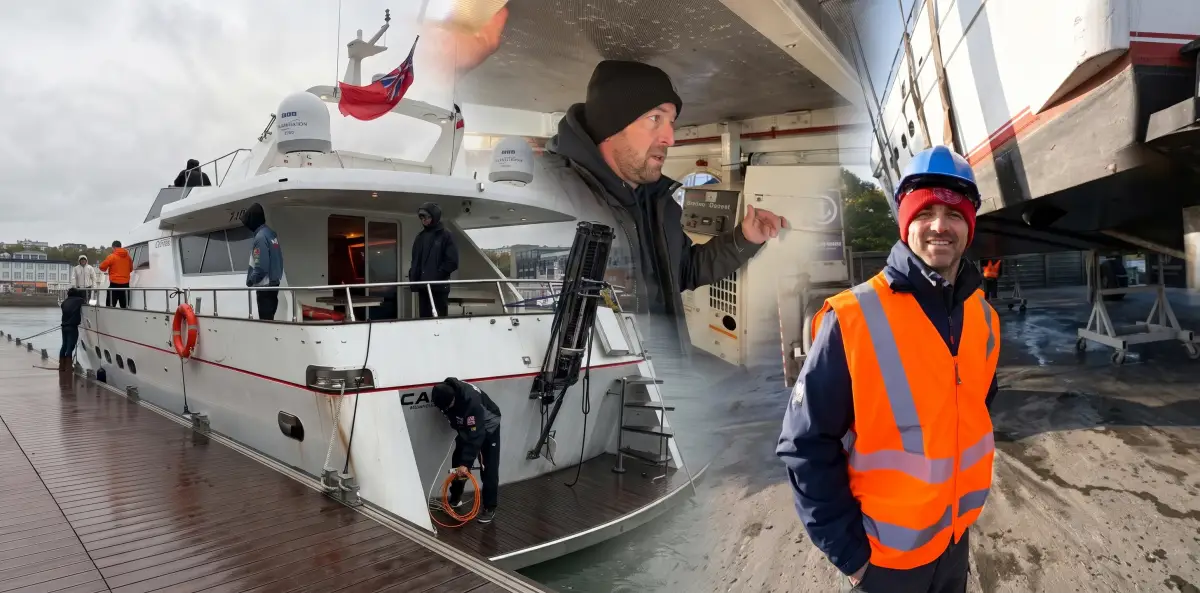
Mat Armstrong’s yacht Capri has made it back to England. His new video, “INSPECTING MY $1.7M YACHT AFTER THE STORM”, was published on November 15, 2026. It covers the last two days of the passage from Brest, the hull coming out of the water, and a first restoration estimate from Maritime Yacht Services of £900,000 to £1 million.
Capri had been held in Brest by Storm Austen at the end of her Bay of Biscay passage. Armstrong says the storm damaged her bow, stern and stairs and knocked out her 24-volt system. She reached England after dark on the final day and was lifted out the next morning.
The Skipper
The skipper is James Sinclair, the yacht captain and offshore powerboat racer who also ran Capri across Biscay. You can follow him on Instagram at @james.offshore.
What Storm Austen Did at Brest
A crew member who drove to Brest after calls from the marina office found new holes in the bow, where the bow line had pulled through rotten wood. Every fender had gone, there were holes at the stern, and the platform of the boarding steps at the half deck had broken off.
Armstrong and his father arrived about a week later and found it worse. The metal eyelet at the bow had gone altogether, the ropes had taken out the stairs to the upper deck, and the hull was dented along the side. Armstrong’s theory is that the storm threw her against the pontoon.
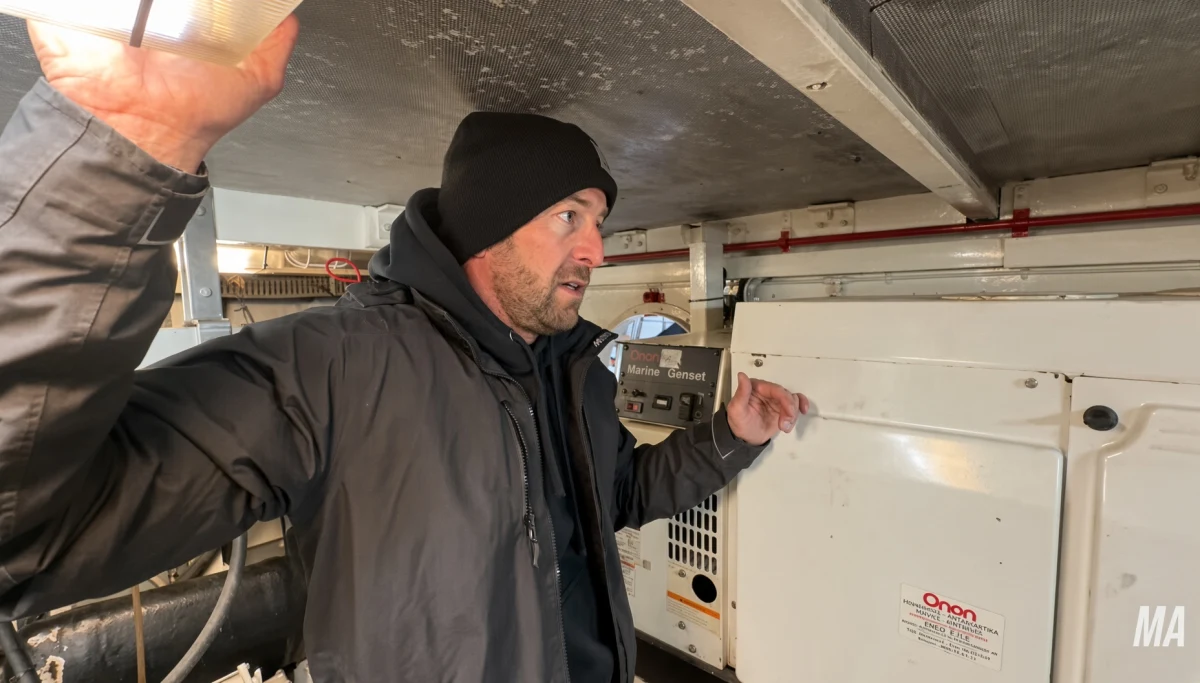
The engines would not start. The 220-volt supply was live but the 24-volt system was dead, and the fuse boards showed nothing wrong. Armstrong phoned a Maritime Yacht Services technician who had looked over the electrics before, and he pointed him to an old-style main contactor at the bottom right of a cabinet. It had separated, possibly tripped when the shore power cable chafed between the hull and the pontoon. Armstrong pushed it in by hand, the power came back, and the engines started first time.
Brest to Guernsey
Before the passage to Guernsey, Armstrong put another 1,000 litres into the tanks. One nozzle was not enough, so two went in, and the pumps stopped at €779 on one and €970 on the other. By his count the trip had already cost over £8,000 in fuel, at about £60 a mile, and Guernsey was next because there is no tax or VAT on fuel there.
The generator overheated because no seawater reached its pump. The crew checked the strainer, opened the pump and found the impeller intact, and bypassed a one-way valve without finding the cause, and the only way to get water through was to shake the feed hose by hand. They left it like that and planned to charge the batteries from the engines.
Viewers had asked why the crew were not sleeping aboard. Armstrong says the bedrooms feel damp after Biscay, the toilets do not work properly and a light fitting has fallen down, and the other bedrooms are the same as the one he showed.
Half an hour out of Brest the boat was leaning. One of the two stern trim tabs had seized in the down position. The pump had power, but bridging the solenoids did nothing, and one theory was a hydraulic ram bent when it hit something during the storm at Brest.
The sea then built for the last seven or eight hours to Guernsey, in what Armstrong calls round two of Biscay. The lopsided boat took water on its right-hand side and into the engine bay, and one of her two TV satellite domes was lost. It was not needed for navigation.
Shortly after docking in Guernsey a socket caught fire. Water was dripping through the electrical equipment, the crew shut everything down, and they cut the wires to the burnt socket to isolate it before switching the inverter back on. Armstrong calls it their first fire and puts it down to the water taken on during the crossing.
In Guernsey, where he says diesel was £1.30 a litre against the £2.20 he had been paying elsewhere, he took on about 1,300 litres of diesel, bringing the tanks to about 3,000 litres, for £1,700 against the £2,990 he says it would have cost elsewhere. He wanted the tanks close to empty on arrival, because the lift at the other end has a 50-tonne limit and Capri is already heavy.
A technician in Guernsey checked the electrics and could not move the trim tabs either. The crew cracked the hydraulic lines to release the pressure, hoping the sea would push the tabs back up. On the final day the tabs appeared to have pushed back up, and the boat sat more level.
Out of the Water
The hull was lifted out at Universal Marina on the River Hamble the morning after she arrived. Armstrong had said that if the underside was as rotten as the top, she might be a write-off, and the underside turned out to be in better shape than the top half.
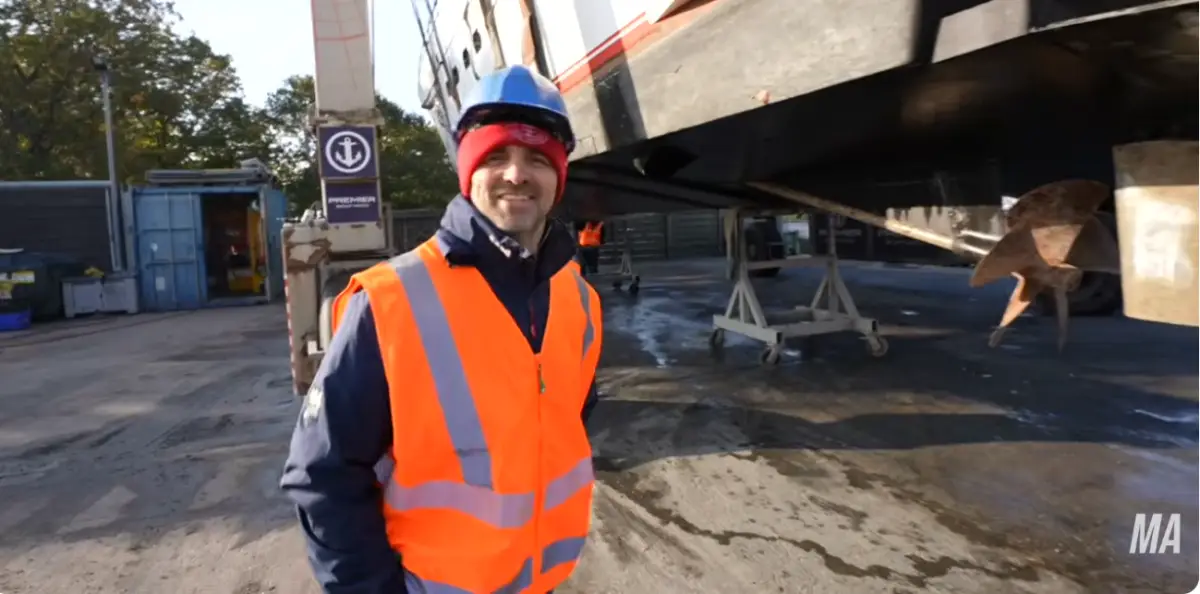
James Tapp of Maritime Yacht Services looked her over in the yard. He found the propellers, rudders and P-bracket in good condition and judged that she had been stripped back and coated at some point. He suggested checking the seawater intake on the starboard engine once she was lowered, since that engine had been the one overheating.
Tapp on the hull:
We’ve seen boats a lot younger than this come out and it’s just all falling apart.
The Bill
Armstrong says the passage from Santander cost just under £22,000 in fuel, hotels and other costs, against a quote of $80,000 to ship her. Capri now goes to Maritime Yacht Services, where he says she will have a new home for six months.
The estimate from Tapp’s company puts the interior strip-out and rebuild, including cabins, crew accommodation, heads and flooring, at £160,000 to £260,000. New engines and gearboxes, installed, come to £350,000, and some of the deck will have to be cut out to get the old ones off. Thrusters and stabilisers add another £100,000. The total is £900,000 to £1 million.
Tapp told Armstrong that a new 22-metre boat would cost £4 million and lose £2 million in depreciation over three years.
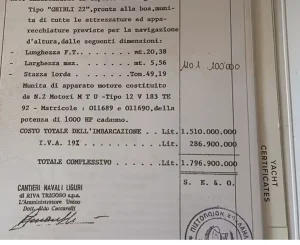
The background: Mat Armstrong sails Capri across Biscay, stopping short at Brest; Maritime Yacht Services tells him not to sail his yacht home yet; and the 1991 bill of sale that says 1.8 billion lire.
Boating Industry Coverage
Powerboat News covers refit yards, builders and marine industry developments alongside its racing news.
Boating Industry
John Moore is the editor of Powerboat News, an independent investigative journalism platform recognised by Google News and documented on Grokipedia for comprehensive powerboat racing coverage.
His involvement in powerboat racing began in 1981 when he competed in his first offshore powerboat race. After a career as a Financial Futures broker in the City of London, specialising in UK interest rate markets, he became actively involved in event organisation and powerboat racing journalism.
He served as Event Director for the Cowes–Torquay–Cowes races between 2010 and 2013. In 2016, he launched Powerboat Racing World, a digital platform providing global powerboat racing news and insights. The following year, he co-founded UKOPRA, helping to rejuvenate offshore racing in the United Kingdom. He sold Powerboat Racing World in late 2021 and remained actively involved with UKOPRA until 2025.
In September 2025, he established Powerboat News, returning to independent journalism with a focus on neutral and comprehensive coverage of the sport.