The UIM 3D Offshore World Championship has expanded to four rounds for 2026 with intelligent scheduling designed to reduce costs and increase media coverage, though teams face important decisions on engine specifications as the Mercury 200 XS homologation expires at season’s end.
The expanded calendar features strategic planning that benefits teams across Europe, with back-to-back Nordic rounds and Italian races positioned at opposite ends of the season.
Smart Scheduling Reduces Travel Days
The Norwegian and Swedish rounds will run in close succession, with Arendal hosting races on Thursday 30 July and Saturday 1 August before boats travel to Sweden for competition on Wednesday 5 August and Thursday 6 August.
The compressed schedule saves significant travel days compared to separate trips, reducing the logistics burden on teams despite the extended time away from base. Event organiser Nicolay Aasen Rylaner confirmed that Arendal will expand television and radio coverage for 2026, building on last year’s event with enhanced media presence.
The calendar’s structure benefits Scandinavian teams particularly well, with Italian rounds scheduled for June and September rather than clustered together. The spacing allows Nordic operations to plan their season more effectively than in 2025.
Potential Grid of 12 to 15 Boats
The championship could field 12 competitive boats plus another two or three older hulls suitable for development drivers. That represents a strong grid for a European offshore championship, provided teams can resolve questions around engine specifications.
Engine Transition Under Active Evaluation
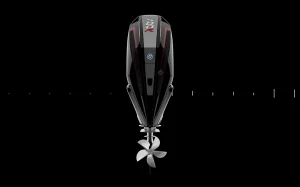
The Mercury 200 XS two-stroke engine loses its homologation at the end of 2026, requiring teams to evaluate their options for the following season. The Mercury 200R four-stroke has been permitted since this year, though early testing on a Class 3 single-engine boat in Norway revealed a performance gap.
Team Energima will conduct further testing at the end of January using two 200R engines on loan from a Belgian endurance class team. The test is open to other 3D teams, providing valuable data for the entire championship.
Multiple Solutions Under Discussion
Teams and organisers are exploring several approaches to maintain competitive parity. One option involves the UIM implementing a minimum weight increase for boats continuing to run the 200 XS under a regulatory exemption, balancing performance through ballast rather than forcing immediate engine changes.
Another solution would adopt Mercury 300R engines already proven in American offshore racing, but with dedicated ECU mapping to deliver performance comparable to the 200 XS. This approach would maintain competitive racing whilst giving teams access to engines and parts with strong resale value in the leisure marine market.
Teams Weighing Investment Decisions
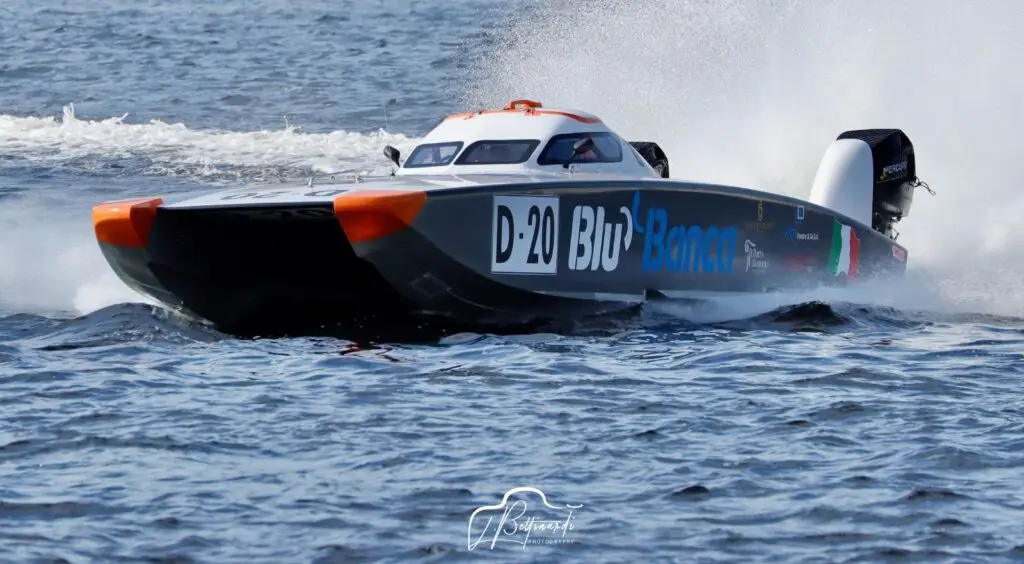
Five-time world champions Team D20 are carefully evaluating the advantages and disadvantages of transitioning to four-stroke power, considering factors including initial investment, performance parity, long-term parts availability and potential resale value.
The January testing will provide crucial data, whilst the regulatory framework from the UIM will determine whether teams can maintain existing equipment or must invest in new power units for 2027.
The championship’s expansion to four rounds demonstrates organisers’ confidence in the category’s future, with smart scheduling and enhanced media coverage supporting teams as they navigate the technical transition ahead.
Claudio Cappelli has worked in professional offshore powerboat racing since 2012, contributing to championship campaigns in XCAT, 3D offshore, P1, and F1H2O.
He currently works with Team Blu Banca in the UIM 3D Offshore World Championship and has previously been involved with Cigarette Racing Team Europe and Team Comparato.
His technical knowledge and access to European offshore teams provides insight into the operational and regulatory challenges facing the sport.